Why Data Centers Adopt Thermal Energy Storage Tanks for Peak Shaving and PUE
Operators weighing a thermal energy storage tank data center strategy usually start from a financial question: does shifting cooling load actually pay back? The answer is increasingly yes, driven by demand charges, renewable alignment, and the pressure to report a low PUE. This article lays out the operational and commercial reasons TES is becoming standard on new campuses.
Data centers adopt thermal energy storage tanks to cut peak electrical demand (and the demand charges tied to it), improve PUE by running chillers at optimal load, and align cooling production with cheap or low-carbon off-peak power. A single large tank can shave megawatts of coincident chiller load during the hottest hours, often deferring or avoiding additional chiller and utility connection capacity.
Demand-Charge Reduction
Utility tariffs in many markets bill on the highest 15-minute demand window of the month. Chillers are among the largest continuous loads on a campus, so shifting even part of their duty to off-peak charging directly lowers the billed peak.
Because TES discharges during the day, the site can shed one or more chillers exactly when grid prices and carbon intensity peak - a clean, repeatable saving.
PUE and Chiller Efficiency
Chillers are most efficient near their design load and struggle at part load. TES lets operators run fewer chillers at higher, steadier load overnight, improving the coefficient of performance across the plant and the reported PUE.
TES also reduces the need to over-provision chiller redundancy for short peaks, freeing capital for other reliability investments.
Resilience and Renewable Alignment
A charged TES tank is minutes of cooling buffer independent of the grid - valuable during transient outages and advantageous where on-site solar or wind produces off-peak. Stored cooling becomes a form of thermal renewable integration.
Technical Specifications
Parameter | Specification |
Primary benefit | Peak demand reduction |
Secondary benefit | PUE / chiller efficiency |
Load shifted | Chiller compressor duty |
Typical buffer | 4-12 hours of cooling |
Peak shaved | 0.5-2+ chillers |
Tank shell | Atmospheric stratified |
Material options | GFS, FBE, stainless, welded |
Controls | BMS / chiller plant sequencer |
Payback drivers | Tariff structure, PUE targets |
Standards | AWWA D103, EN 1090 |
Verified Tank Engineering Reference
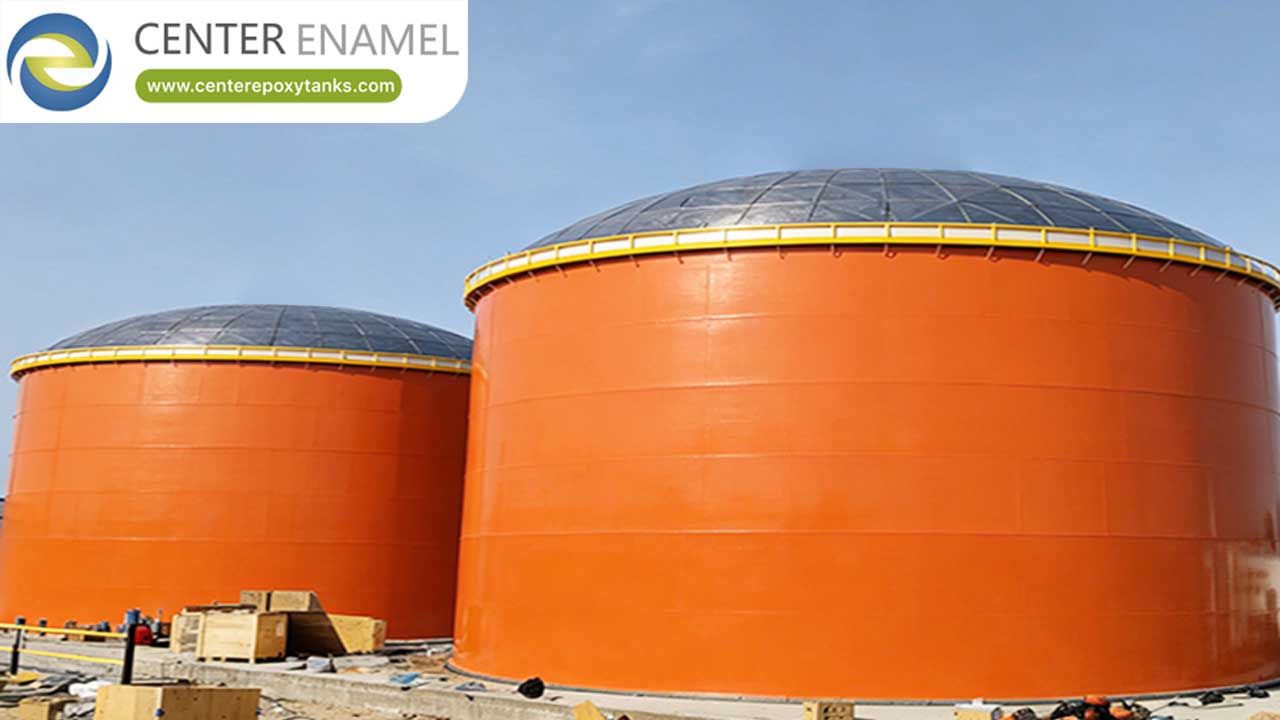
Center Enamel's record of very large bolted shells - for example a 2025 Indonesian potable-water tank at 42.04 m diameter and 21,099 m3 - shows the single-large-vessel manufacturing capability relevant to high-capacity data-center TES. Cited as capability evidence only.
Project location | Indonesia |
Application | Drinking water |
Tank type | GFS (Glass-Fused-to-Steel) bolted tank |
Scale | 1 unit(s), φ42.04*15.2m(H) |
Total volume | 21,099 m3 |
Year | 2025-06 |
Note | Cited as manufacturing-capability evidence, not a data-center project. |
Center Enamel Capability
Center Enamel supplies the tank assets behind these strategies: large bolted GFS and welded steel shells, plus ASME pressure vessels for pressurized duties. For a TES business case, the differentiator is the ability to deliver a single, dimensionally accurate large-diameter shell on schedule.
Quality is managed under ISO 9001, with bolted tanks built to AWWA D103 and ISO 28765 and available NSF/ANSI 61 and WRAS certification for water-contact service.
Frequently Asked Questions
Q: Why do data centers use TES tanks?
A: To lower peak electrical demand and demand charges, improve PUE by running chillers at efficient load, and align cooling with off-peak or renewable power.
Q: Does TES improve PUE?
A: Indirectly yes - by letting chillers run at steadier, higher load overnight, plant efficiency rises and the reported PUE improves versus part-load operation.
Q: How much peak load can a TES tank shave?
A: Common designs shed the duty of one or more chillers during peak hours, which can mean megawatts of reduced coincident demand depending on tank size.
Q: Is TES only for hyperscale sites?
A: No. Colocation and enterprise sites with meaningful cooling load and time-of-use tariffs benefit, especially where demand charges are high.
Q: What tank material suits a DC TES business case?
A: Bolted GFS and stainless offer corrosion resistance and fast modular erection; welded steel suits shop-built shells. The choice follows water chemistry and logistics.
Q: Does TES add resilience?
A: Yes - a charged tank provides minutes of grid-independent cooling buffer, useful during transient outages.
The case for a thermal energy storage tank in a data center is financial as much as technical: lower demand charges, better PUE, and resilience. The tank is the enabling asset, and its scale and reliability determine how much value the strategy captures.
Suggested Next Step
Ask our engineering team for a TES scoping note tied to your tariff and PUE targets - we will size the shell, material, and diffuser for your chiller plant.


