2. Advanced Materials & Construction Mechanics
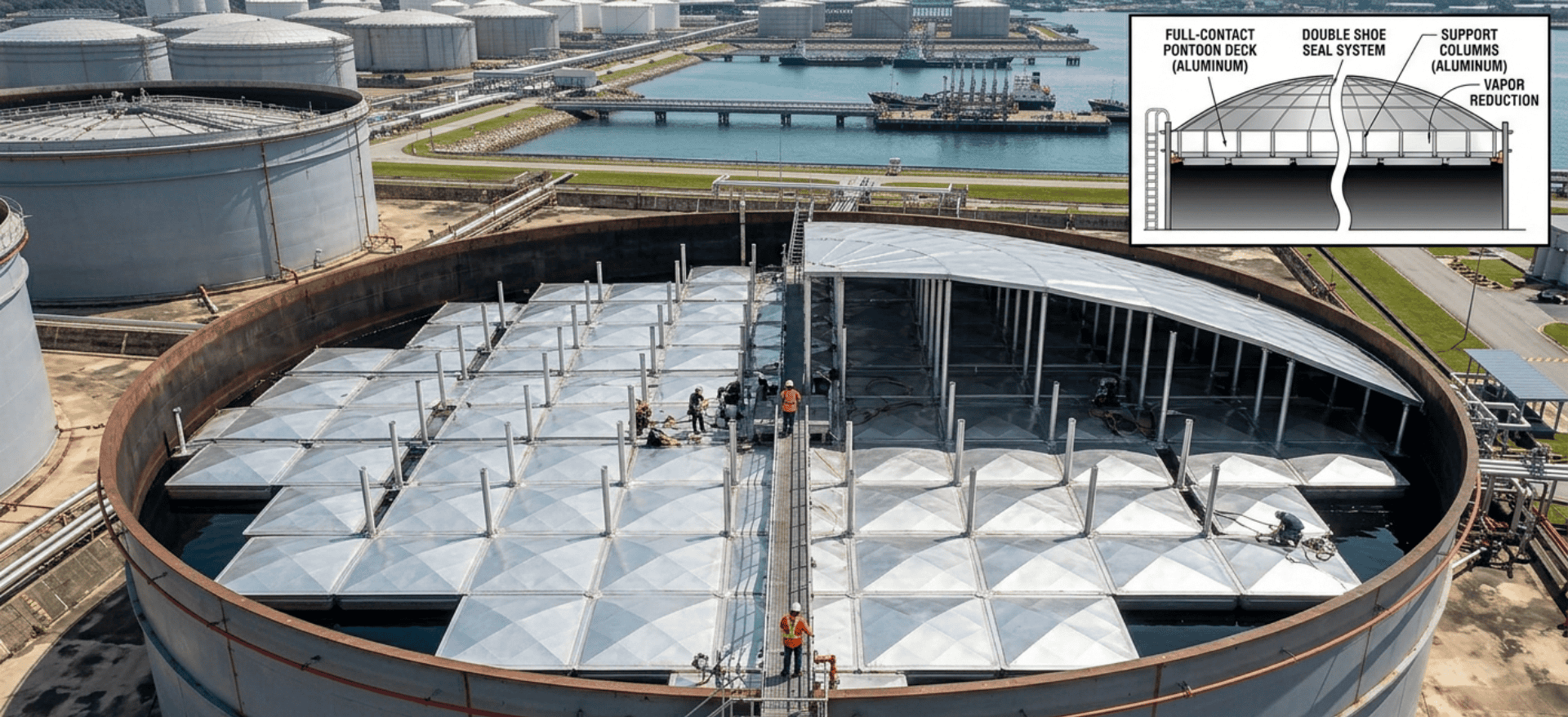
Center Enamel's Full-Contact Aluminum Floating Roof is constructed using heavy-duty, marine-grade aluminum alloys to ensure structural resilience and chemical compatibility:
Structural Space Frame (Extrusions): Made from Alloy 6063-T6 or 6005A-T6, providing excellent yield strength under high load stresses while resisting atmospheric corrosion.
Sheeting Panels: Fabricated from high-durability Alloy 3003-H14 or 5052-H32. These alloys are highly compatible with light hydrocarbons, gasoline, aviation fuels, diesel, and sweet crude oils.
Sandwich Panel Technology: The deck is assembled using modular, interlocking aluminum panels. Each panel is sealed with specialized, product-resistant compounds to form a completely vapor-tight, high-buoyancy barrier.
3. VOC Vapor Loss & ROI Calculator
This interactive calculator demonstrates how upgrading to a Full-Contact Aluminum IFR reduces annual product loss and atmospheric emissions compared to a standard pontoon IFR. Adjust your tank diameter and product value to see the immediate financial and environmental benefits.
4. Modular Assembly and Installation Flow
Because open welding is highly hazardous on operational petrochemical sites, Center Enamel's floating roofs are designed as 100% bolted systems. All components are pre-engineered to fit through a standard 24-inch (600 mm) tank manway, allowing for rapid assembly inside the tank without hot work.
The standard on-site installation sequence is highly structured to prevent structural misalignment:
1.Interior Tank Preparation:Zero Hot Work
The tank is thoroughly cleaned, degassed, and ventilated. Support legs are set at temporary assembly heights on the tank floor, and a safe entry protocol is established.
2.Component Logistics:Manway Deliver。
Pre-cut aluminum extrusions, sandwich panels, and peripheral seals are transferred manually into the tank through the existing 24-inch manway.
3.Chassis & Panel Assembly:Grid Structural Set。
Installers bolt together the load-bearing space frame using stainless steel fasteners. High-buoyancy aluminum sandwich panels are systematically interlocked and sealed with fuel-resistant gaskets to form a flat, continuous deck.
4.Seal & Appurtenance Mounting:Rim Seal Calibration。
Adjustable support legs, guide-pole wells, and automatic vacuum breaker vents are integrated. Finally, the perimeter primary and secondary wiper seals are adjusted to ensure a constant seal against the tank shell during roof travel.
5. Frequently Asked Questions (FAQ)
Q: How does an aluminum floating roof compare to stainless steel in terms of cost and weight?
A: Aluminum roofs are significantly lighter—often up to 50% lighter than stainless steel equivalents. This lower dead weight reduces the structural load on the tank shell, allowing them to be retrofitted onto older, thinner tanks. Economically, aluminum is also much more cost-effective than stainless steel, delivering a faster return on investment (ROI) for standard hydrocarbon services.
Q: Is aluminum compatible with all chemical and petrochemical products?
A: While aluminum is ideal for standard hydrocarbons (such as gasoline, diesel, jet fuel, benzene, and toluene), it should not be used for highly corrosive or acidic chemicals, chlorinated hydrocarbons, high-sulfur (sour) crude oil, or wastewater containing biogenic sulfuric acid (H2S). For those aggressive services, a Stainless Steel Floating Roof (SSFR) is required.
Q: What prevents static electricity buildup on an aluminum floating roof?
A: In compliance with API 650 Annex H and NFPA 77 guidelines, the floating roof is grounded to the tank shell. This is achieved using high-conductivity, flexible stainless steel grounding cables (shunts) connected directly from the roof perimeter to the tank wall. Additionally, the full-contact design prevents the formation of an explosive air-vapor mixture beneath the deck, mitigating ignition risks.
Q: Can a full-contact aluminum roof be retrofitted into any tank type?
A: Yes. Because of its lightweight, modular, and bolted design, a full-contact aluminum floating roof can be installed inside standard welded steel tanks, concrete tanks, and modern Glass-Fused-to-Steel (GFS) bolted tanks.