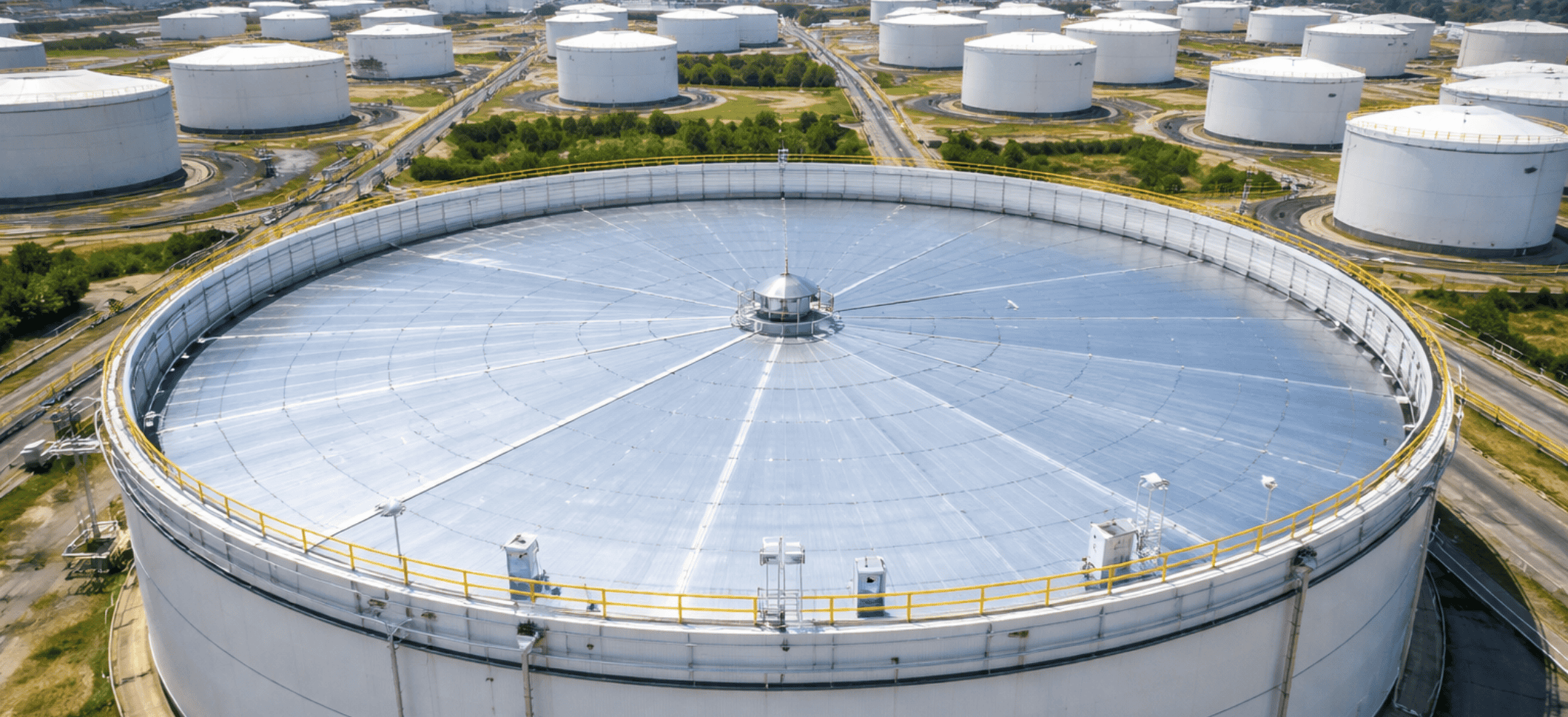
On-Site Assembly and Installation Flow
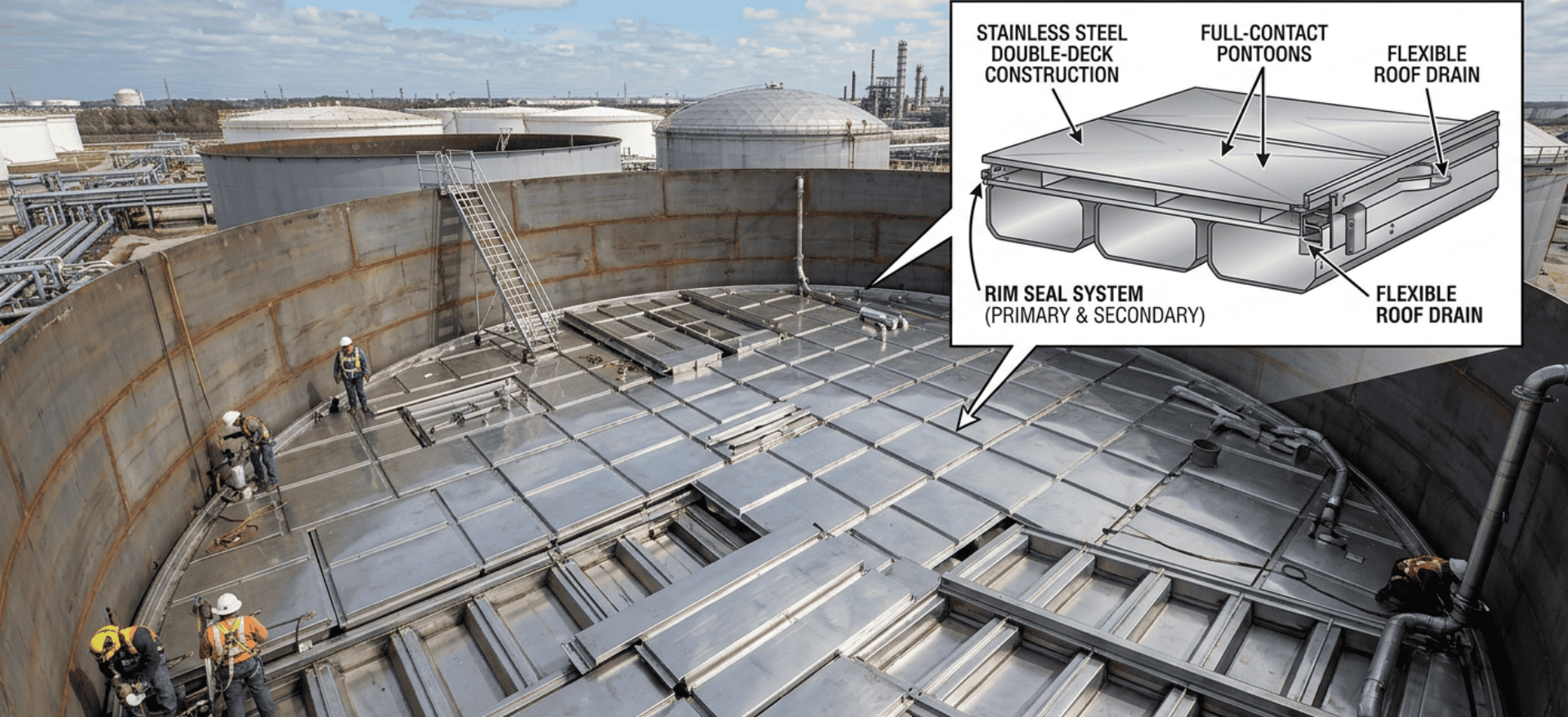
One of the greatest engineering challenges of replacing or retrofitting an internal floating roof is managing the installation process within existing, confined tank spaces. Because welding inside chemical storage tanks presents significant safety risks, modern full-contact roofs utilize a precision-engineered, modular design that is assembled entirely without hot work.
The standard sequence for a non-welded, bolted modular installation follows these critical phases:
1.Internal Tank Preparation:Step 1: Deflashing & Levelling。
Clean and gas-free the tank interior. Measure the vertical alignment of the tank shell, column guides, and gauge poles to ensure the seal clearances will remain uniform across the entire stroke.
2.Component Material Entry:Step 2: Manhole Feeding。
Feed the pre-punched, modular stainless steel panels and framing beams through the standard tank manhole (typically 24 inches / 600 mm). This eliminates the need to cut expensive access doors into the tank shell.
3.Chassis & Panel Assembly:Step 3: Tension Bolting。
Lay out the high-strength stainless steel support beams on temporary support stands. Bolt the modular full-contact sandwich panels together with PTFE seals, forming a continuous, liquid-tight deck directly above the tank floor.
4.Appurtenances & Leg Mounting:Step 4: Leg & Sleeve Fitting。
Install the high-strength, adjustable support legs into their designated sleeves. Set them to the standard low clearance setting for operation, or the high position (typically 6 feet / 2 meters) to allow maintenance access beneath the roof during shutdowns.
5.Rim Seal Installation:Step 5: Shoe or Wiper Seal Calibration。
Fit the custom primary and secondary perimeter seals (such as mechanical stainless steel shoe seals or elastomer double wipers). Calibrate the seal tension to accommodate localized shell deformations while maintaining a continuous vapor barrier.
Frequently Asked Questions (FAQ)
What is the difference between a pontoon IFR and a full-contact IFR?
A pontoon-type roof floats above the liquid surface on tubular pontoons, leaving an open vapor space (ullage) beneath the deck. Vapors naturally collect in this gap, leading to higher emissions and risk of fire. A full-contact IFR has a flat bottom that rests directly on the liquid, effectively compressing and eliminating this vapor space for maximum environmental protection.
Why choose stainless steel over aluminum for floating roofs?
While aluminum is lightweight, it has low chemical resistance to acidic compounds, sour crudes, wastewater, and highly alkaline chemicals. Stainless steel (SS304 or SS316L) offers superior corrosion resistance and can withstand the aggressive chemical attacks that easily degrade aluminum structures. Additionally, stainless steel has much higher fire integrity and structural density.
Do full-contact stainless steel roofs require hot work for installation?
No. High-quality systems are pre-fabricated and pre-punched in the factory. All components are sized to fit through standard tank manholes and are bolted together on-site using specialized, liquid-tight sealing systems, eliminating the fire risks of welding inside a tank.
Which seal types are best paired with an SSFR?
For volatile chemical storage, a combination of a mechanical stainless steel shoe seal (primary) and an elastomeric secondary wiper seal provides the tightest barrier against volatile vapor bypass.