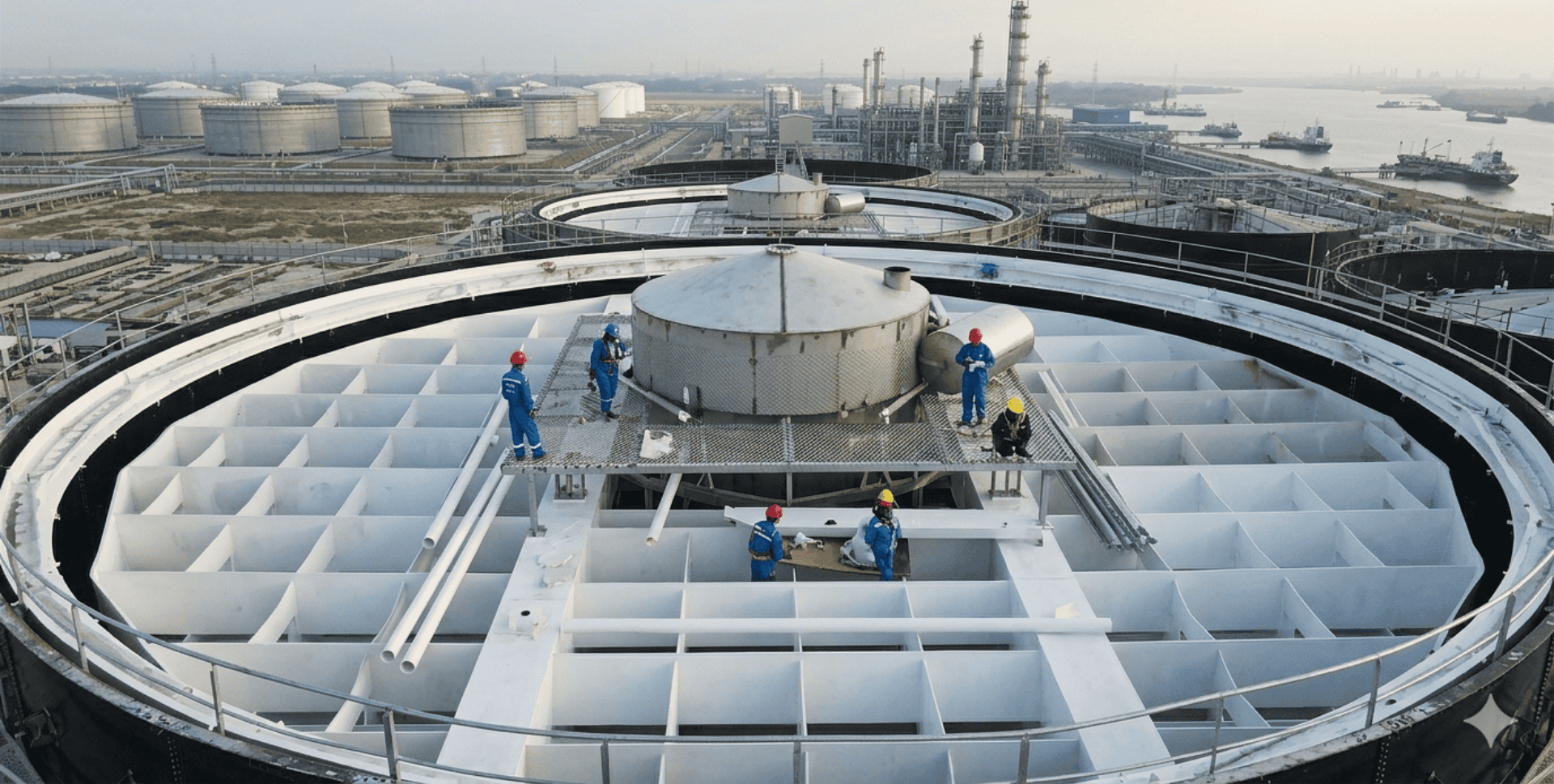
The Heart of Anaerobic Reactors: Engineering the Three-Phase Separator
In modern high-rate anaerobic wastewater treatment systems—specifically Upflow Anaerobic Sludge Blanket (UASB) and Expanded Granular Sludge Bed (EGSB) reactors—the overall treatment efficiency is directly tied to biomass retention. Because anaerobic granular sludge grows slowly, losing this active biomass (known as "washout") can cause a complete system crash.
The critical component that prevents this washout is the Three-Phase Separator. Positioned at the top of the reactor, this internally mounted structure divides the vessel into a lower digestion zone and an upper settling zone. Its primary objective is to separate three distinct phases: Biogas (gas), Treated Effluent (liquid), and Granular Sludge (solid).
1. Physical Mechanics: How Three-Phase Separation Works
The separator relies entirely on fluid dynamics and gravity. As the mixture of biogas, liquid effluent, and granular sludge rises from the sludge blanket, it hits the inverted V-shaped baffle plates of the separator.
1.Step 1: Gas-Liquid Separation:Gas Phase Deflection。
Rising biogas bubbles hit the sloped underside of the lower baffle plates (inclined at a minimum of 45 to 60). The gas is diverted into the gas collection hood (or dome), where it is piped out as fuel.
2.Step 2: Sludge Granule Deflocculation:Solid-Liquid Boundary。
Freed from buoyancy-inducing gas bubbles, the sludge-and-water mixture enters the upper settling zone through a narrow aperture. Here, the cross-sectional area increases, causing a sharp drop in the fluid's upward velocity.
3.Step 3: Sludge Return & Effluent Discharge:Gravitational Descent。
In the quiet settling zone, the sludge's settling velocity exceeds the hydraulic upflow velocity. The heavy granular sludge slides down the sloped baffle surface back into the lower digestion zone, while clear, treated wastewater overflows into the effluent launder weirs.
2. UASB vs. EGSB Separator Design Parameters
While the physical concept remains identical, EGSB reactors operate at much higher upflow velocities than UASB systems. This requires different separator designs to prevent granules from escaping:
Engineering Parameter | UASB Reactor Design | EGSB Reactor Design |
Typical Upflow Velocity (v_up) | 0.5 to 1.5 m/h | 3.0 to 6.0 m/h (Up to 10 m/h peak) |
Baffle Incline Angle (\alpha) | 45 to 50 | 55 to 60 (Steeper slope to ensure rapid sludge slideback) |
Sludge Characteristics | Can handle both flocculent and granular sludge | Must be strictly granular sludge ( 10 m/h) |
Gas Loading Rate | Moderate (< 1.0 m3/m2) | Extremely High (Requires multi-tier gas collection hoods) |
Material Recommendation | Polypropylene (PP) / Fiber-Reinforced Plastic (FRP) | High-Strength PP / Stainless Steel 316L |
3. Frequently Asked Questions (FAQ)
Q: Why are three-phase separators made primarily of PP or stainless steel?
A: The internal atmosphere of an anaerobic reactor is highly corrosive. Biogas contains high concentrations of carbon dioxide (CO_2) and hydrogen sulfide (H_2S), which combine with water vapor to form highly acidic condensation. Polypropylene (PP) and FRP offer complete chemical immunity to acid corrosion, while 316L Stainless Steel provides the structural strength required for deep, high-flow EGSB systems.
Q: What is the purpose of the "baffle overlap" in the design?
A: The lower gas deflection baffles must physically overlap the upper settler opening (typically by at least 100 mm to 200 mm). This overlap acts as a physical shield. It ensures that rising gas bubbles cannot enter the quiet settling zone, as any gas bubbles entering this zone would attach to sludge granules, carry them to the surface, and cause severe sludge washout.
Q: How does scum accumulation affect the three-phase separator?
A: Grease, fats, and floating light solids can accumulate at the water-air interface inside the gas collection hood and the settling zone. If left unmanaged, this scum layer can block gas outlets or overflow into the effluent weirs. High-performance separators from Center Enamel are built with integrated scum baffles and cleanout ports to allow for periodic flushing.
Q: Can a UASB separator be converted to an EGSB separator if we increase the flow?
A: Usually, no. EGSB reactors run at much higher upflow velocities, meaning a standard UASB separator's 45 baffle slope will cause sludge to accumulate on the plates rather than slide back quickly. Running EGSB velocities through a UASB separator will likely lead to rapid, massive sludge washout. The internals must be physically replaced with steeper, multi-tier baffles designed for high flow rates.