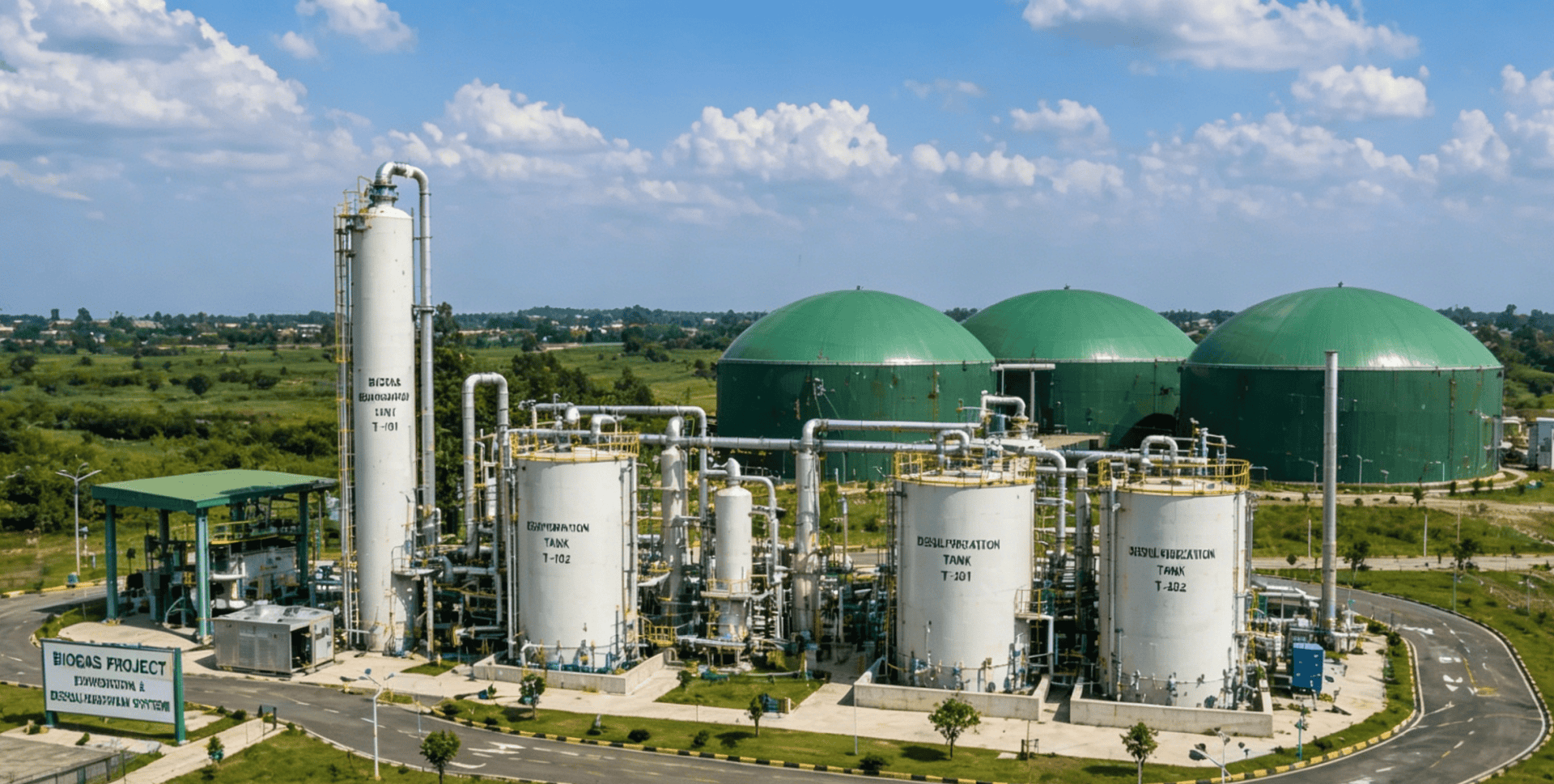
Dehydration and Desulfurization Tanks: The Engineering Guide to Biogas Upgrading
Raw biogas produced via the anaerobic digestion of wastewater sludge, agricultural manure, or municipal organic waste is a valuable renewable energy source. However, in its raw state, biogas is saturated with water vapor and contains highly corrosive hydrogen sulfide (H2S). If left untreated, this wet, acidic gas mixture quickly destroys downstream equipment, including combined heat and power (CHP) engines, compressors, and pipeline networks.
Center Enamel provides highly engineered, integrated Dehydration and Desulfurization Tank Systems designed to remove up to 99% of H2S and moisture. These systems deliver clean, dry, and high-quality biogas suitable for power generation or upgrading to biomethane.
1. The Chemistry of Biogas Purification
Purifying biogas requires two distinct processing stages: Moisture Dehydration and Chemical Desulfurization.
Stage A: Biogas Dehydration (Moisture Removal)
Raw biogas leaves the anaerobic digester saturated with water vapor (typically 30 g/m3 to 50 g/m3 depending on temperature). As the gas cools in downstream piping, this vapor condenses. When combined with H2S, it forms highly corrosive sulfurous and sulfuric acids.
The Process: Biogas is directed through a condensation tank or a specialized refrigeration-based chiller.
The Outcome: By dropping the gas temperature to approximately 4\circC, the dew point is lowered, forcing the water vapor to condense and drain away. This process reduces the moisture content to less than 6 g/m3.
Stage B: Dry Chemical Desulfurization (H₂S Removal)
After dehydration, the dry biogas enters a desulfurization tower containing highly porous iron oxide (Fe2O3 x H2O) media.
Once the iron oxide media becomes saturated and loses efficiency, it can undergo an in-situ regeneration process by introducing controlled amounts of oxygen (O2)
2. Integrated Purifier Sizing Calculator
Use this engineering calculator to estimate your facility's daily water condensation volume and the consumption rate of iron oxide desulfurizer media based on your biogas flow parameters.
3. Strict Compliance & Design Standards
To guarantee high operational safety in volatile gas environments, Center Enamel's dehydration and desulfurization systems conform to major international engineering codes:
Pressure Vessel Integrity: Designed and fabricated in accordance with ASME Section VIII or equivalent regional European pressure codes.
Material Quality: Manufactured utilizing high-strength stainless steel (SUS304/SUS316) or coated carbon steels matching ASTM International specifications.
Environmental Management: Produced in facilities operating under ISO 14001 environmental and safety compliance certifications.
Safety Configurations: Equipped with explosion-proof instrumentation, flame arrestors, automated gas leak detection interfaces, and double-chamber pressure relief valves.
4. Operational & Engineering Advantages
Operational Feature | Center Enamel Design Advantage | Engineering Impact |
H₂S Removal Efficiency | High-performance Fe2O3 porous packing structure | Achieves up to 99% sulfur removal, lowering output concentration to <10 ppm |
Low Pressure Drop | Optimized structural flow distributors within the vessel | Minimizes parasitic blower energy consumption and prevents channeling |
Anti-Corrosion Durability | Heavy-duty internal linings and corrosion-resistant alloys | Resists aggressive biogenic sulfuric acid attack, extending tank life |
Modular Footprint | Compact, skid-mounted design option | Simplifies transport and enables rapid plug-and-play installation |
5. Frequently Asked Questions (FAQ)
Q: Why is it necessary to dehydrate biogas before desulfurization?
A: Dry desulfurization relies on a chemical reaction that can be compromised by excessive moisture. If liquid water enters the desulfurization tower, it can cause the iron oxide media to clump or turn into mud. This blocking increases the pressure drop across the system and prevents the gas from interacting with the active desulfurizer.
Q: How do operators know when the desulfurizer media is spent?
A: There are two main indicators:
Gas Chromatography/Sensors: An increase in H2S concentration at the outlet indicates the media is spent.
Color Change: Active iron oxide media is brownish-red or dark brown. As it reacts with H2S to form iron sulfide (Fe2S3), it turns black.
Pressure Loss: Over time, sulfur deposits can physically coat the media, leading to a noticeable increase in pressure drop across the tower.
Q: Can spent iron oxide media be regenerated indefinitely?
A: No. While introducing oxygen allows the media to regenerate in-situ or ex-situ, this cycle can only be repeated a limited number of times. Over time, elemental sulfur (S) accumulates in the pores of the media, physically blocking active reaction sites. Typically, the media must be completely replaced after 2 to 3 regeneration cycles.
Q: What safety hazards are associated with desulfurization media replacement?
A: The regeneration of iron sulfide (Fe2S3) is a highly exothermic reaction (it releases heat). If spent, black iron sulfide media is unloaded from the tank and exposed to open air too quickly, it can react rapidly with oxygen, heat up, and self-ignite. Unloading must be conducted carefully, often under wet or controlled conditions, to manage this thermal reaction safely.