Why TES Tanks Are Critical for Cooling Data Centers: Reliability and Resilience
When we say TES tanks critical for cooling data centers, we mean resilience as much as cost. Most discussions of TES focus on savings, but for data centers the more compelling case is reliability: a charged TES tank is minutes of grid-independent cooling that protects IT load during transients. This article makes the resilience case.
TES tanks are critical for data center cooling because a charged tank is a thermal buffer independent of chillers and grid power for the minutes that matter during an outage or chiller trip. By decoupling stored cooling from immediate compression, TES protects IT load, reduces chiller stress, and supports higher rack densities - turning a savings device into a resilience asset.
Thermal Buffer During Outages
When grid power falters or a chiller trips, a charged TES tank continues supplying cold water to the CRAHs while generators or backups engage. Those minutes of buffer are often the difference between a graceful ride-through and an IT thermal event.
Because the cooling is already stored, it does not depend on compressors running - a uniquely robust failure mode.
Chiller Protection and Density
TES absorbs load swings that would otherwise hammer chillers, reducing wear and extending life. By smoothing peaks, it also lets a campus push higher rack densities without over-provisioning chiller capacity.
In effect, TES buys both resilience and headroom from the same asset.
Resilience as a Design Requirement
For colocation and hyperscale operators, resilience metrics (e.g., Tier objectives) make TES a design assumption, not an option. The tank's reliability is then part of the site's availability case.
Technical Specifications
Parameter | Specification |
Role | Thermal buffer |
Outage value | Minutes of cooling |
Protects | IT load, chillers |
Enables | Higher density |
Failure mode | Robust (stored cold) |
Shell | Atmospheric stratified |
Material | GFS / stainless |
Standard | AWWA D103 |
QA | ISO 9001 |
Code | Site Tier obj. |
Verified Tank Engineering Reference
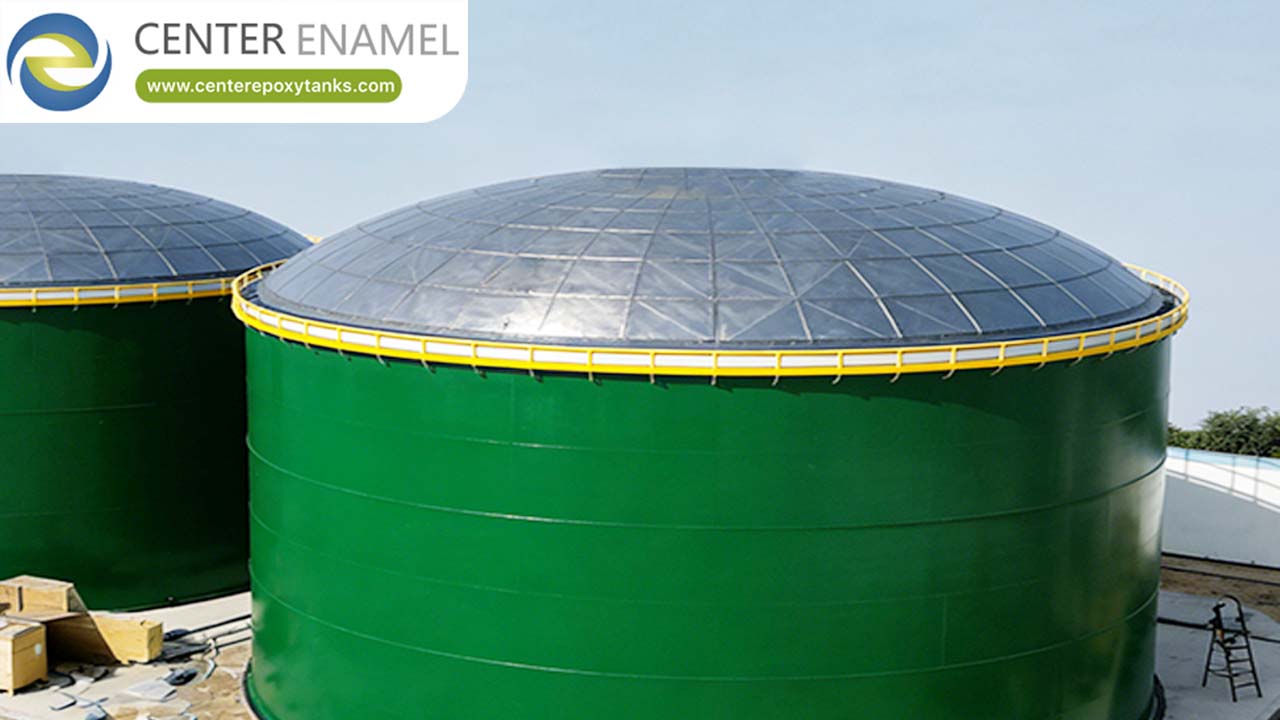
Center Enamel's water-storage tank programs - such as a 2024 Indian installation of three GFS tanks at 19.86 m diameter and 12,261 m3 - reflect the large-bolted-tank manufacturing behind resilient campus water systems, including the chilled-water TES that supports data-center reliability. Capability evidence only, not a DC project.
Project location | India |
Application | Fire-protection water |
Tank type | GFS (Glass-Fused-to-Steel) bolted tank |
Scale | 3 unit(s), φ19.86*13.2m(H) |
Total volume | 12,261 m3 |
Year | 2024-06 |
Note | Cited as manufacturing-capability evidence, not a data-center project. |
Center Enamel Capability
Center Enamel supplies the tank assets that underpin resilient cooling: large bolted GFS and stainless TES/buffer tanks plus ASME pressure vessels, built under ISO 9001 to AWWA D103 and ISO 28765 with available NSF/ANSI 61 and WRAS certification.
For campuses where resilience is a design requirement, the engineering team coordinates tank specification with the site's availability objectives.
Frequently Asked Questions
Q: Why are TES tanks critical for data centers?
A: A charged tank provides minutes of grid-independent cooling during outages or chiller trips - protecting IT load.
Q: How does TES protect chillers?
A: By absorbing load swings, reducing short-cycling and wear, and extending compressor life.
Q: Does TES support higher density?
A: Yes - by smoothing peaks, it lets campuses push rack density without over-building chillers.
Q: Is TES a resilience requirement or option?
A: For many colocation/hyperscale sites, it is a design assumption tied to Tier/availability objectives.
Q: What happens during a chiller trip?
A: The tank keeps supplying cold water while backups engage.
Q: What material for resilient TES?
A: GFS or stainless bolted tanks, chosen by chemistry and code.
For data centers, TES tanks earn their place through resilience as much as savings. A charged tank is stored, grid-independent cooling - the simplest, most robust buffer you can put between your IT load and a thermal event.
Suggested Next Step
Discuss your site's availability objectives with our engineers - we will size a TES buffer that meets your resilience targets.


