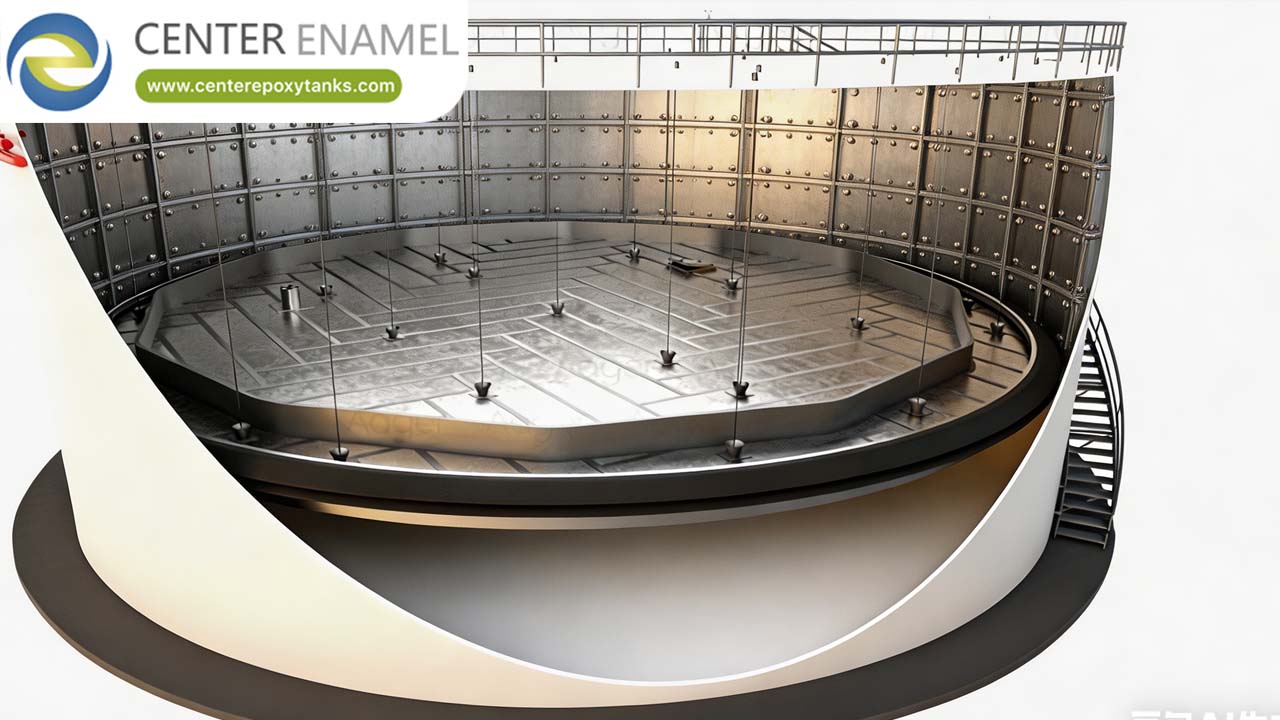
What Is the Floating Roof Effect? How Surface-Contact Design Transforms Industrial Storage
In industrial bulk liquid containment—spanning crude oil terminals, petroleum refineries, and chemical processing facilities—the behavior of stored liquids under varying atmospheric conditions dictates environmental and financial efficiency.
The "floating roof effect" refers to the distinct thermodynamic, operational, and environmental phenomenon that occurs when a buoyant roof rests directly on the surface of a stored liquid, eliminating the vapor headspace (ullage) inside a storage tank. By changing how a vessel interacts with temperature fluctuations and product movement, this engineering effect solves major industrial challenges related to product evaporation, Volatile Organic Compound (VOC) emissions, and fire safety.
1. The Core Mechanics Behind the Floating Roof Effect
In a conventional fixed-roof storage tank, a permanent roof encloses the vessel, leaving an empty pocket of air above the liquid surface. As ambient temperatures shift throughout the day, this headspace drives two primary loss mechanisms:
·
Breathing Losses (Diurnal Losses): As solar heat warms the tank during the day, liquid evaporates into the headspace, and expanding vapors are forced out through pressure vents. At night, cooling air draws fresh oxygen back in.
·
·
Working Losses: When liquid is pumped in or out, the movement displaces vapor-laden air directly into the atmosphere.
·
The floating roof effect neutralizes these losses. Because the roof floats dynamically on the liquid surface, no independent vapor pocket exists. Without headspace to expand into, diurnal breathing cycles are effectively halted, and evaporative product losses are reduced by up to 99%.
2. Environmental and Safety Implications of the Effect
The elimination of vapor headspace yields critical secondary benefits across environmental compliance and plant safety:
·
Suppression of VOC Emissions: By maintaining a continuous physical barrier sealed tightly against the tank shell via primary and secondary rim seals, the floating roof effect prevents harmful hydrocarbons and pollutants from escaping, ensuring strict adherence to environmental regulations.
·
·
Elimination of Flammable Vapor Clouds: In fixed-roof tanks storing volatile fuels, an explosive vapor-air mixture frequently accumulates in the headspace. The floating roof effect removes this oxygen-rich vapor zone entirely, drastically lowering the risk of internal fires and lightning-induced explosions.
·
·
Prevention of Internal Corrosion: Condensation inside fixed-roof headspaces mixes with sulfur compounds from crude oils to rust upper shell plates. By sealing the liquid interface, the floating roof prevents corrosive vapor condensation.
·
Data Table: Fixed-Roof vs. Floating Roof Storage Effects
Operational Parameter | Fixed-Roof Tank (Headspace Effect) | Floating Roof Tank (Surface-Contact Effect) |
Vapor Headspace (Ullage) | Large, permanent air pocket susceptible to thermal expansion | Minimal to zero (Roof floats directly on fluid) |
Evaporative Product Loss | High due to daily breathing and working cycles | Negligible (Reduced by over 90%) |
VOC Emissions Profile | High; requires external vapor recovery units (VRUs) | Very low; compliant with strict environmental mandates |
Fire and Explosion Hazard | Moderate to high due to accumulated vapor-air mixtures | Low; absence of vapor headspace eliminates combustible gas pockets |
Governing Standards | API 650 (Standard atmospheric design) | API 650 (Annex C for EFR, Annex H for IFR) |
Frequently Asked Questions (FAQ)
Q: What is the primary benefit of the floating roof effect in industrial tanks?
A: The primary benefit is the complete elimination of vapor headspace, which stops daily breathing losses, prevents product evaporation, and reduces Volatile Organic Compound (VOC) emissions by up to 99%.
Q: How does temperature fluctuation impact a floating roof tank compared to a fixed roof tank?
A: In a fixed-roof tank, temperature changes cause the vapor-air mixture inside the headspace to expand and force hydrocarbons out through vents (breathing loss). In a floating roof tank, the roof rises and falls directly with the liquid surface, neutralizing thermal vapor expansion.
Q: Does the floating roof effect completely eliminate fire risks?
A: While it drastically minimizes fire risks by removing internal vapor pockets where explosive gas mixtures gather, external rim seal fires can still occur under rare conditions. Consequently, floating roof tanks feature specialized rim seals and fire suppression systems.
Q: Can existing fixed-roof tanks be retrofitted to achieve the floating roof effect?
A: Yes. Facilities frequently install Internal Floating Roofs (IFRs) inside existing fixed-roof or domed tanks as a cost-effective upgrade to improve vapor control and meet modern environmental standards without building new infrastructure.


