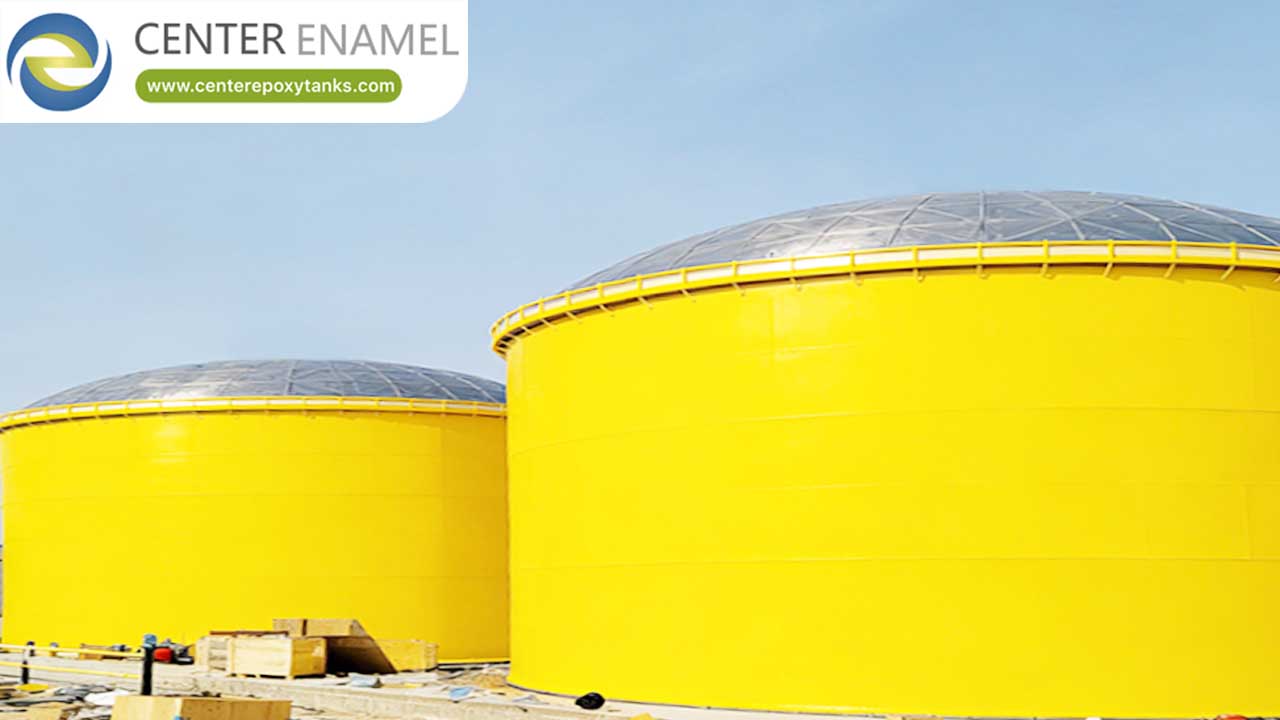
What is an Umbrella Roof Tank?
An Umbrella Roof Tank is a type of fixed-roof aboveground storage tank (AST) characterized by a curved, self-supporting roof structure that resembles the canopy of an umbrella. Unlike standard cone-roof tanks that often require internal support columns, the umbrella roof design uses a modified dome geometry—typically constructed of plate segments—that transfers structural loads directly to the tank shell. This design is highly favored in industrial applications where an unobstructed internal volume is required, and it serves as a cost-effective alternative to full spherical dome roofs.
Design and Structural Characteristics
The umbrella roof is essentially a structural hybrid. It mimics the aesthetics and load-distributing properties of a dome but is often easier to fabricate using flatter, segmented steel plates.
1. Self-Supporting Geometry
The most significant feature of an umbrella roof is its self-supporting nature. By distributing structural loads (wind, snow, and dead weight) through membrane stress to the perimeter shell, the design eliminates the need for internal rafters, trusses, or central support columns.
2. Column-Free Interior
By removing internal supports, the umbrella roof provides a completely clear internal volume. This is a massive operational advantage for two reasons:
● Maintenance: Without columns, there are no internal "shadow areas" or structural intersections where corrosion can hide, making the tank interior much easier to clean and inspect.
● Product Quality: It prevents the build-up of sediment or contaminants around column bases, which is critical for high-purity product storage.
3. Fabrication Efficiency
While a true dome roof (spherical) can be complex to fabricate, the umbrella roof is often constructed using trapezoidal or polygonal plate segments. This simplifies the field-welding process while still achieving the structural benefits of a curved, curved-load-bearing shape.
Comparison: Umbrella Roof vs. Other Fixed Roofs
Feature | Umbrella Roof | Cone Roof | Dome Roof (Geodesic/Spherical) |
Structure | Self-supporting (Curved) | Often needs columns (Straight) | Self-supporting (Spherical) |
Internal Obstructions | None | Yes (Columns/Rafters) | None |
Fabrication | Moderate (Segmented plates) | Simple (Flat plates) | Complex (Spherical geometry) |
Best Application | General liquid storage | Small diameter / Low cost | High-pressure or large diameter |
Maintenance | Low | Higher (Column/Rafter issues) | Very Low |
When to Select an Umbrella Roof
The umbrella roof is the "sweet spot" for many mid-to-large scale industrial tanks. It is often specified when:
● You require a clear span: The process inside the tank (e.g., mixing or clean-in-place) makes internal columns a liability.
● You are building to API 650: The umbrella roof is a recognized, standard configuration under API 650 design codes.
● Budget vs. Performance: It offers the "clear-span" benefit of a geodesic dome at a fabrication cost that is often more competitive for specific tank diameters.
Frequently Asked Questions (FAQ)
1. Why is it called an "Umbrella" roof?
It is named for its shape. The roof curves downward from a center point, similar to how an umbrella canopy curves. It provides a natural slope for rain and snow drainage, preventing the "ponding" that can occur on flat or poorly designed roof structures.
2. Are umbrella roof tanks always self-supporting?
Generally, yes. The primary engineering goal of the umbrella design is to transfer loads to the tank shell. If the tank diameter is excessively large, however, structural engineers may still incorporate some reinforcement, but the defining characteristic of the "umbrella" design is the intent to avoid a forest of internal support columns.
3. How does the umbrella roof differ from a geodesic dome?
A geodesic dome is a true spherical geometry, often built with many small triangular panels to create a precise sphere. An umbrella roof is typically built with larger, segmented plate sections. Umbrella roofs are generally more "economical" to fabricate for specific medium-sized tanks, whereas geodesic domes excel in very large-diameter, high-load environments.
4. Can I retrofit a cone-roof tank to an umbrella roof?
While you could technically replace the roof of an existing tank, it is not a simple "swap." Changing from a supported cone roof to a self-supporting umbrella roof changes how structural loads are transferred to the tank shell. You would need a structural engineer to verify that the existing tank shell and foundation can support the new load distribution.
5. Is an umbrella roof suitable for volatile product storage?
Yes, provided the tank is designed according to API 650. However, for highly volatile products (like gasoline or crude oil), the umbrella roof is often paired with an internal floating roof (IFRT). The umbrella roof acts as the weather-tight enclosure, while the internal floating roof provides the emission control.
Are you evaluating roof designs for a new tank procurement, or are you looking for solutions to modernize existing tank infrastructure?


