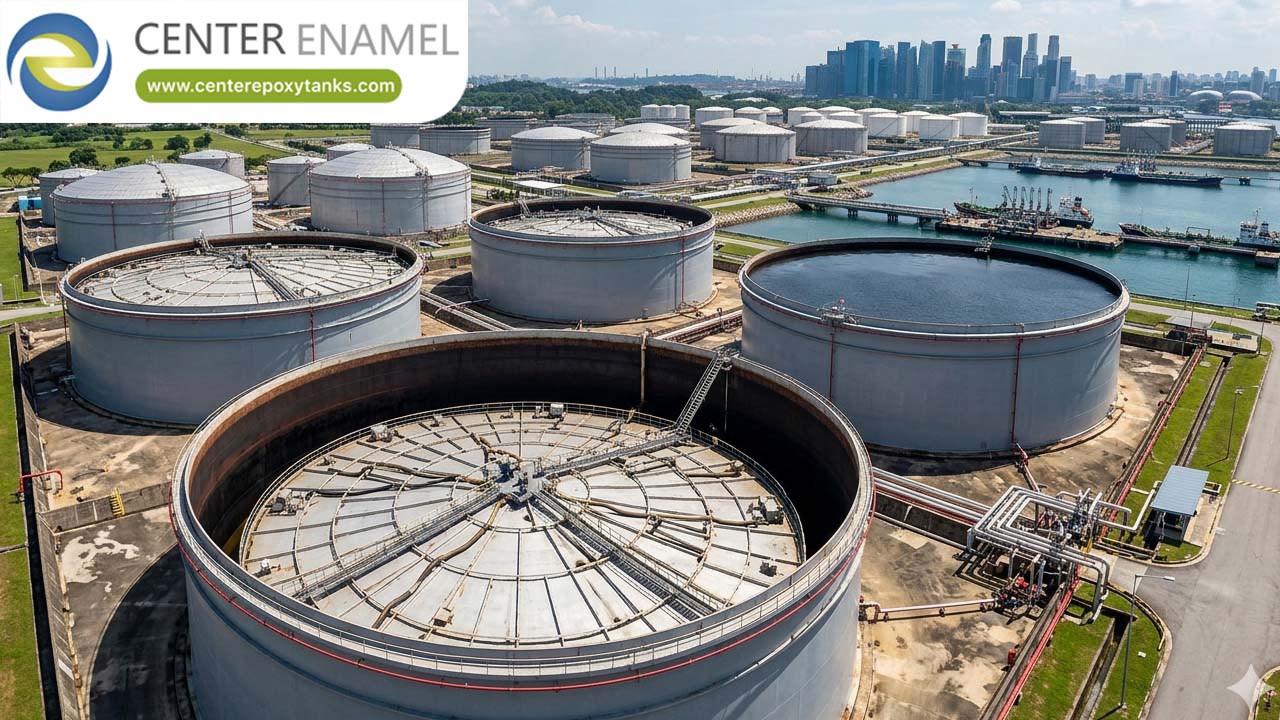
What Is an Internal Floating Roof
An internal floating roof is a deck that floats on the stored liquid inside a tank that also has a conventional fixed roof above it. That single sentence contains most of what matters, including the reason it exists and the reason it is not a complete answer to vapour control. This article explains the mechanism properly, and then sets out, explicitly, the problems an internal floating roof does not solve, because the limits are where specifications usually go wrong.
The Mechanism in One Paragraph
The deck is buoyant. It floats on the product, rising and falling with the liquid level, so the distance between the product surface and the underside of the deck stays roughly constant instead of growing as the tank empties. Around the perimeter of the deck is a seal that presses against the inside of the tank shell, closing the annular gap between the moving deck edge and the fixed wall. Above the deck, inside the fixed roof, remains a vapour space that is vented, and it is normally kept close to atmospheric pressure.
The result is that the large vapour space of an ordinary fixed roof tank, which grows as the tank empties, is largely removed and replaced by a small constant space just above the deck. Since evaporation is driven by the vapour concentration in that space, the volumetric reduction is the main mechanism. The US EPA reference document on organic liquid storage tanks describes the internal floating roof in regulatory terms as a pontoon type roof, a double deck type roof, or an internal floating cover, resting or floating on the liquid surface and equipped with a closure seal that closes the space between the roof edge and the tank wall.
The fixed roof above is not decorative. It is what protects the deck, the seal and the product from rain, snow, ultraviolet radiation and wind, and it is what distinguishes an internal floating roof tank from an external floating roof tank, where the deck is exposed to the weather and must be designed to shed rainfall.
The Components You Are Actually Buying
An internal floating roof is a system of five functional groups, and it is worth knowing their names because enquiries and specifications are organised around them. The deck is the horizontal surface that covers the product, either a single skin over pontoon buoyancy members, a double deck arrangement, or a full-contact panel construction that rests directly on the product. Buoyancy is what keeps the deck afloat and what determines its freeboard, and it has to be sufficient for the product density with a margin for contamination, ice, rainwater and sludge.
The primary seal is the element that closes the gap to the shell. The EPA reference describes three families for internal floating roofs: a mechanical shoe seal, in which a light-gauge metallic band formed from shoe sections is held against the shell and normally extends a short distance below the liquid surface; a resilient filled seal, in which a resilient core such as foam encapsulated in coated fabric maintains contact as the annular space changes width, installed either liquid-mounted or vapour-mounted; and a wiper seal, in which a continuous annular flexible blade is fastened to a bracket on the deck perimeter and spans the gap to the shell.
The third group is the deck-mounted and tank-mounted fittings: guide rails or guide poles that keep the deck centred and control its rotation, landing legs that support the deck when the tank is drained, deck drains and sumps, and the seal, gauge and instrument assemblies. The fourth group is the seal arrangements around every penetration, including columns, gauge poles, stilling wells, sample wells, drains and ladder wells. The fifth is the fixed roof above, together with its vents, and the pressure and vacuum relief that the tank still requires.
Standing and Working Losses: Where the Emissions Come From
Storage tanks lose volatile organic compounds in two broadly different modes, and it matters because an internal floating roof addresses them differently. Standing losses occur while the tank sits, as vapour works past the seal and out through the tank vents. Working losses occur during filling and emptying, when liquid movement and the changing wetted shell drive additional evaporation.
Because the deck removes the large vapour space, it reduces the standing loss substantially. It does not eliminate the loss: vapour still passes the seal, and during filling and emptying the working loss remains, which is why regulations written around floating roofs generally require that gauging and sampling devices be gas tight except while gauging or sampling is taking place, and why the Louisiana implementation plan for volatile organic compound storage treats internal floating roof openings as a design condition rather than a detail.
The practical consequence is that an internal floating roof is a large improvement and a complete solution only in combination with a properly specified seal, sealed penetrations and operating discipline. Any specification that treats the roof as a single item and leaves the penetrations and the gauging regime open will not deliver the performance the buyer expects.
What an Internal Floating Roof Does Not Solve
Problem | Does an IFR address it? | Explanation |
Product contamination from rainwater | Yes, largely | The fixed roof above keeps rain and debris out of the tank, which is one of the main reasons to prefer an internal arrangement in a high-rainfall region |
Insolation and product temperature swings | Partially | The fixed roof shields the product from direct sun and wind, which reduces daytime excursions, but the tank still has a defined thermal envelope |
Evaporation loss during filling and emptying | No | The working loss is driven by liquid movement and the changing wetted shell, and an internal floating roof does not change that mechanism |
Flammable atmosphere inside the tank | Partially | Removing the large vapour space reduces the volume in which a flammable mixture can form; the space above the deck still requires venting and monitoring |
Need for a fixed roof and for tank venting | No, it adds one | An internal floating roof still sits inside a fixed roof tank, and the vent and relief design has to be reworked for the new vapour conditions |
Accessibility for inspection | Mixed | Weather is removed as a constraint, but the deck and its compartments still have to be inspected and entered |
Corrosion of the tank shell | No | The deck changes the vapour space above the product, but shell corrosion in a corrosive service is a materials problem, not a roof problem |
Cost of a full tank shutdown for coating work | No | The internal floating roof removes the roof coating cycle, but shell and internal coatings still need their own renewal plan |
This table is the most useful thing on this page for anyone about to write a specification. The commonest failure mode is not choosing the wrong roof; it is expecting the roof to deliver emission performance that depends on the operating regime, then discovering that the operators were never given the seal inspection or the gauging discipline that the performance assumed. An internal floating roof is a well-proven answer to a narrow problem, which is why the limits deserve as much attention as the mechanism.
Why the Fixed Roof Above Is a Design Decision
Because the space above the deck is a different space from the space above the product, the venting and relief arrangement for an internal floating roof tank must be designed for its new conditions rather than inherited. The vapour space above the deck is normally vented to keep it near atmospheric, which is why regulations for floating roof tanks typically require rim space vents to relieve excess pressure or vacuum, and require automatic bleeder vents to be gasketed. The Louisiana implementation plan is specific that rim space vents and automatic bleeder vents are gasketed, that ladder wells are fitted with a sliding cover, and that each opening in the floating roof, other than rim space vents and automatic bleeder vents, is provided with a projection below the liquid surface.
The practical reading of those requirements is that every penetration through a floating deck has to be designed to stay submerged when the deck is at its lowest operating level, and to be sealed where it is not. A roof supplier who has not asked about the deck's lowest level, the tank's minimum filling level and the position of every penetration has not asked the questions that determine whether the installation complies.
The Specification Points That Determine Whether It Works
Six items separate a floating roof that performs from one that merely exists. The seal architecture, stated by type and mounting, with the primary and any secondary seal identified separately. The deck type, with the buoyancy arrangement and the freeboard basis stated. The penetration treatment, itemised by fitting, because a roof is defined by its openings as much as by its deck. The level and landing arrangement, covering the full range of operating levels, the minimum and maximum fill levels and the landing supports. The vent and relief philosophy, including the treatment of the space above the deck. And the inspection and maintenance regime, which has to be realistic about entry and about product management.
A specification that includes these six, with the operating envelope stated, is essentially a complete enquiry document. One that specifies a roof diameter and a product and nothing else will generate quotations that cannot be compared, because each supplier will assume a different configuration.
Case evidence disclosure: this article defines a mechanism, and no mechanism can be evidenced by a project reference, so none is offered. Two points of fact are recorded instead. The verified Centre Enamel project library contains no internal floating roof delivery, so no installed deck, seal or vapour performance is claimed. The publicly listed Centre Enamel aluminium internal floating roof product line, including its pontoon and full contact configurations and the API 650 Appendix H reference on the page, is cited from the published product page, and no performance percentage or service life taken from that page is adopted as fact.
Conclusion
An internal floating roof removes the large vapour space above the stored product and closes the perimeter with a seal, while a fixed roof above protects the whole assembly from the weather. That is a genuine and well-proven reduction in standing emissions, and it is the right answer for volatile products in tanks where the alternative is an open-vapour-space fixed roof. It is not a complete answer, because the working losses during filling and emptying, the venting of the space above the deck, the sealing of every penetration and the inspection regime all remain the operator's responsibility. Specify the seal, the deck, the penetrations, the level envelope, the vent philosophy and the inspection regime, and you have specified a system. Send us the tank data and we will work that specification through with you.
Frequently Asked Questions
Q: What is the difference between an internal and an external floating roof?
A: An internal floating roof sits inside a tank that has a conventional fixed roof above it, so the deck and seal are protected from rain, snow, ultraviolet radiation and wind. An external floating roof has no fixed roof, so the deck is exposed and must be designed to shed rainfall, drain, and withstand snow and wind loading directly. The internal arrangement suits climates with heavy rainfall or where the product must be kept free of water; the external arrangement is common on very large crude oil tanks.
Q: Does an internal floating roof stop evaporation losses completely?
A: No. It substantially reduces the standing loss by removing most of the vapour space, because evaporation is driven by the vapour concentration in that space. It does not remove the working loss during filling and emptying, which is driven by liquid movement and the changing wetted shell. The remaining standing loss still passes the seal, which is why sealed penetrations and gas-tight gauging practice are part of the compliance picture.
Q: How much does an internal floating roof cost?
A: We do not publish a price, and no figure should be accepted without a defined scope covering tank diameter, deck type, seal architecture, penetrations, level envelope and the documentation package. Third-party listings in the market for aluminium internal floating roofs show single-set figures in the tens of thousands of US dollars for smaller diameters, but those listings rarely state the deck type, the seal architecture or the design standard, so they cannot be used for comparison.
Q: What is the difference between a pontoon roof and a full contact roof?
A: A pontoon roof uses buoyancy members around the perimeter or distributed across the deck, so a vapour space remains between the deck skin and the product surface, and the deck rides slightly above the liquid. A full contact roof is built from panel sections that rest directly on the product, so almost no vapour space exists beneath the deck at all. Full contact arrangements are the aggressive option for emission control, while pontoon designs are generally more mechanically robust and are the common choice in heavier duty service.
Q: Can an internal floating roof be installed in an existing tank?
A: It can, and retrofitting is a standard route to reducing emissions on tanks originally built with a plain cone roof, because it avoids converting the tank to a fully external floating roof arrangement. The constraints are physical: every component has to pass through the existing tank openings, the column, gauge pole, stair and mixer arrangements have to be accommodated or modified, and the shell has to have the capacity for the added loads. Installation with the tank in service is possible in some cases and is subject to the site permit and gas-freeing regime.
Q: What should I ask a supplier to prove about internal floating roof experience?
A: Ask for the project identifier, country, year, tank diameter, stored product and deck type, and then check whether the item offered was an internal floating roof rather than an external floating roof or a tank shell. A tank project is not automatically a floating roof project. Also ask for the design standard the seal and deck are designed to, stated in full, and for the documented evidence behind any emission or service-life claim, because those figures are frequently asserted without a stated verification basis.
Work With Center Enamel
Center Enamel is the trading name of Shijiazhuang Zhengzhong Technology Co., Ltd, established in 2008 and based in Shijiazhuang, Hebei Province, China. The company manufactures glass-fused-to-steel bolted tanks, fusion-bonded epoxy coated tanks, stainless steel and welded steel tanks, pressure vessels, aluminium geodesic dome roofs and floating roof systems. Aluminium dome design work is carried out against AWWA D108, API 650, ADM 2015, ASCE 7-10 and IBC 2012, and the broader product range is covered by ISO 9001, NSF/ANSI 61, CE/EN 1090, ISO 28765, WRAS and FM approvals. The company reports 30,000 installed projects and an annual output of 300,000 enamel steel plates, with technical support delivered through an international distributor network and a stated 24-hour response commitment.
If your project involves tank roofs, floating decks or the shells that carry them, send the tank diameter, shell height, product, operating temperature and site design loads. We will return a preliminary structural concept, the applicable design code basis, and a written scope that separates what is included from what the site contractor must provide.


