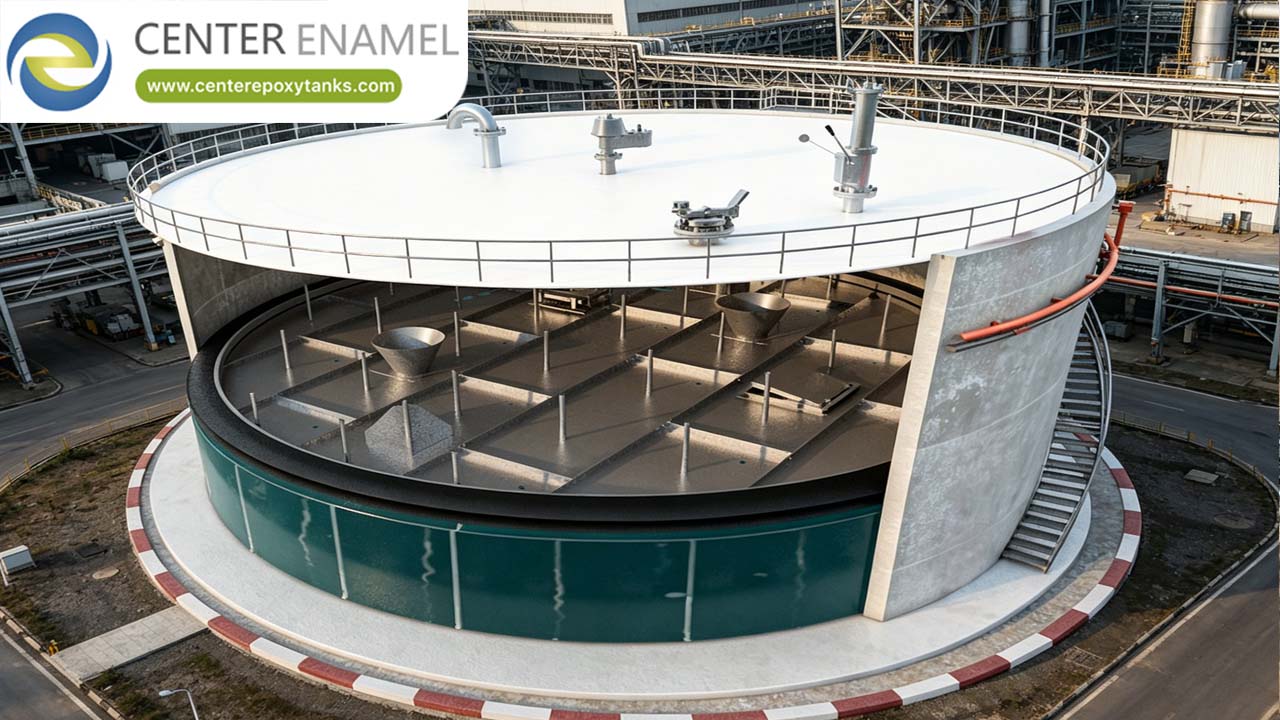
What is an Internal Floating Roof (IFR)? Industrial Emission Control Guide
An Internal Floating Roof (IFR) is a circular, buoyant structure installed inside a fixed-roof storage tank, designed to float directly on the surface of the stored liquid. Its primary engineering function is to eliminate the "vapor headspace"—the air pocket between the liquid and the tank roof—thereby drastically reducing the evaporation of Volatile Organic Compounds (VOCs) and hazardous vapors. Unlike external floating roofs, an IFR is shielded from weather (rain, snow, and wind) by the tank’s permanent fixed outer roof. This configuration creates an ideal environment for long-term emission control, product loss prevention, and regulatory compliance in petrochemical, chemical, and refined fuel storage applications.
The Engineering Mechanics: How an IFR Works
The effectiveness of an IFR relies on three fundamental engineering components that ensure a near-zero vapor environment:
● Buoyant Deck: The roof is constructed with pontoon chambers or a full-contact deck that provides the buoyancy to sit on the liquid surface. As the tank fills or discharges, the roof tracks the liquid level vertically, ensuring constant contact.
● Rim Seal System: This is the most critical feature. The seal bridges the gap between the IFR edge and the tank shell.
○ Primary Seal: Prevents the bulk of vapors from escaping.
○ Secondary Seal: Provides a "wiping" action against the tank wall to catch any residual vapors, often required by environmental agencies for "best available control technology" (BACT).
● Guide Poles & Anti-Rotation: These structural members maintain the roof’s alignment, preventing tilting or rotation, which ensures the seal maintains uniform pressure against the tank wall throughout the entire travel range.
Comparative Overview: Storage Roof Designs
Feature | Internal Floating Roof (IFR) | External Floating Roof (EFR) | Fixed Roof (No IFR) |
Vapor Headspace | Near Zero | Near Zero | Large |
Weather Protection | Excellent (Fixed roof) | None (Exposed) | Excellent |
VOC Emissions | Minimal (Compliant) | Low | High |
Maintenance | Low | Moderate (Drainage req.) | Low |
Best Application | Volatile Chemicals, Fuels | Large Crude Oil Tanks | Water, Non-volatile |
Engineering Standards & Procurement Benchmarks
When specifying an IFR for an industrial project, the engineering documentation should prioritize these benchmarks:
1. API 650 (Appendix C) Compliance: This is the global benchmark for the design, material selection, and fabrication of internal floating roofs. It dictates deflection tolerances, structural load-bearing capacity, and seal design.
2. Material Compatibility: The roof material (typically high-grade aluminum or stainless steel) must be chemically compatible with the stored product. Aluminum is standard for general fuels, while stainless steel is specified for corrosive or aggressive chemical media.
3. VOC Emission Compliance: Ensure the design meets local air quality standards (e.g., EPA, EU directives). A "Primary + Secondary" seal configuration is often the minimum requirement for high-volatility products.
4. Seal Durability: Modern seals are designed for long service life. Procurement should evaluate the seal material (e.g., fluoroelastomer or polyurethane) to ensure it resists chemical degradation from the stored liquid.
Frequently Asked Questions (FAQ)
Q: Can I retrofit an existing fixed-roof tank with an IFR?
A: Yes. Retrofitting an existing fixed-roof tank with an internal floating roof is one of the most cost-effective ways to bring an aging storage asset into compliance with modern environmental and emission standards.
Q: Do I need an IFR for potable water storage?
A: No. IFRs are specifically engineered to suppress the evaporation of volatile hydrocarbons and chemicals. For water, the primary concern is preventing contamination, not VOC evaporation.
Q: How do I inspect an IFR?
A: IFRs are equipped with manways to allow for periodic visual inspections of the seals and structural deck. Modern designs prioritize ease of access for maintenance crews to ensure the seal remains intact.
Partnering for Reliable Infrastructure
Integrating an Internal Floating Roof is a strategic upgrade that yields a high Return on Investment (ROI) through product conservation, improved site safety, and immediate compliance with stringent environmental mandates.
Are you evaluating storage solutions for volatile chemicals or hydrocarbons?
[Contact our engineering team] to discuss your specific product data, capacity requirements, and emission control targets. We can provide a structural load assessment and a design proposal for either new IFR construction or retrofitting your existing infrastructure.
Would you like a detailed technical brief on the difference between "contact" floating roofs versus "non-contact" floating roofs for high-viscosity product storage?


