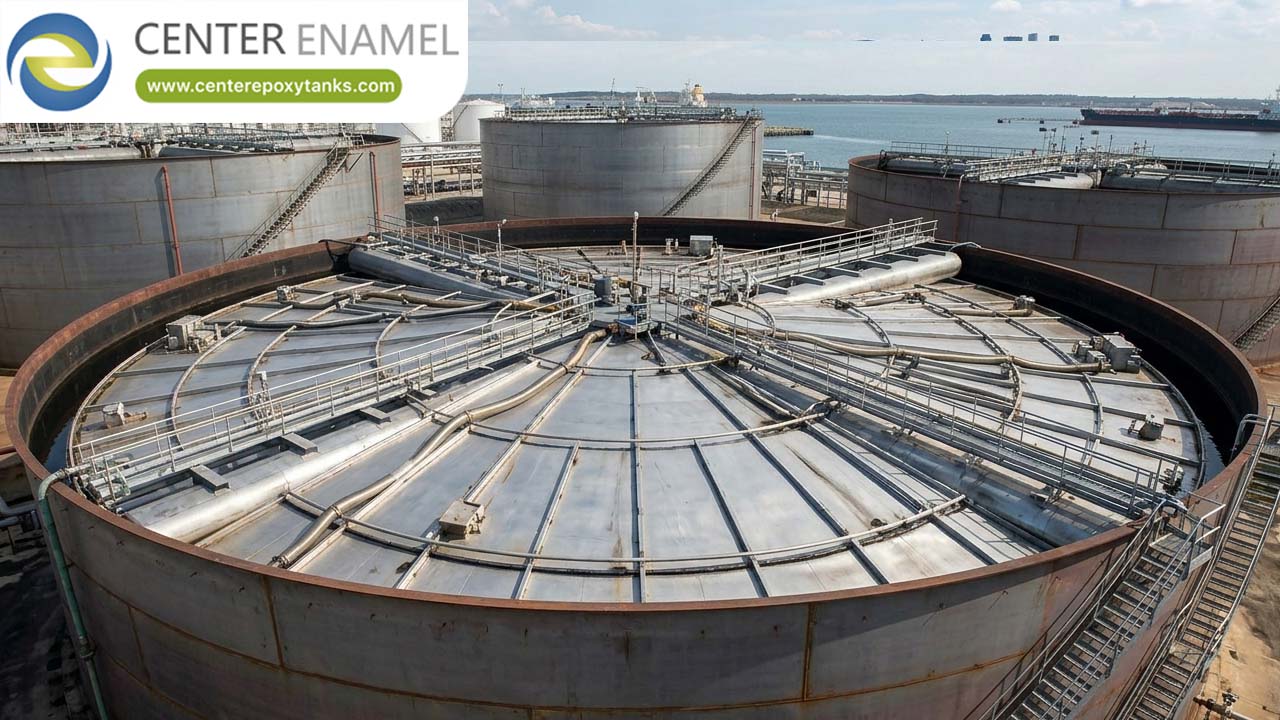
What is an External Floating Roof Tank (EFRT)?
An External Floating Roof Tank (EFRT) is an industrial storage vessel characterized by an open-topped cylindrical steel shell equipped with a roof that floats directly on the surface of the stored liquid. Designed to rise and fall with the liquid level, the floating roof maintains continuous contact with the product, effectively eliminating the vapor space (ullage) above it. This design is the industry standard for large-scale storage of volatile petroleum products—such as crude oil and condensate—because it minimizes product evaporation and significantly reduces the emission of Volatile Organic Compounds (VOCs).
How It Works: The Mechanics of Buoyancy
The core innovation of the EFRT is its ability to adapt to volume changes without allowing a large vapor-air mixture to form.
● Vertical Movement: As the tank is filled, the buoyant roof rises; as it is emptied, the roof descends. Because the roof rests on the liquid, it acts as a mechanical barrier against evaporation.
● Seal Systems: A flexible rim seal system is installed in the annular space between the roof edge and the tank wall. This seal acts as a gasket, preventing vapors from escaping through the gap while allowing the roof to move vertically without friction or binding.
● Drainage: Because the roof is open to the elements, it is equipped with a specialized flexible drain hose or articulated pipe system. This system safely removes rainwater that collects on top of the roof, funneling it out of the tank without exposing the stored product to the atmosphere.
Strategic Benefits for Industrial Storage
1. Emission Control
Fixed-roof tanks suffer from "breathing losses" due to temperature-induced vapor expansion. EFRTs eliminate the vapor space, reducing evaporative losses by up to 90–98% when equipped with proper secondary seals. This is essential for meeting modern environmental regulations (e.g., EPA standards).
2. Operational Safety
By eliminating the vapor space, EFRTs significantly reduce the risk of creating a flammable fuel-air mixture. This design limits the potential for fire and explosion, which is a primary safety concern when storing highly volatile hydrocarbons.
3. Economic Efficiency at Scale
While IFRTs (Internal Floating Roof Tanks) are excellent for smaller diameters or harsh climates, EFRTs are often the most cost-effective solution for massive crude oil terminals where diameters can exceed 60–80 meters. They eliminate the high capital cost of building a large, structural fixed-roof dome.
Comparative Matrix: EFRT vs. IFRT
Engineering Metric | External Floating Roof (EFRT) | Internal Floating Roof (IFRT) |
Top Design | Open-top (Exposed) | Fixed roof (Sheltered) |
Climate Suitability | Stable/Mild climates | Harsh climates (Rain/Snow) |
Diameter Limits | Unlimited (Optimal for large scale) | Typically < 60 meters |
Emission Control | Moderate (Wind impact) | Superior (Double barrier) |
Capital Cost | Lower (No fixed dome) | Higher (Fixed dome structure) |
Best Use | Large-scale Crude Oil terminals | Volatile chemicals/Small tanks |
Frequently Asked Questions (FAQ)
1. Why choose an EFRT over an IFRT?
The choice is usually driven by diameter and scale. If you are building a massive crude oil tank (e.g., 80+ meters in diameter), constructing a fixed roof dome for an IFRT becomes prohibitively expensive. EFRTs provide the most cost-effective storage for high-volume products in regions with stable weather.
2. What happens if the drain system fails on an EFRT?
This is a critical maintenance point. If the drainage system clogs or breaks, rainwater can accumulate on top of the floating roof, increasing the weight and potentially causing the roof to "sink." This is why EFRTs require rigorous inspection schedules and redundant emergency drain systems.
3. Can an EFRT be used in snowy climates?
Generally, no. EFRTs are susceptible to snow accumulation, which puts extreme stress on the roof structure and buoyancy systems. In cold climates, an Internal Floating Roof Tank (IFRT) is almost always the required solution to shield the floating deck from the elements.
4. How does an EFRT help with environmental compliance?
By eliminating the "breathing" space above the liquid, the EFRT prevents the escape of VOCs (Volatile Organic Compounds). Modern EFRTs use double-seal systems to ensure that even at the rim—the point of contact with the tank wall—emissions are kept to a regulatory minimum.
5. Do I need to clean the roof of an EFRT?
While the roof moves with the liquid, it is exposed to the elements. Regular inspections are required to ensure the drain is clear, the seals are intact, and no debris has accumulated that could interfere with the roof's movement or buoyancy.


