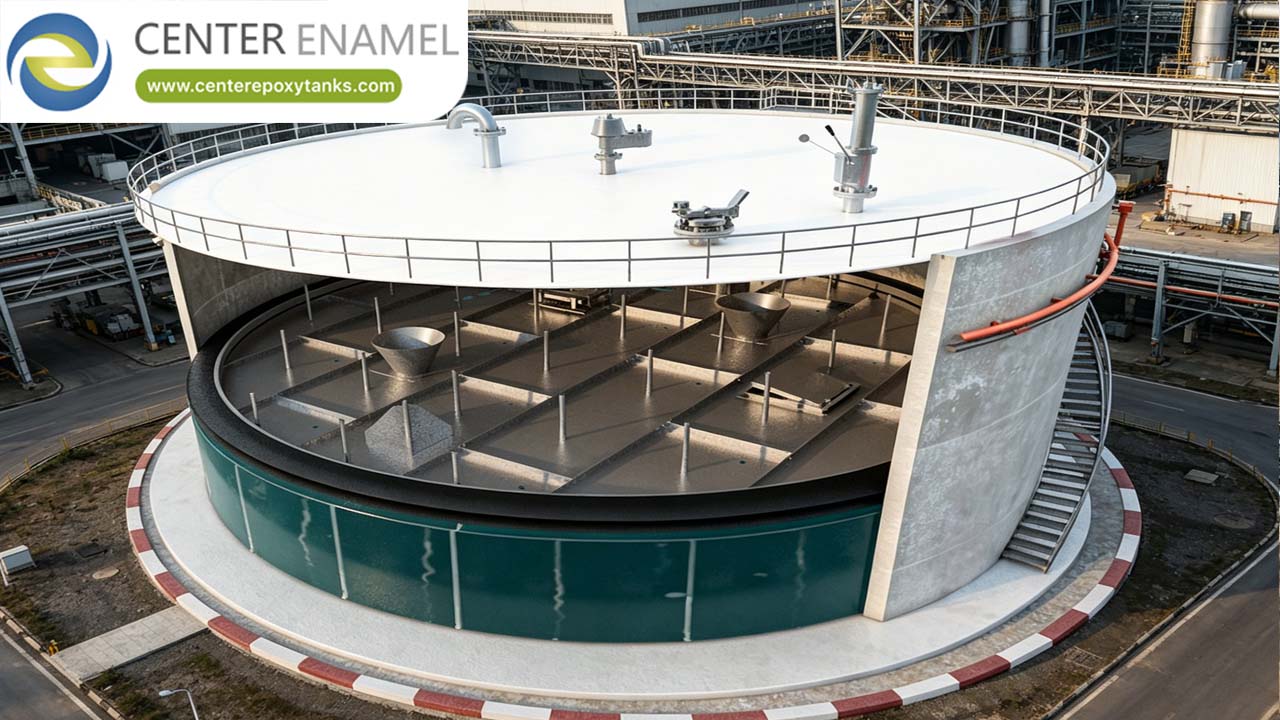
What is an Internal Floating Roof Tank (IFRT)?
An Internal Floating Roof Tank (IFRT) is an aboveground storage vessel that combines a fixed outer roof with an internal floating deck. Unlike external floating roof tanks (EFRTs), which are exposed to the elements, the IFRT’s floating deck sits directly on the surface of the stored liquid inside a protected, enclosed environment. This design creates a double-barrier effect that virtually eliminates the vapor space above the liquid, making it the industry standard for controlling volatile organic compound (VOC) emissions and preventing product evaporation in volatile chemical and petroleum storage.
Engineering Design: The Double-Barrier Advantage
The fundamental engineering logic of an IFRT is to minimize the "ullage" or vapor space—the air gap between the liquid and the tank roof. By reducing this space, the tank prevents the formation of explosive vapor mixtures and significantly slows down evaporation.
How It Functions
● Floating Deck: The internal deck floats directly on the liquid surface. As the liquid level rises or falls during filling or withdrawal, the deck rises and falls with it, maintaining constant contact.
● Fixed Roof: The outer fixed roof (usually a cone or geodesic dome) acts as a structural shell, protecting the internal floating deck from wind, rain, snow, and UV radiation.
● Seal Systems: A primary (and often secondary) rim seal is installed around the circumference of the deck to bridge the narrow gap between the deck and the tank wall, preventing vapors from migrating upward into the fixed-roof space.
Why EPC Professionals Choose IFRTs
For facilities handling highly volatile liquids—such as gasoline, aviation fuel, and various organic solvents—the IFRT is often the preferred choice over the EFRT due to its superior environmental and maintenance profile.
1. Superior Emission Control
Because the floating deck is shielded from wind, the seal system is under much less stress than in an EFRT. This stability ensures tighter vapor containment, making IFRTs highly effective at meeting stringent EPA and global environmental regulations.
2. Protection from Weather
In regions with significant rainfall, snow, or high wind, EFRTs face a high risk of the roof "sinking" due to weight accumulation or drain failure. The IFRT’s fixed roof eliminates this risk entirely, reducing the need for complex, failure-prone roof drainage systems.
3. Longer Component Life
Since the floating deck and rim seals are protected from direct sunlight (UV) and weather, they typically experience slower degradation than those in external systems. This translates to lower long-term maintenance costs and less frequent seal replacement.
Comparison: Internal Floating Roof Tank (IFRT) vs. External (EFRT)
Feature | Internal Floating Roof Tank (IFRT) | External Floating Roof Tank (EFRT) |
Top Design | Fixed outer roof (Enclosed) | Open-top (Exposed) |
Climate Resilience | High (Sheltered from snow/rain) | Low (Vulnerable to weather) |
Diameter Limits | Typically < 60 meters | Unlimited (Optimal for large scale) |
Emission Control | Superior (Double-barrier protection) | Moderate (Wind impact on seals) |
Maintenance | Lower (Sheltered components) | Higher (Requires roof drain upkeep) |
Primary Use | Volatile liquids/Harsh climates | Massive crude oil terminals |
Frequently Asked Questions (FAQ)
1. Why does an IFRT have a fixed roof if it also has a floating deck?
The fixed roof serves two purposes: structural protection and environmental shielding. It prevents rain, snow, and debris from accumulating on the floating deck (which could cause it to sink) and protects the deck’s seals from UV radiation and weathering, significantly extending their service life.
2. Can I use an IFRT for large-scale crude oil storage?
Yes, but economics often dictate the choice. As tank diameters scale beyond 60 meters, the cost of building a large-span fixed dome roof for an IFRT becomes prohibitively expensive. For massive, multi-million-barrel terminals, EFRTs are typically used due to their lower capital expenditure (CAPEX) for large-diameter storage.
3. Are there different types of internal floating decks?
Yes. Common types include:
● Pontoon-style: Floating decks supported by buoyancy pontoons.
● Full-contact/Pan-style: Decks that rest entirely on the liquid surface to completely eliminate vapor space.
● Aluminum/Stainless Steel: These materials are chosen based on the chemical compatibility of the product being stored (e.g., stainless steel for corrosive chemicals).
4. How does an IFRT compare to a standard fixed-roof tank?
A standard fixed-roof tank (without a floating deck) is essentially a large, empty drum. The space above the liquid is constantly filling with flammable or toxic vapors. An IFRT is a massive upgrade in safety and environmental performance because it removes that "vapor pocket" entirely.
5. What is the most important maintenance task for an IFRT?
Regular inspection of the rim seals and floating deck integrity is critical. If the seal fails or the deck is compromised, vapors will accumulate in the fixed-roof space, creating a hazardous, potentially explosive atmosphere that requires immediate remediation.


