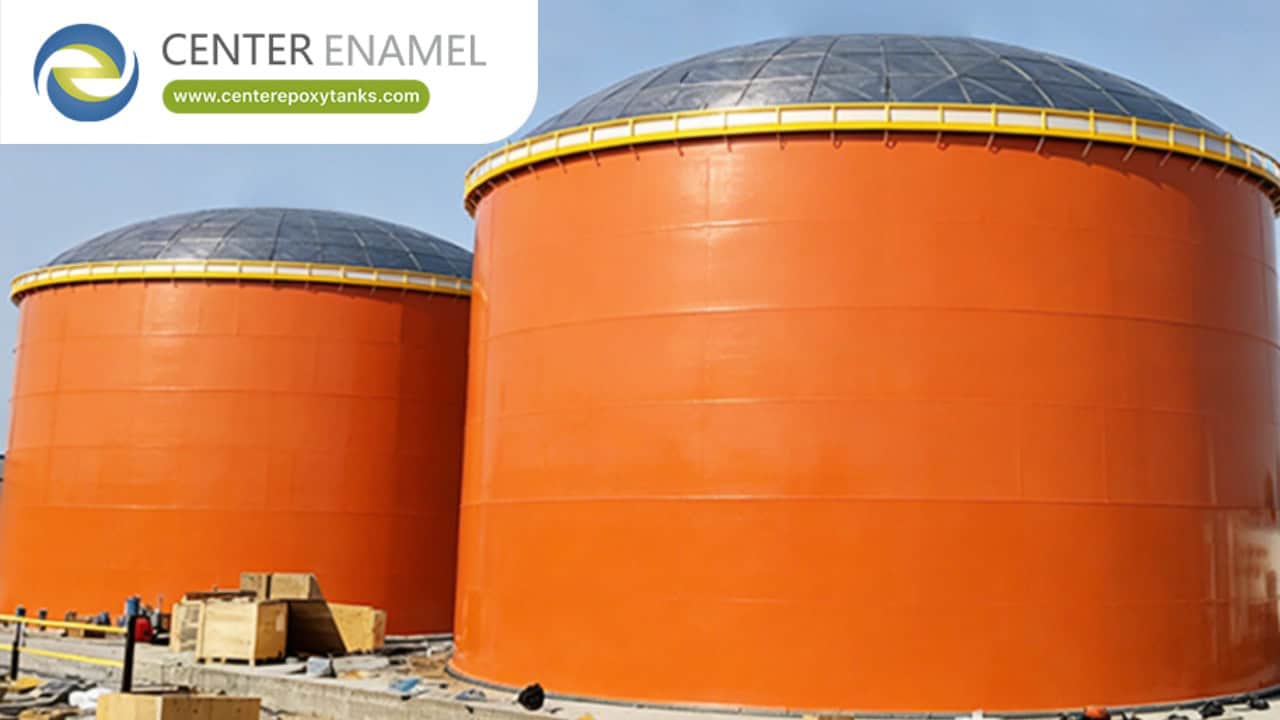
What is an Atmospheric Storage Tank?
An atmospheric storage tank is a large-scale industrial container designed to hold liquids at internal pressures ranging from ambient atmospheric pressure up to a maximum of 0.5 psi gauge (psig). Unlike pressurized vessels, these tanks are vented directly to the surrounding environment to continuously balance internal and external pressure.
These vessels are the backbone of bulk liquid containment, ranging from 5,000 to over 5,000,000 gallons. They are deployed globally for petroleum refineries, municipal water towers, anaerobic digesters, and industrial wastewater engineering projects.
How Atmospheric Tanks Work: The Venting Mechanism
Atmospheric tanks are not completely sealed; they function through a continuous balance between liquid volume, vapor space, and outside air. A central venting system prevents the thin walls of the tank from rupturing or collapsing due to two primary pressure changes:
Thermal Breathing (Standing Losses): As ambient temperatures rise during the day, the stored liquid and vapor expand, increasing internal pressure. The vent releases this excess vapor. At night, the vapors cool and contract, and the vent draws outside air in to prevent a vacuum from collapsing the tank walls.
Working Losses: When pumps rapidly fill the tank, the incoming liquid displaces vapor out through the vent. Conversely, draining the tank creates a partial vacuum, pulling air inside.
API 650 Standards & Material Selection
The definitive international baseline for designing, fabricating, and inspecting these vessels is API 650. While API 620 covers low-pressure tanks (up to 15 psig), API 650 dictates the strict requirements for atmospheric and near-atmospheric welded tanks.
API 650 dictates requirements for wall thickness, foundation design, and welding protocols based on environmental loads (wind, seismic) and the specific gravity of the stored fluid. While API 650 traditionally specifies carbon steel, stainless steel, and aluminum, modern industrial storage increasingly relies on specialized materials depending on the application:
Material Type | Primary Application | Key Advantage |
Carbon Steel | Crude oil, refined petroleum, fuel oil | High structural strength and cost-effectiveness for hydrocarbons. |
Stainless Steel | Corrosive chemicals, specialty organics | Resists chemical degradation; ideal for specialized refining processes. |
Glass-Fused-to-Steel (GFS) | Industrial wastewater, anaerobic digesters, biogas | Exceptional resistance to harsh biological and chemical environments; rapid on-site assembly. |
Fixed Roof vs. Floating Roof Tanks
The volatility of the stored liquid dictates the tank's roof architecture.
Fixed Roof Tanks (Cone or Dome): The roof is permanently welded to the shell. These are utilized for low-volatility liquids such as water, wastewater, biofuels, and heavy fuel oils.
Floating Roof Tanks (Internal or External): The roof rests directly on the surface of the liquid, rising and falling with the fluid level. By eliminating the vapor space above the liquid, floating roofs minimize volatile organic compound (VOC) emissions by up to 99%. These are mandatory for highly volatile hydrocarbons like aviation fuel, naphtha, and gasoline.
Explore the parameters that dictate tank selection using the tool below:
Frequently Asked Questions (FAQ)
What is the difference between an API 650 and an API 620 tank?
API 650 governs atmospheric tanks operating at internal pressures up to 0.5 psig (and occasionally up to 2.5 psig under specific appendices). API 620 covers large, welded, low-pressure storage tanks designed for higher internal pressures ranging from 2.5 psig up to 15 psig, commonly used for liquefied natural gas (LNG) and cryogenic substances.
Can atmospheric tanks operate without a venting system?
No. Because atmospheric tanks possess relatively thin walls, they are highly vulnerable to both overpressure and vacuum. A failure to vent during rapid fluid withdrawal or sudden thermal drops can cause the massive steel shell to instantaneously buckle and implode.
Why are internal floating roofs (IFR) preferred for aviation fuel?
An internal floating roof combines a fixed outer weather roof with an internal deck that floats on the fuel. The fixed roof prevents rain, dust, and windborne debris from contaminating the sensitive jet fuel, while the floating deck suppresses combustible vapors and eliminates wind-driven evaporative losses.


