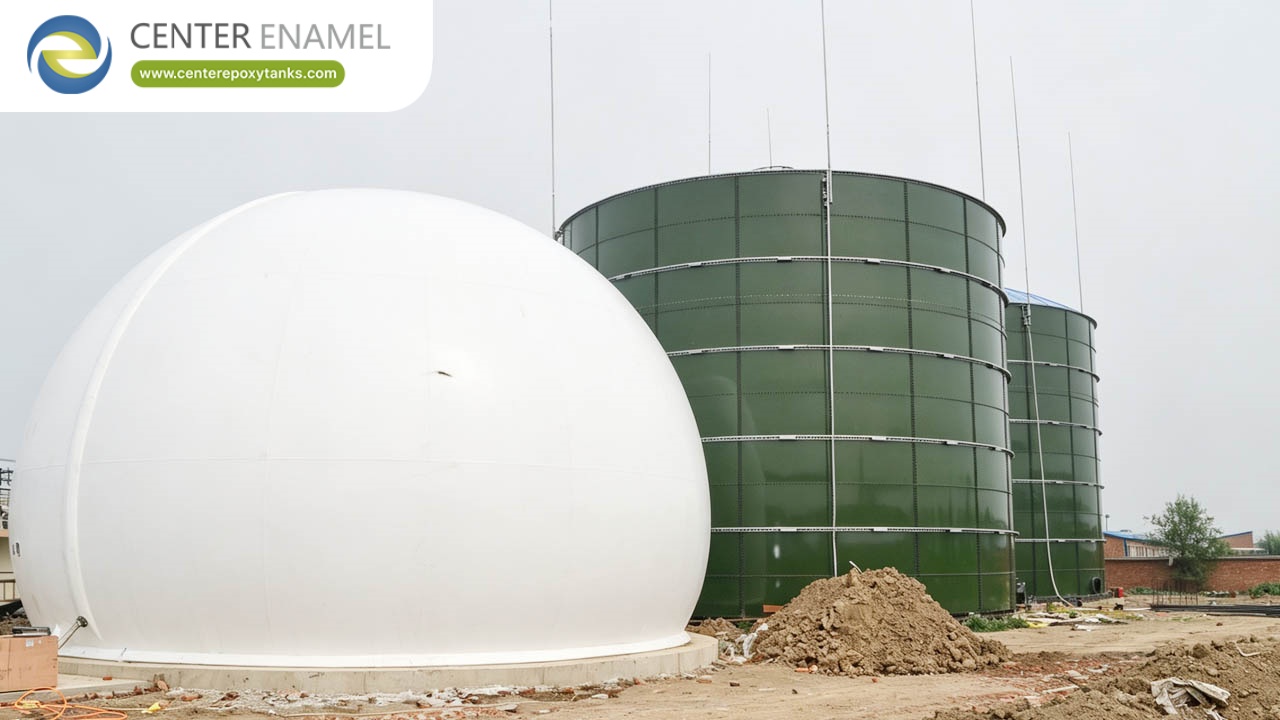
What is an Anaerobic Digestion Tank?
An anaerobic digestion tank is the process vessel of an anaerobic digestion plant: a cylindrical tank sized by hydraulic retention time (HRT) — commonly 15 to 30 days — and organic loading rate (OLR), designed to hold warm feedstock in contact with a stable population of methane-forming bacteria.
Beyond simple volume, a digestion tank integrates gas-tight construction, structural mounting for mixers, heating loops that hold mesophilic or thermophilic temperature, and instrumentation ports for level, temperature, and gas pressure. Epoxy coated bolted steel digestion tanks deliver all of it as a factory-manufactured package: panels coated and holiday-tested before shipment, assembled on site in weeks, and engineered to AWWA D103-09 for a 30+ year service life.
How Digestion Tank Design Decides Plant Performance
Tank design errors surface as chronic plant problems: short-circuiting feed that exits unreacted, dead zones that fill with grit, cold spots that suppress biology, and gas roofs that fail under vacuum or overpressure.
l Undersized HRT leaves volatile solids undigested and gas revenue unrealized.
l Poor mixing integration creates stratification and scum crust formation.
l Coatings damaged during site fabrication become the first corrosion failures in H2S service.
The Engineering and Fusion-Bonding Process
Digestion tank quality is fixed in the factory through an automated coating and testing sequence:
1. Surface Preparation (Shot Blasting): Premium structural steel plates undergo automated grit or shot blasting to achieve a pristine anchor profile, removing all rust, mill scale, oils, and surface impurities.
2. Electrostatic Powder Application: Specialized thermoset epoxy powder is applied uniformly across both sides of the steel panels using automated electrostatic spray equipment.
3. Thermal Cross-Link Curing: The coated sheets pass through precision tunnel ovens (150°C to 250°C), where the epoxy powder melts, flows, and chemically cross-links into a dense, continuous protective polymer film.
4. Rigorous Quality Control & Holiday Testing: Every individual panel undergoes strict dry film thickness verification and high-voltage holiday spark testing (typically at 1,100V to 1,500V) to guarantee absolute zero pinholes or micro-discontinuities.
Technical Performance Matrix: Anaerobic Digestion Tank Construction
Technical Parameter | Epoxy Coated Bolted Steel Digestion Tanks | Concrete Digestion Tanks | Welded Steel Digestion Tanks |
Design Flexibility | Diameter, height, and mixer interfaces tailored to HRT and loading | Geometry constrained by civil engineering economics | Flexible geometry but coating limits interior features |
Gas-Tight Integrity | Engineered gasketed joints and membrane roof options | Creep and thermal cracking admit air over time | Seams sound; penetrations and coatings are weak points |
Corrosion Performance | Factory-fused FBE lining tested on every panel | Requires lining systems with limited service intervals | Site coatings fail early in warm H2S atmospheres |
Schedule & Expansion | Weeks on site; capacity added with panel courses | Seasonal civil program; no practical expansion | Long fabrication; expansion requires major works |
Anaerobic Digestion Tank Applications
l Complete-mix digestion vessels for manure, food waste, and sludge plants
l Contact digesters and anaerobic reactors for industrial wastewater
l Secondary digestion and post-digestion gas collection tanks
l Blending and pre-homogenization tanks feeding the main digester
l High-rate anaerobic systems (UASB/IC) package tankage
l Co-digestion capacity added to existing wastewater plants
Key Advantages of Epoxy Coated Digestion Tanks
1. Sized Precisely to Biology, Not to Civil Convenience
Modular panel geometry lets tank diameter and height be tuned to the calculated HRT and loading rate, maximizing gas yield per unit of feedstock instead of compromising to the nearest pour-able concrete form.
2. Proven Gas-Tight, Corrosion-Resistant Envelope
Factory-tested FBE panels plus engineered gasket joints and membrane roofs keep the digestion atmosphere contained and the steel protected — the two conditions digestion service demands above all.
3. Fast, Phased Construction
Tank packages arrive as kits and erect beside live plant, letting digestion capacity be added or re-arranged as feedstock contracts evolve.
Quality Standards and Proven References
Center Enamel's epoxy coated and glass-fused-to-steel tanks are engineered in strict accordance with AWWA D103-09, OSHA, ISO 28765, and EN 1090, and manufactured under ISO 9001 and ISO 45001 certified quality systems. As the first manufacturer of glass-fused-to-steel tanks in China — holding nearly 200 enameling patents — Center Enamel has delivered bolted tank projects to more than 100 countries, including a 16,760 m³ biogas project in Inner Mongolia and wastewater and biogas references for global environmental leaders such as Paques and Veolia.
Frequently Asked Questions (FAQ)
Q: How is an anaerobic digestion tank sized?
A: Primary sizing comes from hydraulic retention time — typically 15 to 30 days for wet digestion — cross-checked against organic loading rate so the biology receives feed at a stable, digestible rate.
Q: Do digestion tanks need mixing and heating?
A: Yes for complete-mix designs: mixing prevents stratification and scum, while heating maintains the 35°C to 40°C mesophilic or 50°C to 55°C thermophilic band; tank structures are engineered for both systems.
Q: Can a digestion tank be expanded later?
A: Bolted steel digestion tanks extend by adding panel courses or replicate as parallel trains, one of the decisive advantages over cast-in-place concrete vessels.
Q: What is the expected lifespan of an epoxy coated digestion tank?
A: When manufactured in strict compliance with international design codes (such as AWWA D103) and properly maintained, an epoxy coated digestion tank is engineered for a dependable operational lifespan exceeding 30 years.


