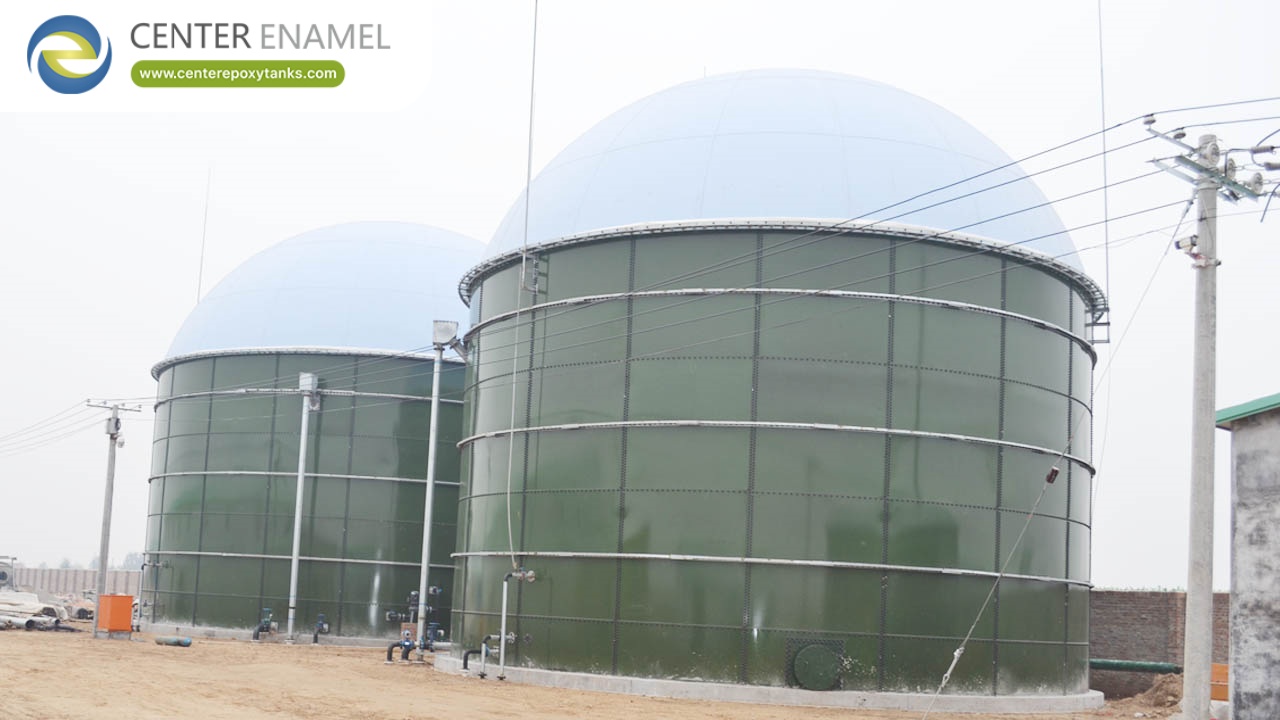
What is an Anaerobic Digester?
An anaerobic digester is the core process unit of a waste-to-energy system: a sealed, heated, mixed vessel where anaerobic microorganisms consume biodegradable material — manure, sewage sludge, food waste, crop residues, and industrial effluents — and release biogas, typically 55% to 70% methane.
The digester delivers three outputs at once: renewable energy (biogas for power, heat, or biomethane), volume and odor reduction of the original waste (volatile solids reduction commonly 40% to 60%), and digestate, a stabilized, nutrient-rich fertilizer. Because the process must exclude oxygen while resisting a warm, sulfurous, continuously agitated environment, modern digesters are built on epoxy coated bolted steel tank platforms engineered to AWWA D103-09 and related codes.
Why Anaerobic Digesters Need Serious Engineering
Anaerobic digestion is biology at industrial scale: the reactor must hold temperature within a few degrees, mix feedstock uniformly, and never admit air — all while the contents actively corrode the vessel that contains them.
l Oxygen ingress at any point suppresses methane production and creates explosive gas mixtures in the headspace.
l H2S and ammonia in the digester atmosphere corrode unprotected steel and concrete structures rapidly.
l Feedstock variability demands flexible tank sizing and the ability to add digesters as volumes grow.
The Engineering and Fusion-Bonding Process
Anaerobic digester tanks are protected by an automated factory coating sequence applied before site assembly:
1. Surface Preparation (Shot Blasting): Premium structural steel plates undergo automated grit or shot blasting to achieve a pristine anchor profile, removing all rust, mill scale, oils, and surface impurities.
2. Electrostatic Powder Application: Specialized thermoset epoxy powder is applied uniformly across both sides of the steel panels using automated electrostatic spray equipment.
3. Thermal Cross-Link Curing: The coated sheets pass through precision tunnel ovens (150°C to 250°C), where the epoxy powder melts, flows, and chemically cross-links into a dense, continuous protective polymer film.
4. Rigorous Quality Control & Holiday Testing: Every individual panel undergoes strict dry film thickness verification and high-voltage holiday spark testing (typically at 1,100V to 1,500V) to guarantee absolute zero pinholes or micro-discontinuities.
Technical Performance Matrix: Anaerobic Digester Construction
Technical Parameter | Epoxy Coated Bolted Steel Digesters | Cast-in-Place Concrete Digesters | Covered Lagoon Digesters |
Process Control | Heated, mixed, true complete-mix digestion with full instrumentation | Heating and mixing possible but structurally demanding | Ambient, unmixed, and climate-dependent biology |
Gas Yield & Quality | High, stable methane output with gas-tight collection | Gas-tightness unreliable as concrete creeps and cracks | Low seasonal yield; gas often flared or vented |
Footprint & Land Use | Compact vertical tanks free land for feedstock and digestate storage | Large buried footprint, permanent land commitment | Very large area; exclusion from other uses |
Build Speed & Expansion | Weeks to erect; expandable tank by tank | Multi-month civil program | Fast to cover but low throughput per hectare |
Anaerobic Digester Applications
l Municipal wastewater sludge stabilization and energy recovery
l Livestock manure and slurry digestion on farms
l Source-separated food waste digestion for cities and processors
l Brewery, distillery, dairy, and slaughterhouse effluent treatment
l Agro-industrial wastewater with high organic load (COD)
l Co-digestion hubs blending multiple regional feedstocks
Key Advantages of Epoxy Coated Anaerobic Digesters
1. Maximum Energy From Every Ton of Waste
Complete-mix, heated digestion converts 40% to 60% of volatile solids into biogas — several times the yield of ambient lagoon systems — turning waste management into an energy business.
2. Gas-Tight Steel Construction, Factory Verified
Gasketed bolted joints and tested membrane roofs keep methane inside the system, while the FBE lining resists the H2S and ammonia that attack lesser vessels above and below the liquid line.
3. Modular Plants That Scale With Feedstock
Digesters are added as parallel bolted steel trains as waste contracts grow — capacity expansion measured in weeks, without the civil works of concrete reactor programs.
Quality Standards and Proven References
Center Enamel's epoxy coated and glass-fused-to-steel tanks are engineered in strict accordance with AWWA D103-09, OSHA, ISO 28765, and EN 1090, and manufactured under ISO 9001 and ISO 45001 certified quality systems. As the first manufacturer of glass-fused-to-steel tanks in China — holding nearly 200 enameling patents — Center Enamel has delivered bolted tank projects to more than 100 countries, including a 16,760 m³ biogas project in Inner Mongolia and wastewater and biogas references for global environmental leaders such as Paques and Veolia.
Frequently Asked Questions (FAQ)
Q: What feedstocks suit an anaerobic digester?
A: Manure and slurry, sewage sludge, food waste, greases, energy crops, silage, and high-COD industrial effluents; most plants blend several feedstocks to balance nutrients and gas yield.
Q: What are the outputs of anaerobic digestion?
A: Biogas for CHP power and heat or upgrading to biomethane, plus digestate — a low-odor, nutrient-stabilized fertilizer with 30% to 50% less volume to handle than raw feedstock.
Q: Is an anaerobic digester the same as a biogas digester?
A: Yes — biogas digester is the industry term for an anaerobic digester operated primarily for energy production; both describe the same sealed biological reactor.
Q: What is the expected lifespan of an epoxy coated anaerobic digester?
A: When manufactured in strict compliance with international design codes (such as AWWA D103) and properly maintained, an epoxy coated anaerobic digester is engineered for a dependable operational lifespan exceeding 30 years.


