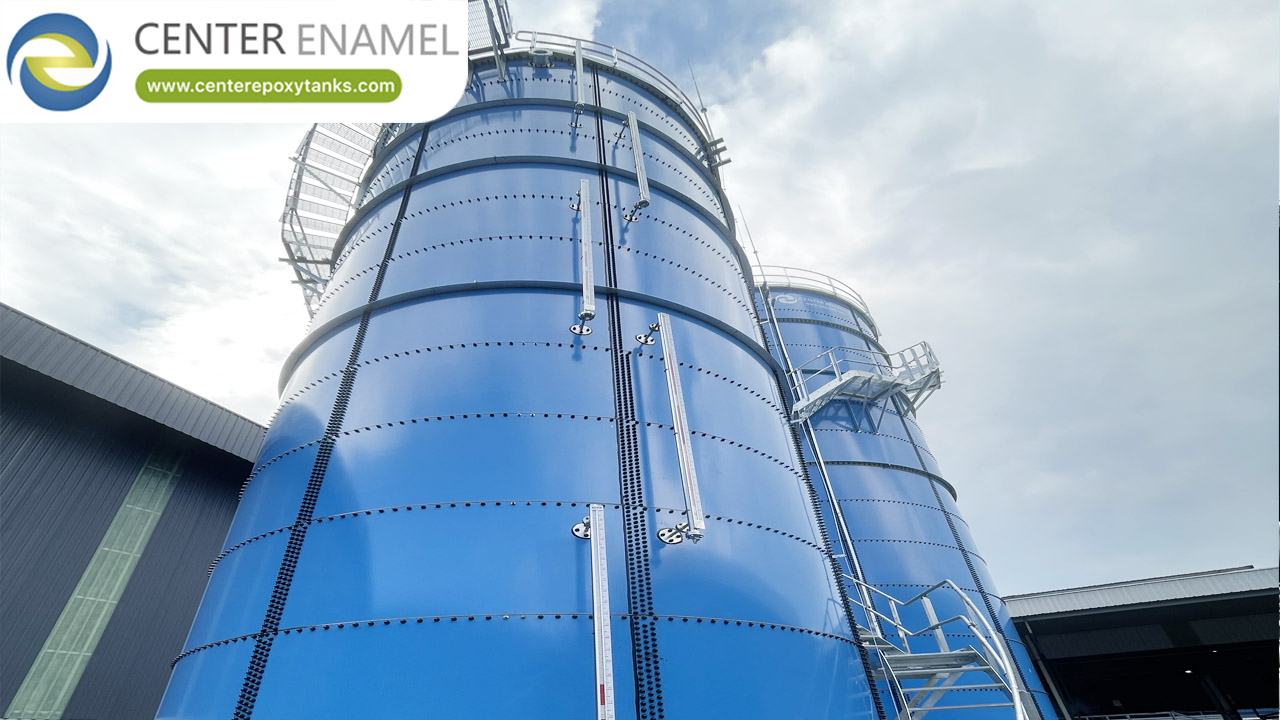
What is a Wastewater Digestion Tank?
A wastewater digestion tank is the heart of sludge treatment at a municipal or industrial wastewater plant: primary and secondary sludge are pumped into a heated, mixed, oxygen-free vessel where anaerobic bacteria reduce volatile solids by 40% to 60%, destroy pathogens, and release biogas that typically powers much of the plant itself.
The duty is severe. The tank runs at 35°C to 55°C around the clock, its headspace carries warm H2S-rich gas, and its structure carries mixers, heat exchangers, and gas collection equipment. Epoxy coated bolted steel digestion tanks are engineered precisely for this service: factory-fused corrosion barriers on every panel, structural design to AWWA D103-09 for all mounted loads, and modular construction that lets utilities add digestion capacity beside live plant.
What Wastewater Utilities Gain From Digestion
Sludge handling is usually the largest single operating cost at a treatment works; digestion attacks that cost from both directions at once.
l Volatile solids reduction of 40% to 60% cuts the sludge volume hauled off site.
l Biogas from digestion typically powers CHP units covering a large share of plant electricity and heat.
l Stabilized, low-odor digestate simplifies biosolids reuse and disposal compliance.
The Engineering and Fusion-Bonding Process
Digestion tank panels receive their corrosion protection in a verified factory sequence:
1. Surface Preparation (Shot Blasting): Premium structural steel plates undergo automated grit or shot blasting to achieve a pristine anchor profile, removing all rust, mill scale, oils, and surface impurities.
2. Electrostatic Powder Application: Specialized thermoset epoxy powder is applied uniformly across both sides of the steel panels using automated electrostatic spray equipment.
3. Thermal Cross-Link Curing: The coated sheets pass through precision tunnel ovens (150°C to 250°C), where the epoxy powder melts, flows, and chemically cross-links into a dense, continuous protective polymer film.
4. Rigorous Quality Control & Holiday Testing: Every individual panel undergoes strict dry film thickness verification and high-voltage holiday spark testing (typically at 1,100V to 1,500V) to guarantee absolute zero pinholes or micro-discontinuities.
Technical Performance Matrix: Wastewater Digestion Tank Construction
Technical Parameter | Epoxy Coated Bolted Steel Digesters | Cast-In-Place Concrete Digesters | Steel Digesters, Field-Coated |
Corrosion Resistance in H2S Service | Factory-fused FBE barrier tested on every panel | Acid attack on matrix; lining systems required | Site coatings degrade in warm digester gas |
Gas-Tightness | Gasketed joints with tested membrane roofs | Creep and cracking admit air over service life | Welds sound; coatings fail at seams first |
Mixer & Equipment Loads | Structure engineered for mixers, heat loops, gas kit | Torque cracking risk under long-term mixing | Structurally adequate; coating damage at penetrations |
Retrofit & Expansion | Added beside live plant in weeks | Major civil program inside a working site | Slow fabrication, hot-work complications |
Wastewater Digestion Tank Applications
l Primary and secondary sludge co-digestion at municipal works
l Food waste co-digestion boosting municipal gas output
l Thermal hydrolysis integration and pre/post-digestion vessels
l Industrial biological sludge digestion at production sites
l Secondary digesters and gas-tight post-digestion storage
l Plant energy self-sufficiency programs feeding CHP units
Key Advantages of Epoxy Coated Wastewater Digestion Tanks
1. Attack the Biggest Cost Line in Treatment
By cutting sludge volume 30% to 50% while generating renewable power for the works, digestion tanks pay back through two of the plant's largest budgets simultaneously.
2. Built for the Most Corrosive Corner of the Plant
Panel-level holiday testing and an inert FBE lining protect against the warm, sulfurous digester atmosphere that destroys site-coated steel and cracks concrete.
3. Retrofit Without Shutdown
Bolted erection beside live process units — no hot work, no formwork, no multi-month civil program inside an operating treatment works.
Quality Standards and Proven References
Center Enamel's epoxy coated and glass-fused-to-steel tanks are engineered in strict accordance with AWWA D103-09, OSHA, ISO 28765, and EN 1090, and manufactured under ISO 9001 and ISO 45001 certified quality systems. As the first manufacturer of glass-fused-to-steel tanks in China — holding nearly 200 enameling patents — Center Enamel has delivered bolted tank projects to more than 100 countries, including a 16,760 m³ biogas project in Inner Mongolia and wastewater and biogas references for global environmental leaders such as Paques and Veolia.
Frequently Asked Questions (FAQ)
Q: How much sludge volume does digestion save?
A: Anaerobic digestion typically reduces volatile solids by 40% to 60%, cutting total sludge mass for dewatering and disposal by roughly 30% to 50% depending on feed solids.
Q: Can wastewater plants co-digest food waste?
A: Yes — co-digestion of food waste with sewage sludge significantly raises biogas output; plants commonly add bolted steel reception and buffer tanks alongside existing digesters to do it.
Q: Can digestion capacity be added to an existing works?
A: Bolted steel digesters install beside live plant in weeks, making them the standard choice for utility capacity upgrades and energy self-sufficiency projects.
Q: What is the expected lifespan of an epoxy coated wastewater digestion tank?
A: When manufactured in strict compliance with international design codes (such as AWWA D103) and properly maintained, an epoxy coated wastewater digestion tank is engineered for a dependable operational lifespan exceeding 30 years.


