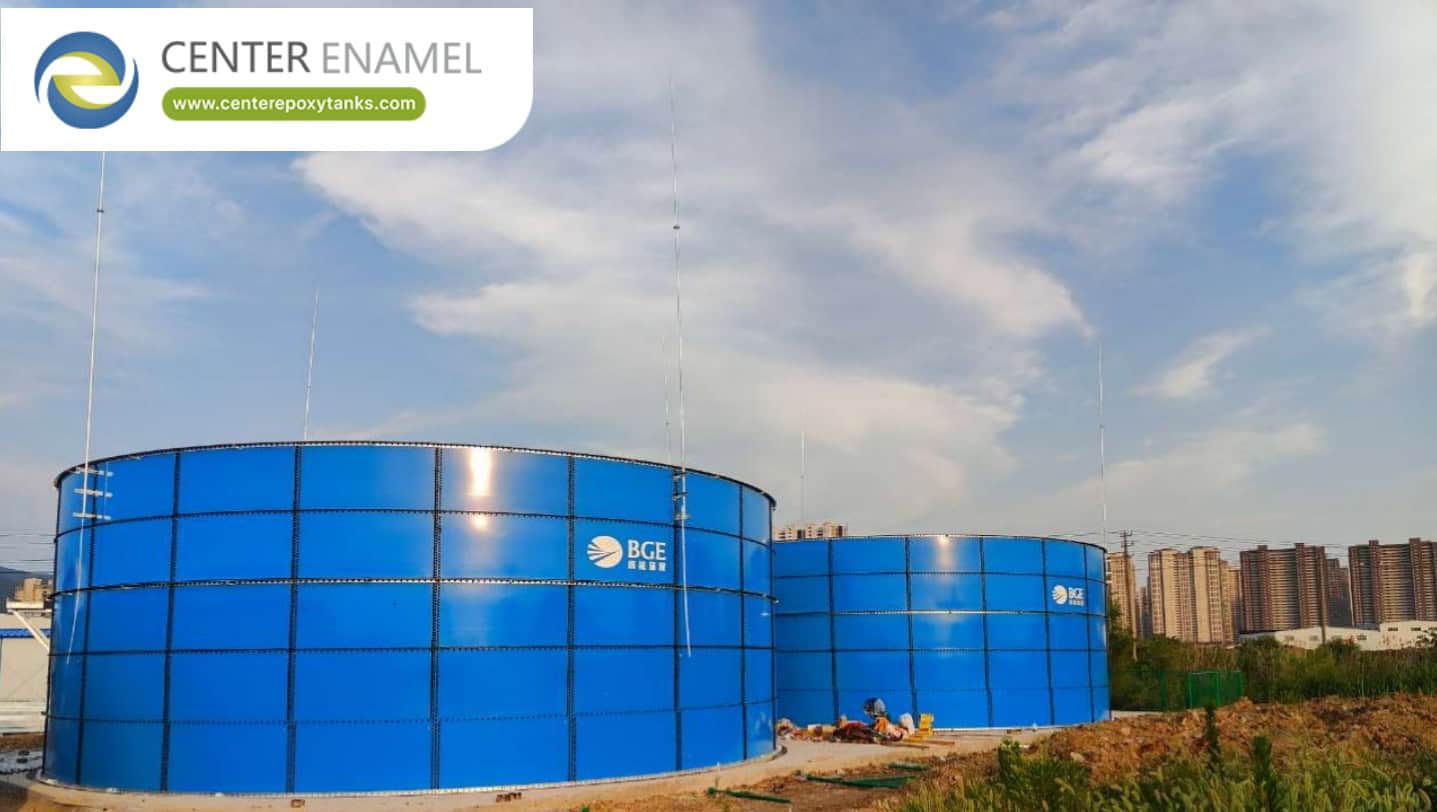
What is a Slurry Tank?
A slurry tank stores liquid agricultural waste — the mixture of animal manure, urine, washing water, and bedding runoff generated by dairy, pig, and beef operations — until conditions allow field spreading, treatment, or use as digester feedstock.
Fresh slurry is aggressively corrosive: ammonia, hydrogen sulfide, and organic acids attack bare steel, while solids settle into compacted crusts unless continuously agitated. Epoxy coated bolted steel slurry tanks pair a factory-fused, chemically inert FBE lining with the structural strength to support powerful agitation systems — and can be built gas-tight to turn stored slurry into a methane-capturing energy asset.
Why Open Slurry Storage Is Being Phased Out
Regulation and economics are moving farms away from earthen lagoons: nitrate directives restrict spreading windows, methane emission rules penalize open storage, and biogas incentives reward sealed, gas-capturing systems.
l Open lagoons lose nitrogen to volatilization and leak nutrients to groundwater.
l Uncovered slurry releases methane — a greenhouse gas roughly 25 times stronger than CO2.
l Concrete stores crack under agitation loads and freeze-thaw cycles.
The Engineering and Fusion-Bonding Process
The corrosion protection of an epoxy coated slurry tank is applied and verified entirely in the factory:
1. Surface Preparation (Shot Blasting): Premium structural steel plates undergo automated grit or shot blasting to achieve a pristine anchor profile, removing all rust, mill scale, oils, and surface impurities.
2. Electrostatic Powder Application: Specialized thermoset epoxy powder is applied uniformly across both sides of the steel panels using automated electrostatic spray equipment.
3. Thermal Cross-Link Curing: The coated sheets pass through precision tunnel ovens (150°C to 250°C), where the epoxy powder melts, flows, and chemically cross-links into a dense, continuous protective polymer film.
4. Rigorous Quality Control & Holiday Testing: Every individual panel undergoes strict dry film thickness verification and high-voltage holiday spark testing (typically at 1,100V to 1,500V) to guarantee absolute zero pinholes or micro-discontinuities.
Technical Performance Matrix: Slurry Storage Technologies
Technical Parameter | Epoxy Coated Bolted Steel Slurry Tanks | Earthen Lagoons | Cast-in-Place Concrete Stores |
Corrosion Resistance | FBE lining resists ammonia, H2S, and organic acids | Bank erosion and liner punctures; leakage risk | Cracking and acid attack on exposed concrete surfaces |
Gas-Tight Capability | Gas-tight construction captures methane for energy use | Open storage; methane and ammonia vent to atmosphere | Difficult to seal; gas-tight covers rarely achieved |
Agitation & Equipment Loads | Steel walls engineered for mounted agitators and pump decks | No mounting capability; agitation by floating units only | Agitation torque cracks walls over time |
Expansion & Relocation | Modular panels add capacity or relocate with the farm | Fixed footprint; expansion means new earthworks | Permanent structure; expansion impractical |
Slurry Tank Applications
l Dairy and cattle slurry storage ahead of seasonal field spreading
l Pig slurry holding in flushed or scraped manure systems
l Feedstock buffering and blending for farm-scale biogas plants
l Digestate return storage on anaerobic digestion facilities
l Yard and parlour wash-down water containment
l Slurry separation and thickening feed tanks
Key Advantages of Epoxy Coated Slurry Tanks
1. Sealed Storage That Turns Waste Into Energy
Gas-tight bolted slurry tanks qualify for biogas feedstock duty and capture methane that open lagoons lose to the atmosphere — converting a regulatory liability into renewable fuel revenue.
2. Corrosion Protection for the Harshest Barn Chemistry
The cross-linked epoxy barrier isolates steel from ammonia-laden, acidic slurry and wash-down chemicals, maintaining full structural integrity through decades of agitation and empty-refill cycles.
3. Modular Capacity That Grows With the Herd
Panel-based construction lets farms extend storage from hundreds to thousands of cubic meters in stages, matching tank investment to herd expansion and spreading-window regulations.
Quality Standards and Proven References
Center Enamel's epoxy coated and glass-fused-to-steel tanks are engineered in strict accordance with AWWA D103-09, OSHA, ISO 28765, and EN 1090, and manufactured under ISO 9001 and ISO 45001 certified quality systems. As the first manufacturer of glass-fused-to-steel tanks in China — holding nearly 200 enameling patents — Center Enamel has delivered bolted tank projects to more than 100 countries, including a 16,760 m³ biogas project in Inner Mongolia and wastewater and biogas references for global environmental leaders such as Paques and Veolia.
Frequently Asked Questions (FAQ)
Q: What capacities do bolted slurry tanks offer?
A: Modular designs serve farm stores from roughly 200 to more than 60,000 cubic meters, extended in stages by adding panel courses as herd size or regulation requires.
Q: Can a slurry tank be made gas-tight for biogas?
A: Yes. Bolted steel tanks with gasketed joints and engineered membrane roofs are widely used as sealed slurry stores and digester feed vessels, capturing methane for energy recovery.
Q: How is crusting and sedimentation prevented?
A: Tanks are structurally designed for mounted or submersible agitators that resuspend solids before pumping or spreading, with wall loads for agitation duty accounted for at design stage.
Q: What is the expected lifespan of an epoxy coated slurry tank?
A: When manufactured in strict compliance with international design codes (such as AWWA D103) and properly maintained, an epoxy coated slurry tank is engineered for a dependable operational lifespan exceeding 30 years.


