What Is A Sludge Storage Tank? Design, Duty Cycles And WWTP Integration
Sludge is the most misunderstood stream in a wastewater treatment plant. It is dense, it stratifies, it turns septic when it sits, and it punishes every tank that was specified as if it were water. A sludge storage tank is not a water tank with thicker walls — it is a duty-cycle vessel where mixing, cover design, draw-off arrangement and odor control must be engineered as one system.
This article covers the design fundamentals: sludge holding and thickening duties, geometric versus working volume, mixing and odor control, and how the tank integrates into the treatment train.
Sludge Holding Vs Thickening: Two Different Duties
Sludge tanks serve two distinct duties that are frequently conflated. Holding tanks equalize flow and concentration between process steps — they store, and ideally homogenize. Thickening tanks increase solids concentration by gravity or flotation before dewatering — they process, and their design is driven by solids loading rate and surface overflow rate.
A tank asked to do both must be sized for the governing duty, and the operating procedure must acknowledge the transition. The classic error is a holding tank that quietly becomes a thickening tank because dewatering runs on day shift and the tank fills on night shift.
Attribute | Holding / Equalization | Thickening |
Primary function | Store and homogenize | Increase solids concentration |
Design driver | Peak solids load, residence time | Solids loading rate, overflow rate |
Mixing requirement | Homogenize, prevent stratification | Gentle — avoid floc breakage |
Odor regime | High — cover and treat | Moderate — shorter residence |
Draw-off strategy | Mid-depth for blended sludge | Depth-selective for thickened sludge |
Geometric Vs Working Volume
Sludge volume planning starts with solids mass balance, not hydraulic balance. The same dry-solids load occupies wildly different volumes at 0.5 percent and 5 percent solids concentration, and the plant’s blend strategy determines which concentration the tank sees. Working volume must further deduct the heel below the lowest draw-off, the freeboard under the cover, and any dead zones the mixing system cannot reach.
The engineering rule of thumb: size for the peak solids load at the expected concentration, then verify the hydraulic residence time against the odor and septicity constraint. If the answer fails the odor check, the tank needs mixing or cover upgrades — not more volume.
Mixing Regimes And Their Limits
Mixing in sludge tanks is specified against stratification and deposit control, not blending speed. Submersible mixers, recirculation jets and gas mixing each have their place: submersible mixers for equalization and holding, recirculation where pumps already exist, gas mixing where odor is the governing constraint because it adds no shaft penetrations.
Over-mixing is a real failure mode. Excessive agitation breaks sludge floc, releases bound water and can worsen downstream dewatering. The mixing system should be specified with variable speed and commissioned against a measured solids profile — top, middle and bottom sampling — before it is accepted.
Mixing System | Best-Fit Duty | Advantage | Limitation |
Submersible mixer | Equalization, holding | Direct, no shaft seal above liquid | Requires removal path for service |
Recirculation jet | Tanks with existing pumps | No internal rotating equipment | Energy cost, nozzle maintenance |
Gas mixing | Odor-sensitive duties | No shaft penetrations, mixes gently | Gas supply and distribution system |
Top-entry mixer | Intense blending, reaction | High power input | Roof penetration, seal maintenance |
Odor Control And Cover Systems
Septicity begins within hours in an unstirred sludge tank: sulfate reduction releases hydrogen sulfide, and the odor problem arrives before any visible change. The defense is layered: minimize holding time, keep the sludge aerobic where the process allows, cover the tank to contain the atmosphere, and treat the contained air with scrubbers or biofilters.
Cover design interacts with everything else: access hatches for mixer removal, sample ports, level instrumentation and the vent path for the odor treatment system. A cover that blocks maintenance gets propped open, and then the odor system is a decorative element.
Integration In The Treatment Train
The sludge tank sits between the clarifier and the dewatering equipment, and its sizing determines whether the clarifier can actually operate at design sludge blanket depth. Undersized storage forces the clarifier to dump solids faster than dewatering can accept them, and the whole plant’s hydraulics destabilize. The tank is a buffer, and its capacity is a plant-stability decision.
Draw-off design completes the integration: multiple draw-off levels let the operator pull thicker sludge from depth when the tank has stratified, and the piping must be sized for the worst-case solids concentration, not the average.
Coatings And Corrosion In Sludge Service
Sludge service is aggressive to bare steel: hydrogen sulfide attack above the water line, biological corrosion at the sludge interface, and abrasion from grit. Internal coatings — FBE at 400-800 microns, or glass-fused-to-steel panels with their vitreous enamel layer — are the primary defense, with corrosion allowance as the engineered backup.
The splash zone is the failure location that surprises owners: it sees alternating wet-dry exposure, sulfate-reducing bacteria and oxygen all at once. Coating systems must be specified for the splash zone explicitly, with holiday testing before the tank goes into service.
Bolted Vs Concrete Vs Welded
Concrete sludge tanks are durable but slow to build and difficult to modify; welded steel tanks offer size range but field welding in corrosive service is a quality risk; bolted coated tanks bring factory-controlled coating quality, erection measured in weeks, and relocatability. For equalization and holding duties in the size band most wastewater scopes occupy, the bolted configuration is usually the fastest path to a coated, documented asset.
The trade-off is the diameter ceiling and the seismic detailing of panel joints — both manageable within the catalog, both requiring the duty to fit the standard panel range.
Draw-Off And Level Control
Draw-off design decides whether the tank delivers thickened sludge or homogenized sludge. Multiple draw-off levels — top, middle and bottom — let the operator pull from the stratified zone when concentration is the objective and from mid-depth when homogenization is. Piping is sized for the worst-case solids concentration, not the average, because sludge that flows at design concentration will not flow at twice it.
Level instrumentation must handle the foam and crust layer that forms on unstirred sludge; guided-wave radar and other contact technologies report the interface, not the surface, and the difference is where many sludge tank level systems disappoint.
Operation And Maintenance Practice
Operating discipline determines whether the tank ages well: hold time minimized, mixing run against a measured profile rather than a fixed schedule, draw-off levels rotated to prevent localized grit accumulation, and the odor system maintained before complaints arrive. None of this is exotic — it is the same discipline any process vessel requires, applied to a stream that punishes neglect faster than most.
Bolted tanks simplify the maintenance model: gaskets and fasteners are inspectable from outside in hours, and panel replacement is a planned activity rather than a hot-work project.
Dewatering Interfaces And Downstream Duty
The sludge storage tank does not exist alone: it sits between the treatment train and the dewatering equipment, and its discharge condition sets that equipment’s duty. Feed concentration, feed rate stability and the presence of grit or rag all arrive at the belt press, centrifuge or filter as consequences of tank operation. A tank operated to protect the dewatering equipment — grit settled and removed, draw-off from a selected level, concentration held in the target band — performs its interface function whether or not the drawing mentions it.
The interface engineering is straightforward but easily omitted: discharge pumps sized for the worst-case solids concentration with a tolerance for ragging, a strainer or grinder where debris is expected, and a dedicated connection for tanker or skip transfer when mechanical dewatering is offline. Storage is also the buffer that lets dewatering run on its own schedule — daytime operation, weekday operation, or a seasonal campaign — while digestion and clarification continue around the clock.
The duty-cycle question — continuous feed, batch feed or peak shaving — should be settled at design stage, because it sizes the draw-off, the mixing and the storage volume together. Getting it wrong is expensive in one direction or the other: an undersized buffer forces the dewatering plant to track the wastewater flow, and an oversized one becomes a septic hold-up that degrades the feed the equipment actually receives.
Center Enamel Sludge Storage Capability
Center Enamel supplies GFS and epoxy-coated sludge storage in covered and mixed configurations, with wastewater engineering scope spanning municipal and industrial duties. Our panel coating is applied in controlled plant conditions and documented per panel, giving the operating team a verifiable baseline for the splash-zone and sludge-interface exposures that govern service life.
From solids balance through commissioning documentation, our engineering team supports the tank as one component of the treatment train — because that is the only way it performs.
Project Case Study
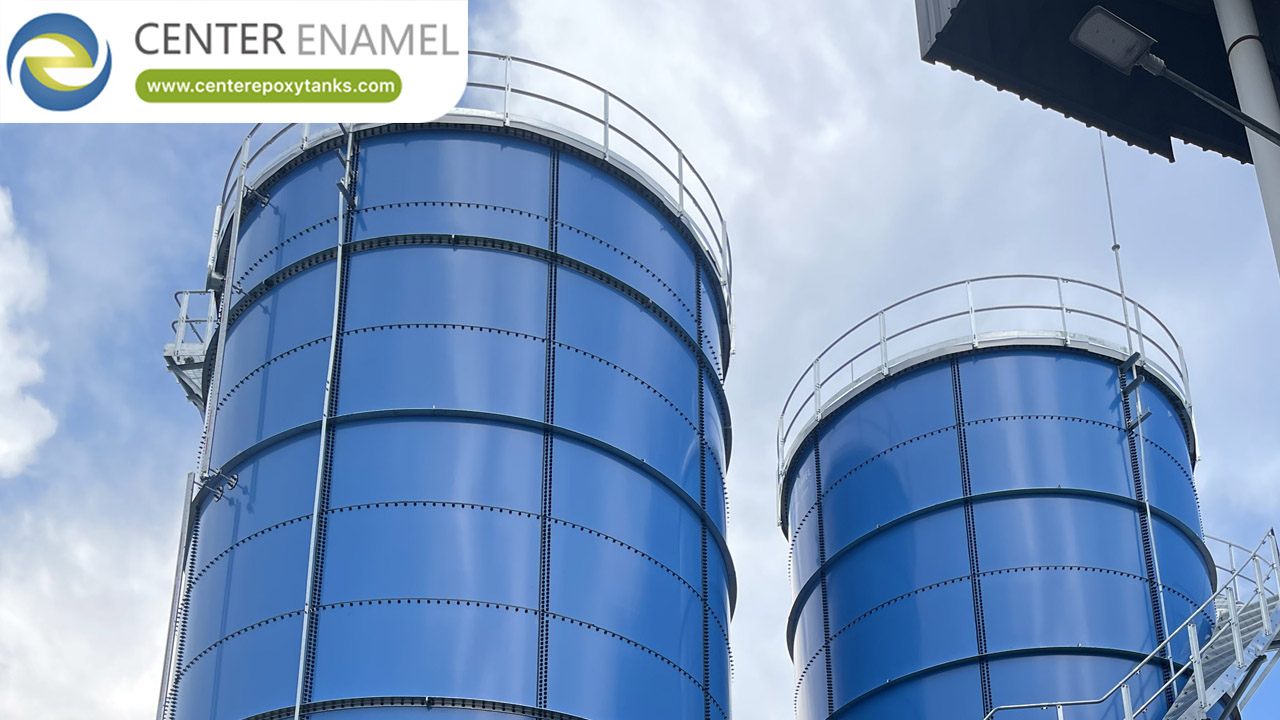
A Canadian dairy processing facility required equalization and holding capacity ahead of its wastewater treatment train, with high-strength organic loading and seasonal production peaks. Center Enamel supplied eight glass-fused-to-steel bolted tanks totaling 6,595 m3: two tanks at 18.34 m diameter by 9.0 m height, and single tanks at 12.23 m, 10.7 m, 5.35 m, 4.59 m and 1.52 m diameter, with the final 1.52 m unit at reduced height.
The multi-specification configuration matched the facility’s flow equalization strategy: large-volume tanks absorb production peaks while smaller units serve buffer and transfer duties. All tanks were factory-coated with GFS panels, bolted on site against the plant’s construction schedule, and delivered complete in November 2025 with coating inspection records for the operating integrity baseline.
Project Reference | 01 Canada Dairy Wastewater 202511 |
Location | Canada |
Application | Industrial Wastewater |
Product / Technology | Glass-Fused-to-Steel (GFS) Bolted Tank |
Tank Count | 8 |
Tank Dimensions | φ18.34*9.0m(H), 2 units; φ12.23*4.8m(H), 1 unit; φ10.7*9.6m(H), 1 unit; φ5.35*10.8m(H), 1 unit; φ4.59*9.6m(H), 1 unit; φ1.52*5.2m(H), 1 unit; φ1.52*3.05m(H), 1 unit |
Total Volume | 6595 m3 |
Completion | Delivered and completed 2025-11 |
Supply Scope Note | A relevance grade to this topic |
About Company
Shijiazhuang Zhengzhong Technology Co.,Ltd(Center Enamel) is a professional manufacturer dedicated to the design and fabrication of bolted storage tanks since 2008. Our products range includes Glass-Fused-to-Steel (GFS) tanks, fusion bonded epoxy tanks, stainless steel tanks, galvanized steel tanks and aluminum geodesic dome roofs. With professional enameling R&D team and nearly 200 enameling patents, Shijiazhuang Zhengzhong Technology Co.,Ltd has become the leader in bolted tanks industry of Asia. Our products are certified to ISO9001, NSF61, EN1090, ISO28765, WRAS ,FM, LFGB, BSCI, IS0 45001 and other international standards.
Shijiazhuang Zhengzhong Technology Co., Ltd is not only the first manufacturer in China which produces Glass-Fused-to-Steel tanks, but also the most experienced professional bolted tanks manufacturer in Asia.The engineering & design, product testing and quality system of Center Enamel Glass-Fused-to-Steel tanks is in strict accordance with AWWA D103-09, OSHA, ISO 28765, NSF/ANSI 61, NFPA and other international standards. Until 2023, Center Enamel bolted tanks have been exported to more than 100 countries including USA, Australia,Canada, Malaysia, Indonesia, Russia, UAE, Panama,Brazil and South Africa etc., the superior tank quality and prompt service gains us worldwide recognition.
As an outstanding containment and cover system provider with decades of industry experience, Shijiazhuang Zhengzhong Technology Co., Ltd sincerely expects to establish long-term cooperation with the local partners throughout the world and make continuous contribution to the development of the industry.
Suggested CTA
Center Enamel delivers epoxy coated / welded steel engineered for sludge handling duty, with wastewater engineering scope, covered and mixed tank configurations. Contact our engineering team for engineering guidance on your next sludge storage tank project — including sizing, standards compliance and delivery scheduling.
Frequently Asked Questions
Q: What is the difference between sludge holding and sludge thickening tanks?
A: Holding tanks equalize flow and concentration between process steps; thickening tanks increase solids concentration before dewatering, with design driven by solids loading and surface overflow rates. A tank asked to do both must be sized for the governing duty.
Q: Why does sludge storage volume not follow hydraulic rules?
A: Because the same dry-solids load occupies different volumes at different concentrations. Volume planning starts from the solids mass balance at the expected concentration, then deducts heel, freeboard and dead zones.
Q: How quickly does unstirred sludge turn septic?
A: Within hours. Sulfate reduction releases hydrogen sulfide before any visible change, which is why odor control, mixing and hold-time management are designed together rather than as add-ons.
Q: What coating is best for sludge service?
A: Internal FBE at 400-800 microns or glass-fused-to-steel panels, with the splash zone specified explicitly — it sees alternating wet-dry exposure, bacteria and oxygen simultaneously. Holiday testing before service is mandatory.
Q: Can mixing be overdone in a sludge tank?
A: Yes. Breaking sludge floc through excessive agitation releases bound water and can push more load onto downstream dewatering. Mixers should be variable-speed and commissioned against a measured solids profile before acceptance.
Q: Why are bolted tanks common for sludge equalization?
A: Factory-controlled coating quality, erection in weeks, relocatability, and external inspectability of gaskets and fasteners. For the size band most wastewater equalization duties occupy, bolted coated tanks are usually the fastest path to a documented asset.


