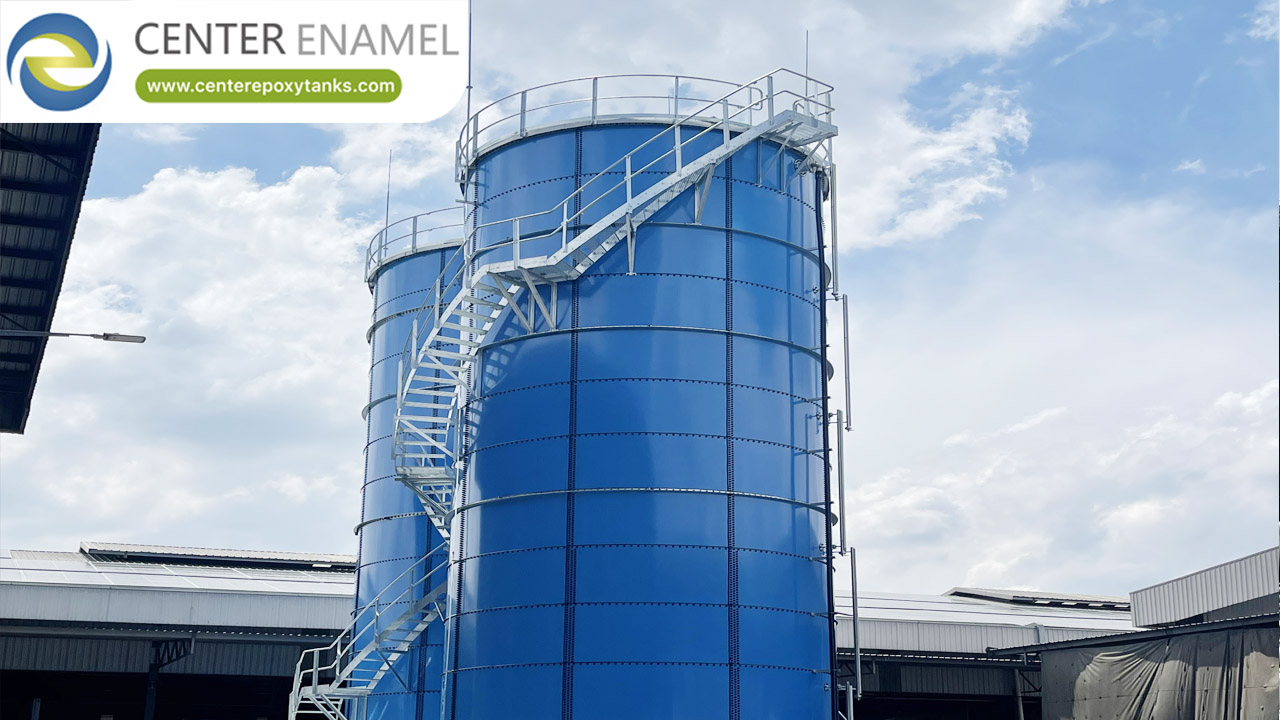
What is a Sewage Treatment Tank?
A sewage treatment tank is a specialized storage and process tank engineered to receive raw sewage, attenuate fluctuating flows, and support treatment stages such as equalization, anaerobic digestion, aeration, and clarification before safe discharge or reuse. At municipal and industrial treatment works, these tanks form the hydraulic and biological backbone of the entire plant.
Sewage is among the most corrosive liquids a tank can hold. Hydrogen sulfide (H2S) generated by anaerobic bacteria combines with moisture to form biogenic sulfuric acid on walls and roofs, aggressively attacking bare steel and degrading concrete. Epoxy coated bolted steel sewage tanks pair high-strength structural steel panels with a factory-fused thermoset epoxy coating, creating a smooth, chemically inert barrier that withstands sewage chemistry, grit abrasion, and continuous biological activity.
Why Sewage Projects Demand Specialized Treatment Tanks
Modern treatment works face tightening discharge consents, variable organic loads, and growing pressure to control odor and emissions. Storage and process vessels that were adequate twenty years ago now corrode, leak, or simply cannot be expanded.
l Cast-in-place concrete basins crack with settlement and temperature cycling, exposing rebar to acid attack.
l Field-welded steel tanks depend on site-applied coatings that weather-dependent workmanship makes unreliable.
l Open lagoons consume valuable land, release odor, and cannot meet modern gas-capture requirements.
The Engineering and Fusion-Bonding Process
The long-term durability of an epoxy coated sewage treatment tank relies on a strict, automated factory-controlled manufacturing workflow:
1. Surface Preparation (Shot Blasting): Premium structural steel plates undergo automated grit or shot blasting to achieve a pristine anchor profile, removing all rust, mill scale, oils, and surface impurities.
2. Electrostatic Powder Application: Specialized thermoset epoxy powder is applied uniformly across both sides of the steel panels using automated electrostatic spray equipment.
3. Thermal Cross-Link Curing: The coated sheets pass through precision tunnel ovens (150°C to 250°C), where the epoxy powder melts, flows, and chemically cross-links into a dense, continuous protective polymer film.
4. Rigorous Quality Control & Holiday Testing: Every individual panel undergoes strict dry film thickness verification and high-voltage holiday spark testing (typically at 1,100V to 1,500V) to guarantee absolute zero pinholes or micro-discontinuities.
Technical Performance Matrix: Sewage Treatment Tank Technologies
Technical Parameter | Epoxy Coated Bolted Steel Sewage Tanks | Cast-in-Place Concrete Basins | Field-Welded Steel Tanks |
Corrosion & H2S Resistance | Factory-fused FBE barrier resists H2S, sulfides, and biological attack on every panel | Prone to cracking and biogenic sulfuric acid attack on rebar and surface | Requires recurring repainting; weld seams vulnerable to pitting and scaling |
Installation Velocity | Rapid modular bolted assembly with no hot work or concrete curing time | Extremely slow; formwork, pouring, and multi-week curing | Slow; blasting, welding, and coating all exposed to weather |
Sealing & Odor Control | Gasketed panel joints with gas-tight roof and cover options contain odors | Joints and cracks leak liquid and gas; difficult to seal | Seam quality varies; inspection and recoating cycles never end |
Lifespan & Maintenance | 30+ year service life with minimal maintenance | Periodic crack injection, relining, and structural repair | Frequent sandblasting and full repaint programs |
Sewage Treatment Tank Applications
l Flow equalization and stormwater attenuation ahead of the treatment train
l Anaerobic digester vessels for primary and secondary sludge stabilization
l Aeration and sequencing batch reactor (SBR) process tanks
l Sludge thickening and sludge holding between treatment stages
l Primary settlement and covered secondary settlement tanks
l Package sewage plants for residential, resort, and remote-site developments
Key Advantages of Epoxy Coated Sewage Treatment Tanks
1. Total Containment in a Corrosive Environment
The dense, cross-linked FBE lining is immune to the H2S and sulfuric acid conditions that destroy bare steel and concrete. Panels arrive fully coated and tested, so corrosion protection never depends on site workmanship.
2. Fast Deployment on Crowded Treatment Sites
Modular bolted assembly needs no hot-work permits, no formwork, and no curing time. Tanks are erected beside live process units with minimal disruption, and new capacity can be added phase by phase as the catchment grows.
3. Lower Lifecycle Cost
With a 30+ year design life and minimal maintenance, epoxy coated bolted tanks avoid the relining and repaint cycles that dominate the whole-life cost of concrete and welded alternatives.
Quality Standards and Proven References
Center Enamel's epoxy coated and glass-fused-to-steel tanks are engineered in strict accordance with AWWA D103-09, OSHA, ISO 28765, and EN 1090, and manufactured under ISO 9001 and ISO 45001 certified quality systems. As the first manufacturer of glass-fused-to-steel tanks in China — holding nearly 200 enameling patents — Center Enamel has delivered bolted tank projects to more than 100 countries, including a 16,760 m³ biogas project in Inner Mongolia and wastewater and biogas references for global environmental leaders such as Paques and Veolia.
Frequently Asked Questions (FAQ)
Q: Can epoxy coated tanks handle the hydrogen sulfide in sewage?
A: Yes. The fusion bonded epoxy coating forms a dense, chemically inert barrier specifically engineered to resist H2S, sulfides, and the biogenic sulfuric acid that forms on tank walls and roofs in sewage service.
Q: What capacities are available for bolted sewage tanks?
A: Modular bolted construction allows sewage treatment tanks from small package-plant volumes up to more than 20,000 cubic meters, with capacity expanded later by adding panel courses.
Q: Can sewage tanks be covered for odor control and gas capture?
A: Yes. Bolted steel tanks accept engineered roof options including aluminum geodesic domes, single and double membrane roofs, and flat panel covers for odor containment and biogas collection.
Q: What is the expected lifespan of an epoxy coated sewage treatment tank?
A: When manufactured in strict compliance with international design codes (such as AWWA D103) and properly maintained, an epoxy coated sewage treatment tank is engineered for a dependable operational lifespan exceeding 30 years.


