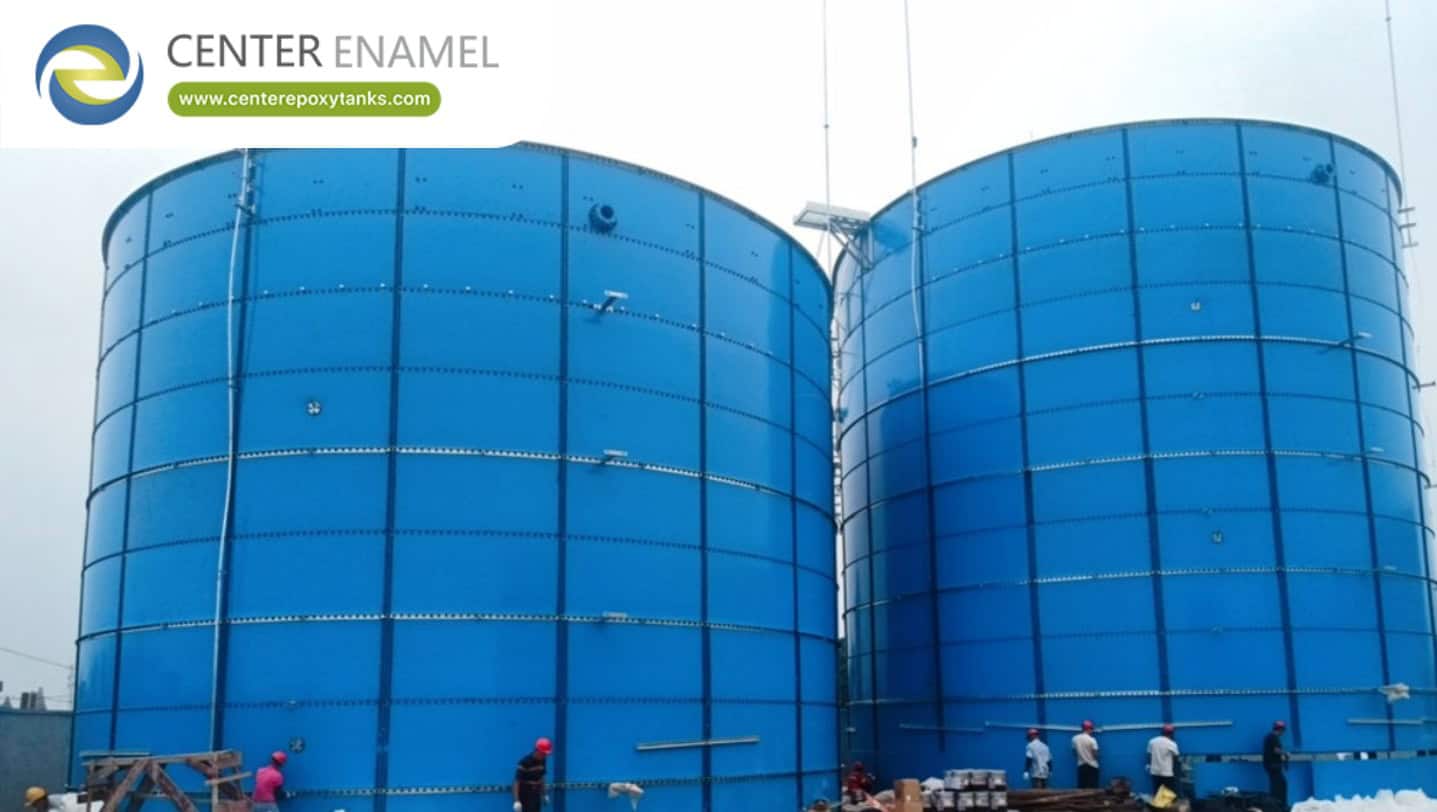
What is a Process Water Tank?
A process water tank stores the treated or raw water that feeds manufacturing operations — cooling, washing, CIP, and boiler systems. Epoxy coated bolted steel tanks keep process water clean and corrosion-free while costing far less than stainless steel, with a 30+ year design life.
What is a Process Water Tank?
A process water tank is a storage vessel dedicated to water used in production rather than for drinking: cooling tower makeup, rinsing and washing, cleaning-in-place (CIP) supply, boiler feed, and fire water reserve all draw from process water storage.
Process water attacks conventional tanks quietly. Dissolved oxygen and chlorides pit bare steel, temperature cycling from cooling loops stresses coatings, and any corrosion products contaminate the water they were meant to protect. Epoxy coated bolted steel process water tanks isolate the water behind a smooth, non-porous, chemically inert FBE lining that neither corrodes nor sheds — delivering stainless-like purity at a fraction of the cost.
Why Process Water Storage Deserves Engineering Attention
Water quality directly determines product quality in food, beverage, pharmaceutical, and electronics manufacturing, while unplanned tank outages idle entire production lines.
l Rust and scale from unlined steel tanks contaminate water and clog nozzles, valves, and heat exchangers.
l Stainless steel solves purity but multiplies capital cost at large volumes.
l Concrete and field-lined tanks leach, crack, and cannot be sanitized to modern standards.
The Engineering and Fusion-Bonding Process
The purity of an epoxy coated process water tank is established by a factory-controlled coating sequence applied before the tank ever reaches site:
1. Surface Preparation (Shot Blasting): Premium structural steel plates undergo automated grit or shot blasting to achieve a pristine anchor profile, removing all rust, mill scale, oils, and surface impurities.
2. Electrostatic Powder Application: Specialized thermoset epoxy powder is applied uniformly across both sides of the steel panels using automated electrostatic spray equipment.
3. Thermal Cross-Link Curing: The coated sheets pass through precision tunnel ovens (150°C to 250°C), where the epoxy powder melts, flows, and chemically cross-links into a dense, continuous protective polymer film.
4. Rigorous Quality Control & Holiday Testing: Every individual panel undergoes strict dry film thickness verification and high-voltage holiday spark testing (typically at 1,100V to 1,500V) to guarantee absolute zero pinholes or micro-discontinuities.
Technical Performance Matrix: Process Water Storage Technologies
Technical Parameter | Epoxy Coated Bolted Steel Tanks | Solid Stainless Steel Tanks | Concrete-Lined / Field-Welded Tanks |
Water Purity & Hygiene | Smooth, non-porous FBE lining adds no taste, odor, or contamination | Ultimate inertness; proven hygienic surface | Leaching, porous surfaces, and coating flakes degrade water quality |
Capital & Material Cost | Highly cost-effective for large-capacity storage | Exceptionally high expenditure at large volumes | Moderate cost but intensive site labor and finishing |
Installation Velocity | Rapid modular bolted assembly with no hot work | Slow field welding, pickling, and passivation | Slow; blasting, welding, and multi-coat lining cycles |
Lifespan & Maintenance | 30+ year service life with minimal maintenance | Long life but costly weld inspection and passivation | Periodic relining and repainting to prevent leaching |
Process Water Tank Applications
l Cooling tower makeup and chilled water buffer storage
l CIP and rinse water supply for food, beverage, and dairy plants
l Boiler feed water and condensate holding
l Fire protection water reserve for industrial sites
l Washing, rinsing, and spray water storage in processing lines
l Rainwater and recycled water harvesting for plant reuse
Key Advantages of Epoxy Coated Process Water Tanks
1. Stainless-Level Purity Without the Stainless Price
The factory-fused FBE lining keeps stored water completely separated from steel, preventing rust, scale, and metallic contamination at a installed cost typically 30% to 50% below solid stainless steel at comparable volumes.
2. Certified Drinking-Water-Grade Options
Coating formulations certified to NSF/ANSI 61, WRAS, and LFGB allow the same tank platform to serve potable and process duties where water grades change or overlap.
3. Fast Installation With Zero Production Downtime
Bolted assembly proceeds beside live plant without hot-work permits, and capacity expands by adding panel courses — new storage without stopping production.
Quality Standards and Proven References
Center Enamel's epoxy coated tanks are engineered in strict accordance with AWWA D103-09, OSHA, and ISO 28765, and manufactured under ISO 9001 and ISO 45001 certified quality systems. With coating formulations certified to NSF/ANSI 61, WRAS, and LFGB, and products certified to EN 1090, Center Enamel has supplied bolted storage tanks to more than 100 countries — including drinking water, industrial, and food and beverage projects for global companies such as Coca-Cola, Heineken, and AB InBev.
Frequently Asked Questions (FAQ)
Q: Are epoxy coated tanks suitable for potable-grade process water?
A: Yes. With NSF/ANSI 61, WRAS, and LFGB certified coating formulations, epoxy coated bolted tanks provide safe, non-contaminating storage for potable and food-contact water.
Q: Can process water tanks handle temperature swings?
A: The thermoset epoxy film is thermally cured at 150°C to 250°C and tolerates the temperature cycling typical of cooling, CIP, and hot water applications without cracking or delaminating.
Q: How much capacity can a bolted process water tank hold?
A: Modular designs span from a few hundred to more than 20,000 cubic meters, and can be expanded in place by adding courses of panels.
Q: What is the expected lifespan of an epoxy coated process water tank?
A: When manufactured in strict compliance with international design codes (such as AWWA D103) and properly maintained, an epoxy coated process water tank is engineered for a dependable operational lifespan exceeding 30 years.


