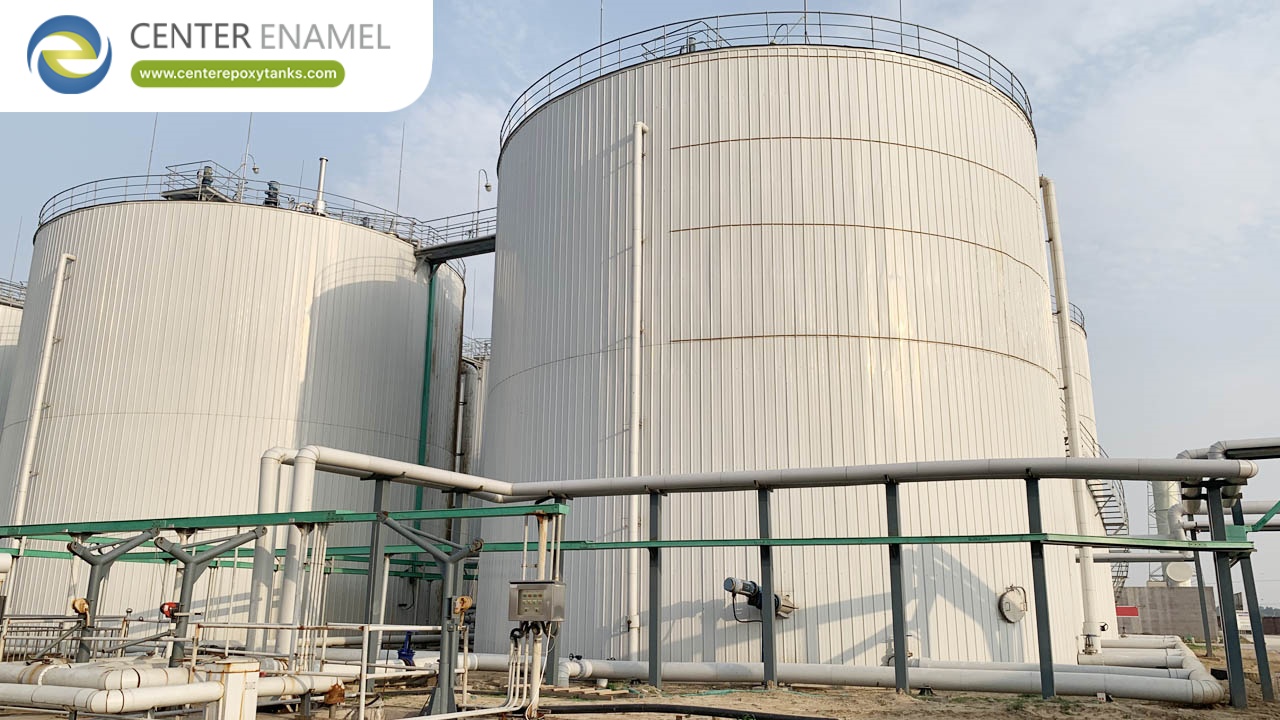
What is a Leachate Storage Tank?
A leachate storage tank is a highly corrosion-resistant bolted steel vessel that contains landfill leachate before treatment or haul-off. Its fusion bonded epoxy lining withstands the ammonia, chlorides, heavy metals, and variable pH of leachate, ensuring zero-seepage containment for 30+ years.
What is a Leachate Storage Tank?
A leachate storage tank holds the liquid that percolates through landfill waste — a complex, concentrated wastewater containing ammonia, chlorides, heavy metals, organic acids, and dissolved salts whose composition shifts continuously as the landfill matures.
Leachate ranks among the most corrosive liquids handled in environmental engineering. Young leachate is organic and acidic; mature leachate turns ammonia-rich and saline — and all of it must be contained with absolute reliability, often at remote sites far from maintenance support. Epoxy coated bolted steel leachate tanks deliver factory-tested, chemically inert containment that ships flat-pack to any location and assembles in weeks.
Why Leachate Containment Cannot Fail
Leachate escapes are immediate environmental incidents: groundwater contamination, aquifer damage, and regulatory enforcement. Storage systems must therefore combine chemical resistance with verifiable, factory-applied quality rather than site-dependent workmanship.
l Ammonia levels in mature leachate can exceed 2,000 mg/L, attacking concrete and lesser coatings.
l High chloride and sulfate content drives pitting and stress corrosion in unprotected steel.
l Remote landfill sites make ongoing maintenance and repainting expensive and slow.
The Engineering and Fusion-Bonding Process
Containment integrity is guaranteed by an automated factory sequence before any panel ships to the landfill:
1. Surface Preparation (Shot Blasting): Premium structural steel plates undergo automated grit or shot blasting to achieve a pristine anchor profile, removing all rust, mill scale, oils, and surface impurities.
2. Electrostatic Powder Application: Specialized thermoset epoxy powder is applied uniformly across both sides of the steel panels using automated electrostatic spray equipment.
3. Thermal Cross-Link Curing: The coated sheets pass through precision tunnel ovens (150°C to 250°C), where the epoxy powder melts, flows, and chemically cross-links into a dense, continuous protective polymer film.
4. Rigorous Quality Control & Holiday Testing: Every individual panel undergoes strict dry film thickness verification and high-voltage holiday spark testing (typically at 1,100V to 1,500V) to guarantee absolute zero pinholes or micro-discontinuities.
Technical Performance Matrix: Leachate Storage Technologies
Technical Parameter | Epoxy Coated Bolted Steel Leachate Tanks | HDPE-Lined Earthen Lagoons | Cast-in-Place Concrete Basins |
Chemical Resistance | FBE barrier tolerates ammonia, chlorides, metals, and pH swings | Liner vulnerable to puncture, seam failure, and UV aging | Chemical attack on concrete matrix; rebar corrosion from chlorides |
Site Deployment | Flat-pack panels ship to remote landfill sites; bolted assembly in weeks | Requires large land area and earthworks on prepared ground | Heavy civil works; multi-week curing on site |
Sealing Verification | Every panel holiday-tested at 1,100V-1,500V; gasketed joints verifiable | Seam integrity only as good as field welding conditions | Crack development over settlement and thermal cycling |
Lifespan & Maintenance | 30+ year service life with minimal site maintenance | Periodic liner inspection, patching, and eventual replacement | Ongoing crack repair and protective coating renewal |
Leachate Storage Tank Applications
l Raw leachate equalization and collection sump storage
l Leachate treatment process tanks, including biological stages and RO feed
l Reverse osmosis concentrate and reject holding
l Tanker loading and off-site haul-out buffer storage
l Landfill gas condensate collection and storage
l Capping and closure-phase leachate management
Key Advantages of Epoxy Coated Leachate Storage Tanks
1. Verified Resistance to the Full Leachate Spectrum
The high-temperature cross-linked epoxy film withstands the ammonia, chloride, and heavy-metal profile of both young and mature leachate, with panel-level holiday testing proving zero pinholes before dispatch.
2. Rapid Deployment on Remote Landfill Sites
Panels and gaskets arrive as a flat-pack kit assembled with hand tools and bolted joints — no concrete batch plants, no coating crews, no extended site presence.
3. Expandable Containment for Changing Leachate Volumes
As rainfall patterns and waste acceptance change, bolted tanks grow by adding panel courses, absorbing wet-season peaks without new civil construction.
Quality Standards and Proven References
Center Enamel's epoxy coated and glass-fused-to-steel tanks are engineered in strict accordance with AWWA D103-09, OSHA, ISO 28765, and EN 1090, and manufactured under ISO 9001 and ISO 45001 certified quality systems. As the first manufacturer of glass-fused-to-steel tanks in China — holding nearly 200 enameling patents — Center Enamel has delivered bolted tank projects to more than 100 countries, including a 16,760 m³ biogas project in Inner Mongolia and wastewater and biogas references for global environmental leaders such as Paques and Veolia.
Frequently Asked Questions (FAQ)
Q: Can epoxy coated tanks handle high-ammonia mature leachate?
A: Yes. The chemically inert FBE lining is specifically suited to the ammonia and chloride profiles of mature leachate that rapidly degrade concrete and unprotected steel.
Q: How much leachate storage does a typical landfill need?
A: Sizing depends on catchment area, rainfall, and haul-out frequency; modular bolted tanks are commonly configured from a few hundred to several thousand cubic meters and extended as needed.
Q: Can leachate tanks support mixers and pump equipment?
A: Yes. Tank structures are engineered for mounted pumps, mixers, access platforms, and instrument decks required by leachate management systems.
Q: What is the expected lifespan of an epoxy coated leachate storage tank?
A: When manufactured in strict compliance with international design codes (such as AWWA D103) and properly maintained, an epoxy coated leachate storage tank is engineered for a dependable operational lifespan exceeding 30 years.


