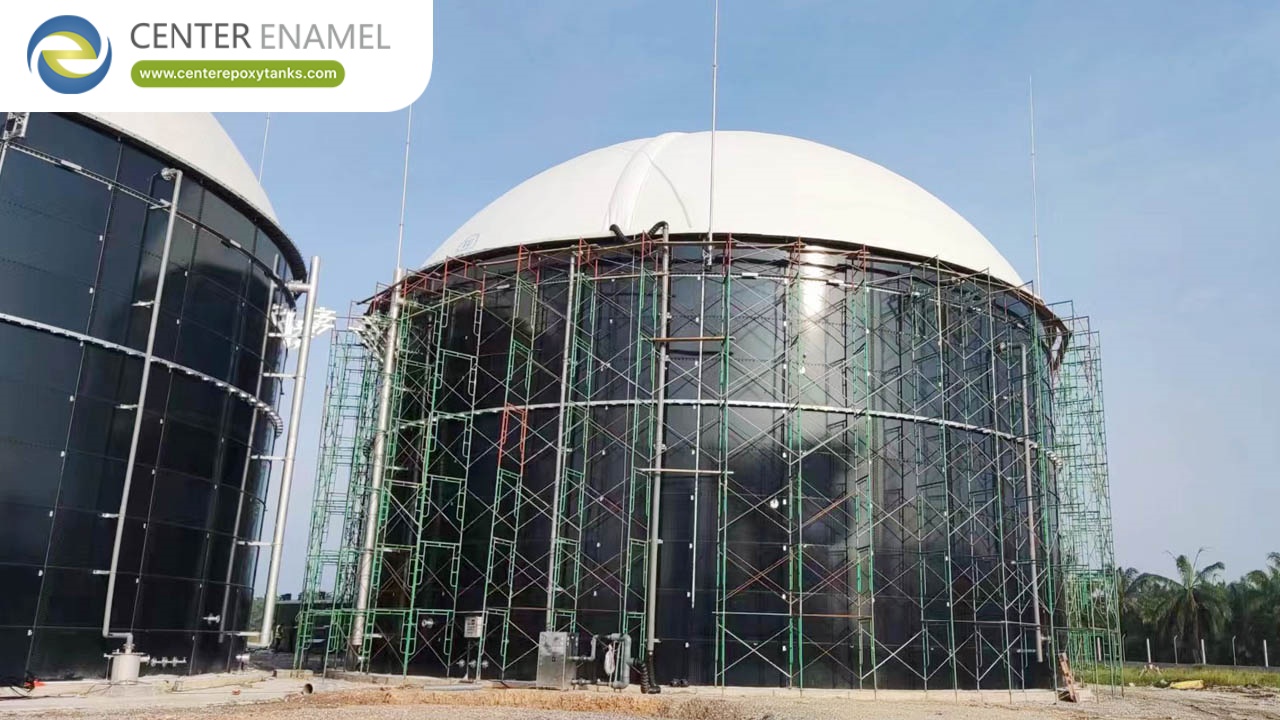
What is an Industrial Effluent Tank?
An industrial effluent tank is a dedicated storage and equalization vessel that receives liquid waste discharged from manufacturing processes — from chemical production, food and beverage processing, textiles, pulp and paper, mining, and metal finishing — before it is treated, recycled, or released under permit.
Industrial effluent is rarely predictable. pH can swing from strongly acidic to alkaline within a single production shift, temperature spikes stress coatings, and dissolved salts, solvents, and metals attack lesser materials. Epoxy coated bolted steel effluent tanks combine high-strength structural steel with a factory-applied thermoset fusion bonded epoxy (FBE) coating, creating a chemically inert, non-porous barrier that tolerates this aggressive chemistry for decades while costing far less than solid stainless steel.
Why Effluent Storage Is a Critical Compliance Asset
Discharge permits and zero-liquid-discharge targets make effluent storage a compliance asset rather than a passive cost. Spills, overflows, and tank failures now carry direct environmental, legal, and reputational consequences.
l Unequalized effluent shocks biological treatment plants, causing permit exceedances.
l HDPE and fiberglass tanks deform under high-temperature or high-density effluent.
l Field-welded steel depends on coatings applied in uncontrolled site conditions.
The Engineering and Fusion-Bonding Process
The chemical endurance of an epoxy coated effluent tank is established in an automated, factory-controlled manufacturing sequence:
1. Surface Preparation (Shot Blasting): Premium structural steel plates undergo automated grit or shot blasting to achieve a pristine anchor profile, removing all rust, mill scale, oils, and surface impurities.
2. Electrostatic Powder Application: Specialized thermoset epoxy powder is applied uniformly across both sides of the steel panels using automated electrostatic spray equipment.
3. Thermal Cross-Link Curing: The coated sheets pass through precision tunnel ovens (150°C to 250°C), where the epoxy powder melts, flows, and chemically cross-links into a dense, continuous protective polymer film.
4. Rigorous Quality Control & Holiday Testing: Every individual panel undergoes strict dry film thickness verification and high-voltage holiday spark testing (typically at 1,100V to 1,500V) to guarantee absolute zero pinholes or micro-discontinuities.
Technical Performance Matrix: Industrial Effluent Storage Technologies
Technical Parameter | Epoxy Coated Bolted Steel Effluent Tanks | High-Density Polyethylene (HDPE) Tanks | Field-Welded Steel Tanks |
Chemical & pH Resistance | Excellent; cross-linked FBE barrier handles broad pH swings, salts, and many solvents | Good for mild effluent but permeable to certain concentrated chemicals | Relies on site-applied coatings of variable quality |
Temperature & Load Tolerance | High-strength steel handles hot effluent and heavy liquid loads without deformation | Softens with temperature; wall bulging under high density or heat | Adequate structure, but thermal cycling degrades field coatings |
Scalability & Modularity | Modular bolted panels allow easy expansion, dismantling, or relocation | Fixed-volume molded tanks; impossible to expand | Rigid footprint; modification requires cutting and rewelding |
Lifecycle & Durability | 20+ year service life with minimal maintenance | UV degradation and embrittlement over long outdoor exposure | Frequent abrasive blasting and repainting programs |
Industrial Effluent Tank Applications
l Effluent equalization and buffering ahead of wastewater treatment plants
l Neutralization and pH adjustment process vessels
l Treated effluent holding and controlled discharge under permit
l Stormwater and first-flush containment in industrial yards
l Emergency containment for process upsets and spills
l Recycled process water storage for closed-loop manufacturing
Key Advantages of Epoxy Coated Effluent Tanks
1. Broad-Spectrum Chemical Resistance
The thermoset epoxy barrier is cross-linked at high temperature into a dense polymer film that tolerates the acidic, alkaline, and saline profiles typical of mixed industrial effluent, keeping the steel substrate completely isolated from attack.
2. Engineered for Heavy Loads and Hot Liquids
Structural carbon steel panels carry the hydrostatic loads of deep tanks and high-specific-gravity effluent, and tolerate inlet temperatures that soften or stress plastic alternatives.
3. Modular Capacity That Grows With the Plant
Bolted panels are added, removed, or relocated as production changes. Factories avoid the stranded capital of oversized fixed tanks and the delays of civil construction for every expansion.
Quality Standards and Proven References
Center Enamel's epoxy coated and glass-fused-to-steel tanks are engineered in strict accordance with AWWA D103-09, OSHA, ISO 28765, and EN 1090, and manufactured under ISO 9001 and ISO 45001 certified quality systems. As the first manufacturer of glass-fused-to-steel tanks in China — holding nearly 200 enameling patents — Center Enamel has delivered bolted tank projects to more than 100 countries, including a 16,760 m³ biogas project in Inner Mongolia and wastewater and biogas references for global environmental leaders such as Paques and Veolia.
Frequently Asked Questions (FAQ)
Q: What industries use epoxy coated effluent tanks?
A: Typical applications include chemical and petrochemical plants, food and beverage production, textiles, pulp and paper, mining and mineral processing, metal finishing, and pharmaceutical manufacturing.
Q: Can FBE coatings resist solvents in industrial effluent?
A: The high-temperature cross-linked epoxy film withstands a broad range of waterborne chemicals and many solvents; specific effluent chemistry should always be verified against the coating formulation during design.
Q: How quickly can an effluent tank be installed?
A: Because panels arrive fabricated and coated, a modular bolted effluent tank typically erects in a fraction of the time of concrete or field-welded alternatives, with no hot work or curing on site.
Q: What is the expected lifespan of an epoxy coated effluent tank?
A: When manufactured in strict compliance with international design codes (such as AWWA D103) and properly maintained, an epoxy coated effluent tank is engineered for a dependable operational lifespan exceeding 20 years.


