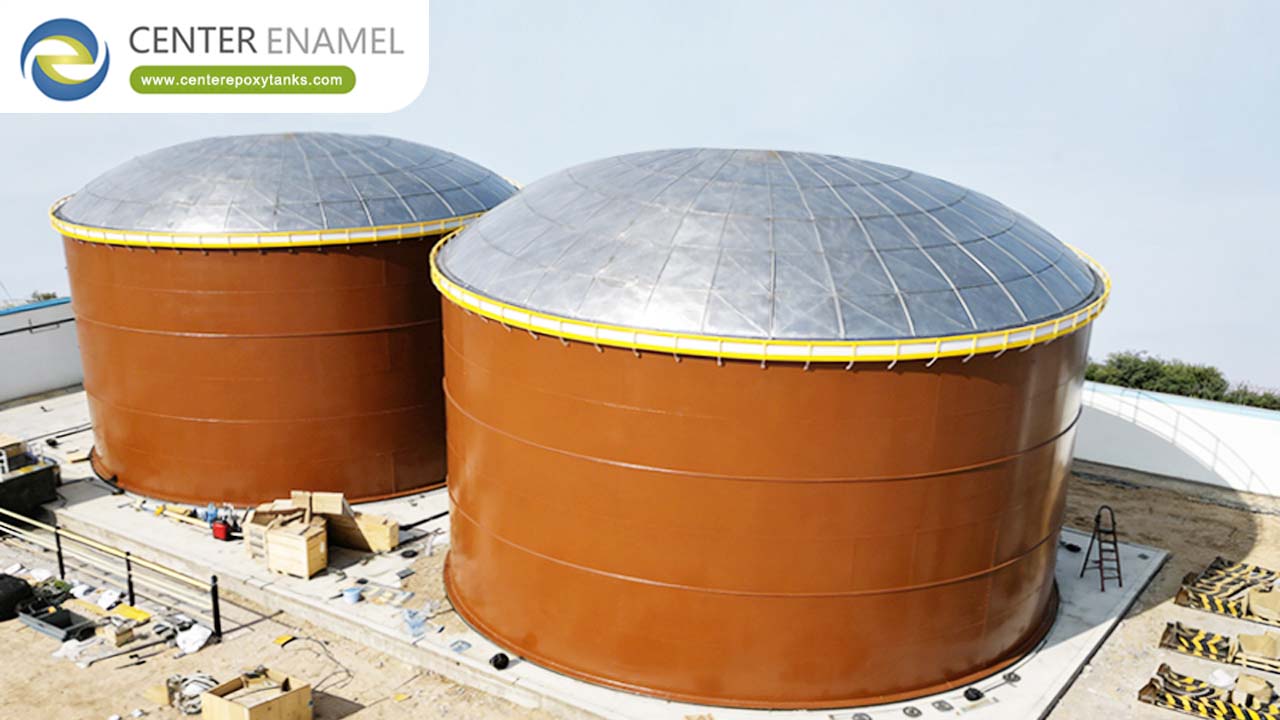
What Is a Geodesic Dome Tank Roof? Structure, Benefits, and Applications
In modern industrial fluid containment—spanning municipal water treatment plants, wastewater processing facilities, petroleum bulk terminals, and chemical manufacturing sites—protecting stored media from environmental contamination is a primary design objective. While historical storage vessels relied heavily on welded carbon steel fixed cone roofs, engineering standards have evolved significantly.
The premier solution for modern aboveground storage tanks (ASTs) is the geodesic dome tank roof. But exactly what is a geodesic dome tank roof, and why has it become the gold standard for industrial tank covers?
1. Definition and Structural Engineering Principles
A geodesic dome tank roof is a self-supporting, clear-span spatial frame structure constructed predominantly from high-strength aluminum alloy triangles (nodes and struts) that form a hemispherical shell over an industrial storage tank.
Unlike traditional flat or cone roofs that require internal support rafters, trusses, and central support columns, a geodesic dome utilizes geometric triangulation. This architectural design distributes structural loads—such as wind shear, seismic activity, and heavy snow accumulations—evenly across a heavy-duty perimeter ring beam anchored directly to the tank's top shell course.
2. Key Advantages of Aluminum Geodesic Domes
The widespread adoption of geodesic domes in industrial storage is driven by several distinct performance advantages over conventional steel roofs:
·
Completely Clear-Span Design: Because the dome is self-supporting, it requires zero internal support columns or vertical guide poles. This eliminates internal corrosion points, removes structural interference with internal floating roofs (IFRs), and simplifies tank mixing operations.
·
·
Exceptional Corrosion Resistance: Fabricated from marine-grade aluminum alloys, the dome naturally forms a self-healing aluminum-oxide passivation layer upon contact with oxygen. This prevents rust, eliminates the need for recurring sandblasting and repainting cycles, and slashes long-term maintenance costs.
·
·
Lightweight Foundation Efficiency: Aluminum is exceptionally lightweight compared to steel. This drastically reduces the dead load imposed on the tank's upper shell plates and foundation, making geodesic domes ideal for retrofitting older concrete or steel storage vessels.
·
3. Integration with Internal Floating Roofs (IFRs)
Geodesic domes are frequently paired with internal floating roof systems to create an ultimate dual-barrier emission and contamination control system:
·
Weather and Debris Shielding: The sealed geodesic envelope blocks rain, snow, UV radiation, and wind-blown dust from entering the tank, preventing water pooling on internal floating decks and eliminating biological contamination in municipal water reserves.
·
·
Volatile Organic Compound (VOC) Suppression: By blocking solar heat gain and preventing wind turbulence across the liquid interface, geodesic domes minimize breathing losses, protecting facility operators and ensuring strict compliance with EPA and AWWA standards.
·
Data Table: Geodesic Dome Roofs vs. Traditional Steel Fixed Cone Roofs
Evaluation Parameter | Aluminum Geodesic Dome Roofs | Traditional Carbon Steel Fixed Cone Roofs |
Structural Support | Clear-span space frame (Zero internal columns) | Requires internal rafters, trusses, and center support poles |
Corrosion Resistance | Excellent (Natural aluminum passivation; zero rust) | Low to Moderate (Requires continuous primer and epoxy coatings) |
Weight & Foundation Load | Extremely lightweight; low stress on tank shell | Heavy structural steel dead load |
Maintenance Profile | Virtually maintenance-free (No recoating cycles) | High (Requires periodic inspection, rust scraping, and repainting) |
Governing Standards | AWWA D108, API 650 (Annex H) | API 650, AWWA D100 |
Frequently Asked Questions (FAQ)
Q: What is a geodesic dome tank roof?
A: A geodesic dome tank roof is a self-supporting, clear-span hemispherical cover built from a triangulated network of aluminum struts, designed to protect industrial storage tanks from environmental elements and vapor loss.
Q: Why are geodesic tank roofs made of aluminum instead of steel?
A: Aluminum is chosen because it is lightweight, non-sparking, and naturally corrosion-resistant, eliminating the rusting and heavy maintenance associated with traditional carbon steel roofs.
Q: Do geodesic dome roofs require internal support poles?
A: No. The triangulated geodesic geometry distributes all structural loads to the perimeter ring beam, allowing for a completely clear-span interior with zero support columns.
Q: What engineering standards govern geodesic dome tank roofs?
A: Geodesic dome roofs are strictly designed, fabricated, and inspected in accordance with international engineering standards such as AWWA D108 and API 650 (Annex H).


