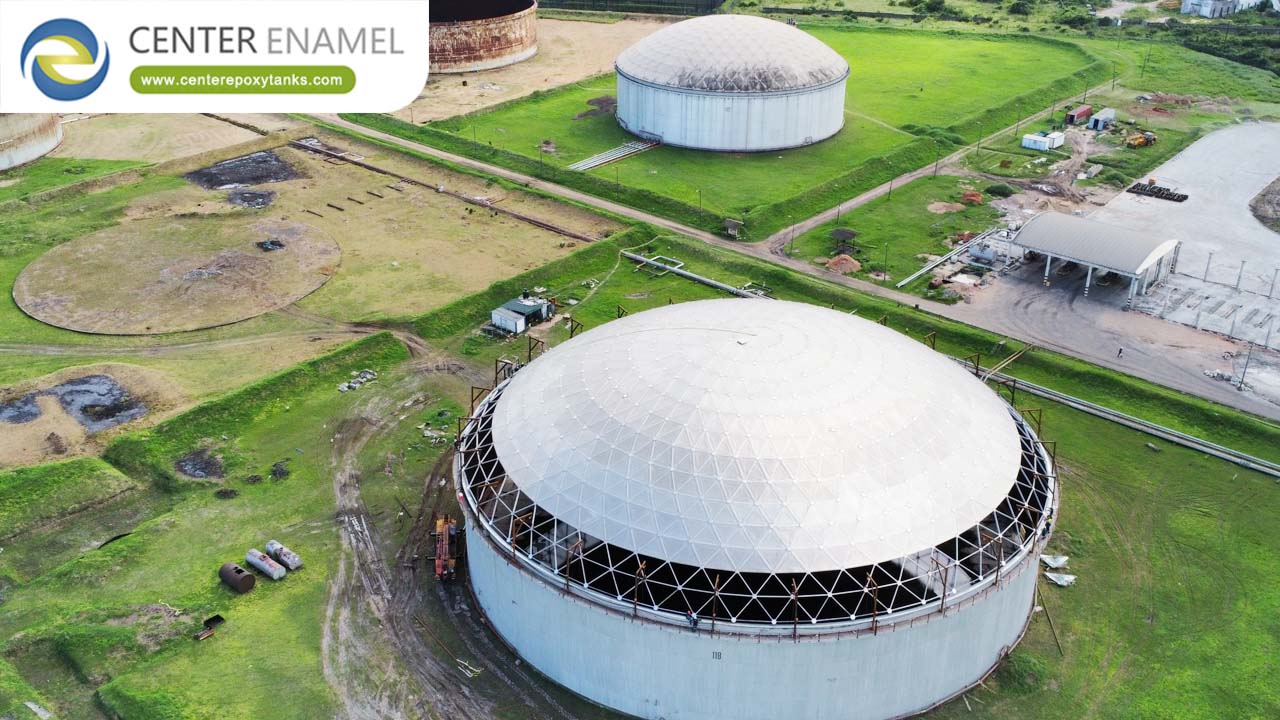
Leading Geodesic Dome Roof Design: Engineering Excellence in Modern Storage
In industrial bulk liquid containment—spanning petroleum storage terminals, wastewater treatment plants, and municipal water reservoirs—protecting stored media from environmental contamination and minimizing emissions requires cutting-edge overhead architecture. Traditional welded carbon steel fixed roofs have largely been superseded by leading geodesic dome roof designs, which combine advanced mathematical geometry with high-performance aluminum metallurgy.
Understanding the core engineering principles, structural specifications, and compliance standards behind leading geodesic dome designs explains why they represent the apex of modern aboveground storage tank (AST) protection.
1. Core Structural Mechanics and Triangulated Space Frames
A leading geodesic dome design relies on a precise hemispherical space frame constructed from interlocking aluminum alloy struts and nodal connectors.
·
Geodesic Triangulation: By utilizing triangles—the only rigid geometric polygon that cannot deform without altering side lengths—structural loads are distributed uniformly across the entire dome network and transferred directly to the perimeter ring beam.
·
·
100% Clear-Span Capability: Unlike conventional steel roofs that require interior rafters, purlins, and center support columns, leading geodesic designs feature a completely clear-span interior. This eliminates internal corrosion points and prevents structural interference with internal floating roofs (IFRs).
·
2. Advanced Sealing and Node Engineering
The operational efficiency of a geodesic dome depends heavily on its sealing systems and node connections, which prevent environmental ingress and volatile organic compound (VOC) escape:
·
Batten Bar and Gasket Systems: Leading designs incorporate specialized batten bar assemblies backed by high-durability silicone or elastomer gaskets. These maintain concentrated clamping pressure along all panel edges, guaranteeing a weather-tight seal under extreme thermal cycling and UV exposure.
·
·
Proprietary Extrusion Nodes: Precision-engineered node details utilize custom aluminum extrusions coupled with spun aluminum gusset covers, ensuring maximum structural rigidity and watertight performance.
·
3. Compliance with Global Engineering Standards
To ensure safety and structural integrity under severe environmental loads, leading geodesic dome designs are strictly engineered in compliance with international codes and standards:
Core Compliance Frameworks:
·
API 650 (Appendix G / Annex H): Governs welded and bolted tanks with structurally supported aluminum dome roofs, requiring non-linear second-order finite element analysis.
·
·
AWWA D108: Establishes precise criteria for aluminum dome roofs on water storage facilities.
·
·
ADM (Aluminum Design Manual) & ASCE 7: Ensures high resistance against regional wind shear, seismic activity, and heavy snow accumulations.
·
Data Table: Geodesic Dome Design vs. Traditional Steel Fixed Roofs
Engineering Parameter | Leading Aluminum Geodesic Dome Design | Traditional Carbon Steel Fixed Roof |
Structural Support | Clear-span space frame (Zero internal columns) | Requires internal rafters, trusses, and center poles |
Material Metallurgy | Marine-grade, non-sparking aluminum alloy | Heavy carbon steel plates and structural profiles |
Corrosion Resistance | Excellent (Self-healing aluminum-oxide passivation; zero rust) | Low to Moderate (Requires continuous paint/epoxy upkeep) |
Wind & Snow Load Capacity | High aerodynamic resistance via spherical geometry | Moderate; flat or conical surfaces catch wind shear |
Governing Standards | AWWA D108, API 650 App. G, ASCE 7, ADM | API 650, AWWA D100 |
Frequently Asked Questions (FAQ)
Q: What makes a leading geodesic dome roof design superior to standard flat or cone roofs?
A: Leading geodesic dome designs utilize a self-supporting triangulated space frame that provides 100% clear-span coverage without internal support columns, eliminates rusting through marine-grade aluminum construction, and optimizes weather shedding and emission control.
Q: Can geodesic dome roofs be installed on existing storage tanks?
A: Yes. Because aluminum geodesic domes are exceptionally lightweight, they can be easily retrofitted onto existing bolted, welded, or concrete storage tanks—often while the tank remains fully in service—without requiring structural shell reinforcements.
Q: How do geodesic domes handle heavy snow and high wind loads?
A: The spherical geometry and triangulated frame distribute wind shear and snow weight evenly across the perimeter ring beam, ensuring compliance with rigorous structural codes like ASCE 7 and API 650.
Q: What engineering standards govern the design of aluminum geodesic domes?
A: They are designed, fabricated, and tested in strict accordance with AWWA D108 for water storage and API 650 (Appendix G) for petroleum storage, alongside the Aluminum Design Manual (ADM).


