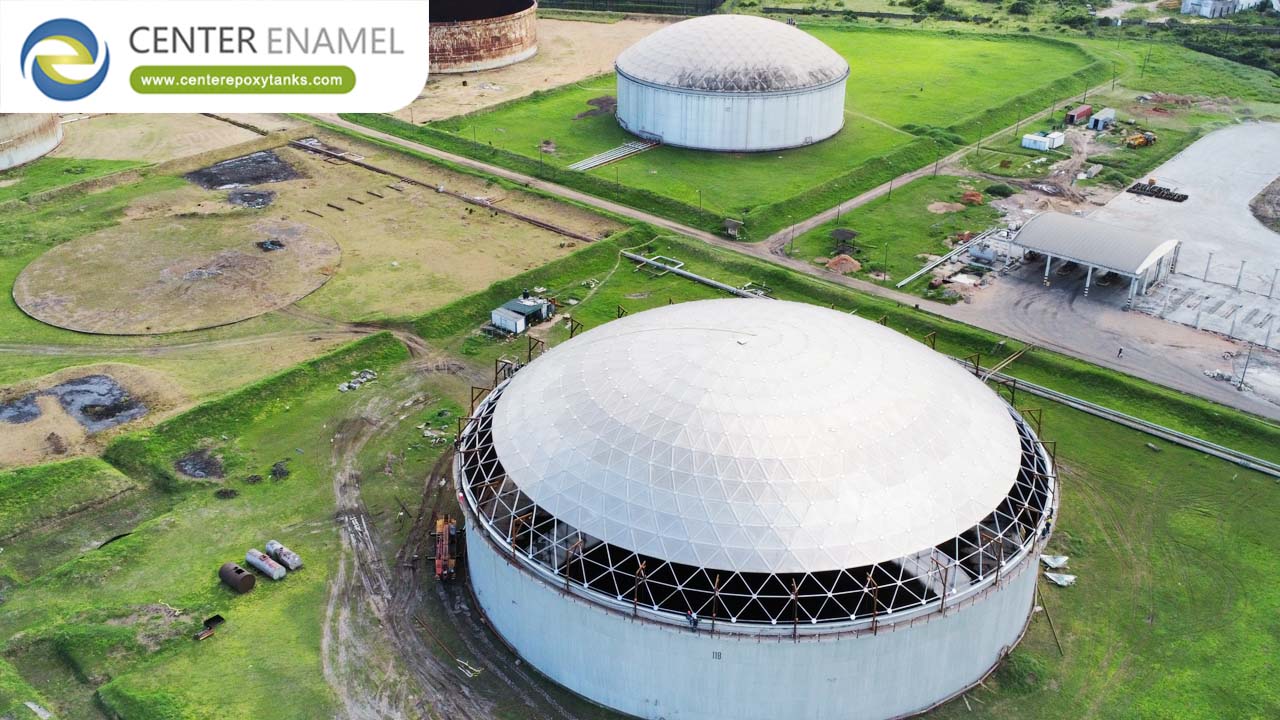
Geodesic Dome Roof: What Makes Them Unique in Industrial Storage?
In modern industrial bulk containment—spanning municipal water reservoirs, wastewater treatment plants, petroleum terminals, and chemical processing sites—roof selection dictates structural reliability and environmental performance. While historical storage vessels relied on welded carbon steel fixed roofs, engineering standards have shifted toward advanced geodesic dome roofs.
What makes a geodesic dome roof truly unique is its intersection of mathematical geometry, high-performance metallurgy, and self-supporting structural physics. Unlike flat or cone roofs that act as passive covers, geodesic domes represent a distinct engineering evolution in aboveground storage tank (AST) protection.
1. Unique Architectural Geometry: Triangulation and Clear-Span Design
The most striking characteristic of a geodesic dome is its triangulated spatial frame network.
·
Load Distribution via Triangulation: Triangles are the only rigid geometric polygons that cannot deform without changing the length of their sides. By assembling interlocking aluminum struts and nodal connectors into a hemispherical dome, structural loads—such as hurricane-force wind shear, heavy snow accumulations, and seismic activity—are distributed uniformly along the perimeter ring beam.
·
·
Zero Internal Support Columns: Because the triangulated network is self-supporting, geodesic domes require zero internal support poles, rafters, or trusses. This creates a completely clear-span interior, eliminating internal corrosion points and preventing structural interference with internal floating roofs (IFRs).
·
2. Unique Material Metallurgy: Corrosion-Resistant Aluminum
Beyond geometry, the choice of material separates geodesic domes from traditional steel alternatives:
·
Natural Passivation and Zero Rust: Geodesic tank roofs are fabricated from marine-grade aluminum alloys. Upon contact with oxygen, aluminum instantly forms a tight, self-healing aluminum-oxide passivation layer that completely prevents rust.
·
·
Elimination of Recurrent Coatings: Unlike carbon steel roofs that demand continuous sandblasting, priming, and repainting cycles to survive industrial atmospheres, aluminum domes are virtually maintenance-free, drastically slashing long-term operational expenditures (OpEx).
·
3. Structural Lightweighting and Foundation Efficiency
Weight distribution plays a critical role in tank engineering, particularly during facility retrofits:
·
Minimal Dead Load: Aluminum is exceptionally lightweight compared to steel. A geodesic dome imposes minimal dead load on the top shell courses of existing steel or concrete tanks, making it the premier choice for upgrading aging infrastructure without requiring costly foundation reinforcements.
·
·
Seismic Resilience: The inherent flexibility and low mass of an aluminum space frame allow it to absorb seismic shockwaves efficiently without buckling or transferring destructive shear stress to the tank shell.
·
Data Table: Geodesic Dome Roofs vs. Conventional Cone Roofs
Evaluation Parameter | Aluminum Geodesic Dome Roofs | Conventional Carbon Steel Cone Roofs |
Structural Geometry | Triangulated space frame (Geodesic tension/compression network) | Radial rafters, purlins, and flat/sloped plate sheets |
Internal Support Span | 100% Clear-span (Zero internal support columns) | Requires internal center support columns and rafters |
Material Composition | Marine-grade, non-sparking aluminum alloy | Heavy carbon steel plates and structural profiles |
Corrosion Resistance | Excellent (Self-healing oxide layer; zero rust) | Low to Moderate (Requires continuous paint/epoxy upkeep) |
Governing Standards | AWWA D108, API 650 (Annex H) | API 650, AWWA D100 |
Frequently Asked Questions (FAQ)
Q: What makes a geodesic dome roof unique compared to traditional tank roofs?
A: Geodesic domes are unique due to their triangulated spatial frame geometry, which distributes structural loads evenly without needing internal support columns, and their lightweight, corrosion-resistant aluminum construction.
Q: Do geodesic dome roofs require internal support poles?
| No. The unique triangulated engineering of a geodesic dome creates a completely clear-span interior, eliminating the need for center poles or structural rafters.
Q: Why is aluminum used instead of steel for geodesic tank roofs?
A: Aluminum is chosen because it is exceptionally lightweight, naturally corrosion-resistant (rust-free without painting), non-sparking, and easy to fabricate into complex geodesic geometries.
Q: What engineering standards govern geodesic dome tank roofs?
A: Geodesic dome roofs are strictly engineered, fabricated, and inspected in accordance with international standards such as AWWA D108 and API 650 (Annex H).


