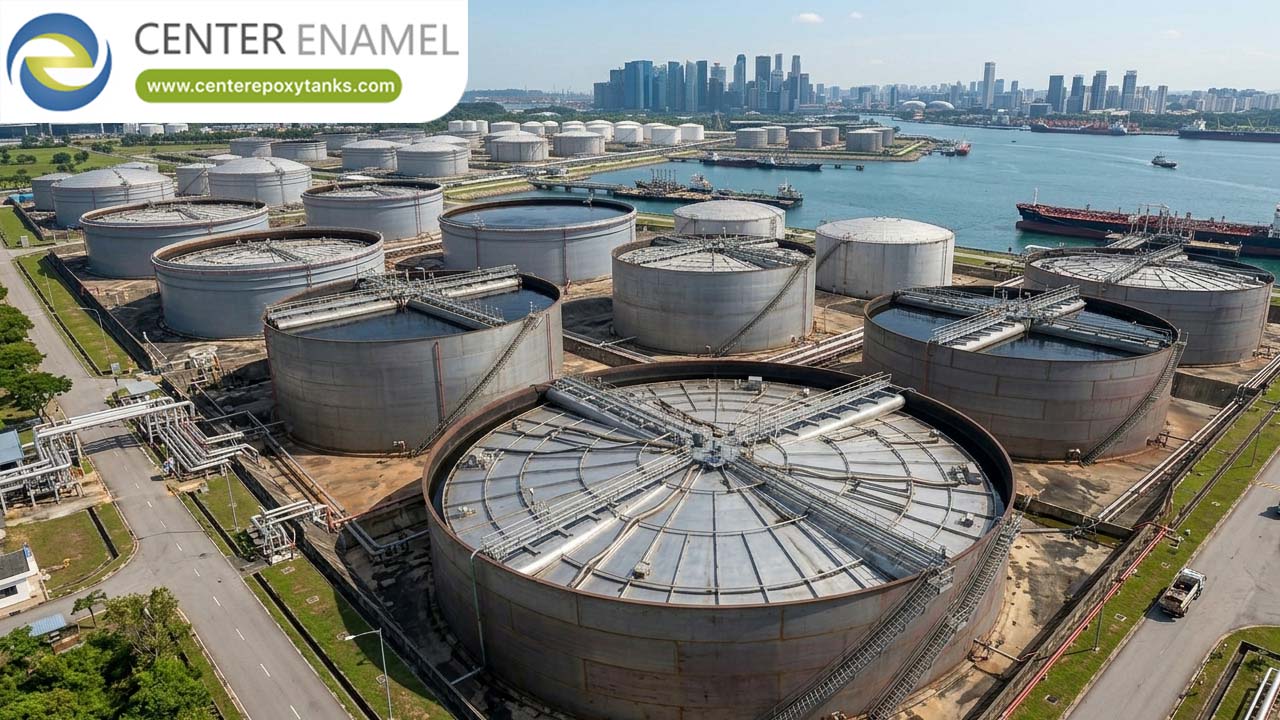
What is a Floating Roof Tank? Engineering & Vapor Control Guide
A floating roof tank is an industrial storage vessel designed to eliminate the "vapor headspace" above the liquid stored within it. Unlike fixed-roof tanks, which contain a pocket of air between the liquid surface and the tank roof, a floating roof rests directly on the product's surface. As the liquid level rises or falls, the roof moves vertically, tracking the product level with precision. This mechanism is primarily engineered to control Volatile Organic Compound (VOC) emissions, prevent product evaporation, and enhance fire safety. These tanks are the industry standard for storing volatile hydrocarbons, crude oil, and solvents, typically adhering to rigorous standards such as API 650 (Appendix C).
The Engineering Mechanics: Tracking & Sealing
The effectiveness of a floating roof tank relies on two fundamental engineering principles: buoyancy and hermetic sealing.
● Buoyancy (The Deck): The roof is constructed with pontoon chambers or a full-contact deck that provides the necessary buoyancy to float on the liquid surface. It moves in tandem with the filling and emptying cycles, ensuring there is never an air gap for vapors to form.
● Rim Seal Systems (The Barrier): The critical component preventing leaks is the rim seal. This flexible barrier bridges the gap between the edge of the floating roof and the tank shell.
○ Primary Seal: Provides the initial vapor barrier.
○ Secondary Seal: Acts as a wiper to clear product residue from the tank wall, ensuring maximum emission reduction (often required to meet environmental regulations).
● Anti-Rotation Guides: These structural members prevent the roof from rotating or tilting as it rises or falls, ensuring the seal maintains uniform pressure against the tank shell throughout its vertical travel.
Types of Floating Roof Configurations
1. Internal Floating Roof Tanks (IFRT)
The most common modern solution. A floating roof is installed inside a tank that also features a permanent fixed outer roof.
● Why it’s preferred: The fixed outer roof protects the internal floating roof from elements like rain, snow, and debris, which simplifies maintenance and prevents operational issues. This is the optimal configuration for long-term emission compliance.
2. External Floating Roof Tanks (EFRT)
The floating roof is exposed directly to the atmosphere.
● Context: While historically common for very large-diameter crude oil tanks, they are less common in new, smaller-to-medium industrial designs because they require complex, roof-mounted drainage systems to handle rainwater accumulation.
Comparative Overview: Floating vs. Fixed Roof
Feature | Floating Roof Tank | Fixed Roof Tank |
Vapor Headspace | Near Zero | Large (High vapor potential) |
VOC Emissions | Minimal (Compliant) | High (Requires recovery systems) |
Fire Safety | Higher (Reduced O₂ contact) | Lower (Oxygen-rich headspace) |
Product Loss | Very Low (Low evaporation) | Moderate to High |
Complexity | High (Moving seals) | Low (Static structure) |
Procurement Considerations for Site Engineers
When specifying a floating roof tank, project engineers should verify the following to ensure compliance and longevity:
1. Seal Integrity: For stringent environmental compliance, specify a Mechanical Shoe Seal combined with a secondary wiper seal. This is the global benchmark for VOC reduction.
2. API 650 Compliance: Ensure the design and fabrication strictly follow API 650 (Appendix C for internal floating roofs), which dictates material specifications, deflection tolerances, and safety standards.
3. Material Compatibility: The roof material (typically high-grade aluminum or stainless steel) must be chemically compatible with the stored product. For aggressive or corrosive media, stainless steel is the preferred specification for structural longevity.
4. Operational Maintenance: Request the maintenance protocol for the seal system. Modern, high-durability seals are designed for easy inspection via manways, minimizing downtime.
Frequently Asked Questions (FAQ)
Q: Do I need a floating roof for water storage?
A: Generally, no. Floating roofs are specifically designed to suppress the evaporation of volatile products (chemicals, hydrocarbons). For potable water or industrial wastewater, fixed roofs or GFS covers are standard, unless the specific process requires vapor capture.
Q: Can I retrofit an existing fixed-roof tank with a floating roof?
A: Yes. Retrofitting an existing tank with an internal floating roof is a highly effective way to bring an aging asset up to modern environmental compliance standards without the capital expenditure of replacing the entire tank shell.
Q: Why are floating roofs considered an environmental requirement?
A: Many jurisdictions mandate them for volatile products because they drastically reduce VOC emissions, which contribute to ground-level ozone and smog.
Optimizing Your Infrastructure for Emissions Control
Integrating a floating roof system is a strategic operational upgrade that pays for itself through reduced product loss, improved site safety, and immediate compliance with environmental regulations.
Are you evaluating storage solutions for volatile chemicals or hydrocarbons?
[Contact our engineering team] to discuss your specific product data, capacity requirements, and emission control targets. We can provide a structural load assessment and a design proposal for either new IFR (Internal Floating Roof) construction or retrofitting your existing infrastructure.
Would you like a detailed technical brief on the difference between "contact" floating roofs versus "non-contact" floating roofs for high-viscosity product storage?


