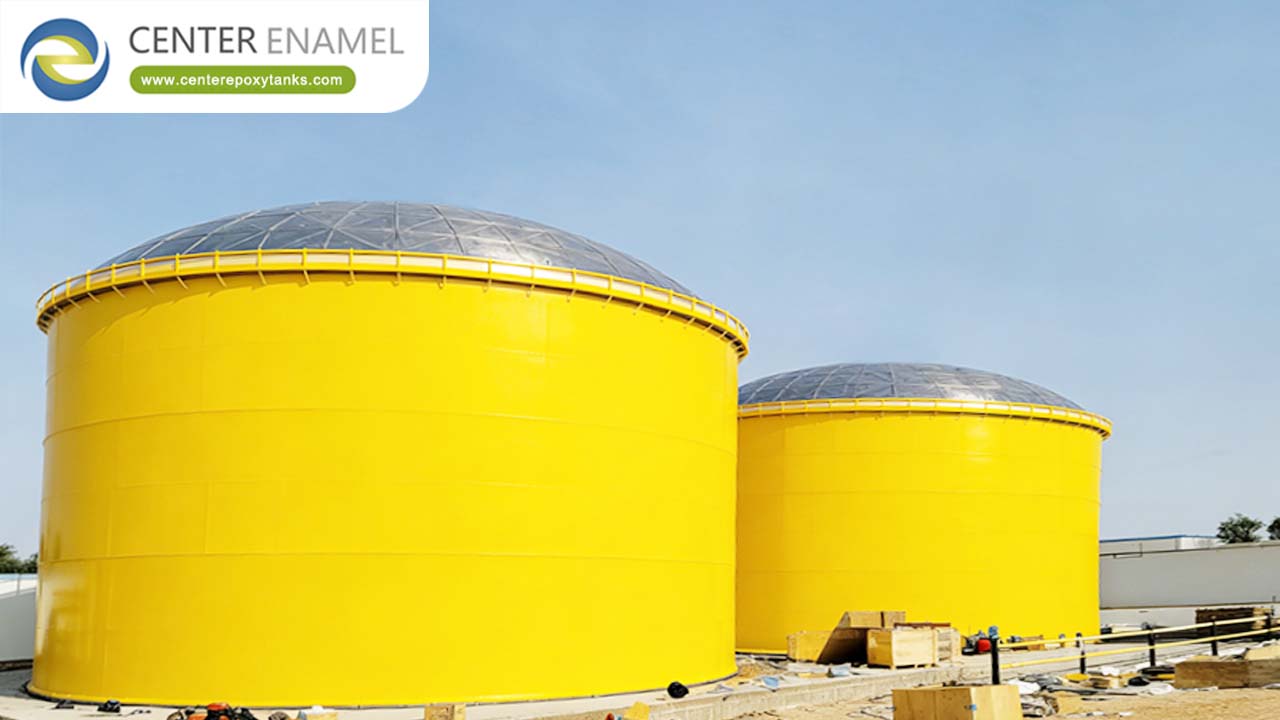
What is a Field Erected Welded Steel Tank?
A field erected welded steel tank is a large-capacity storage vessel fabricated from steel plates that are cut, formed, welded, and tested on the project site. Built to API 650 or AWWA D100, these tanks store from hundreds to more than 50,000 cubic meters of liquid.
A field erected welded steel tank is a storage vessel too large to shop-fabricate and transport, so its steel plates are rolled, welded, and inspected at the final location. Unlike shop-built tanks delivered on a truck, field erected tanks are assembled course by course — shell, roof, and bottom — directly on an engineered foundation, using coded welding procedures and non-destructive examination at every stage.
The format dominates large-volume storage across oil terminals, fuel depots, power plants, breweries, and municipal water systems, because welded construction has no practical diameter or height limit and no bolted or gasketed joints. Wherever a project needs thousands of cubic meters in a single tank, or must comply with API 650 for petroleum service, field erection is the industry-standard answer.
Why Large Projects Choose Field Erected Welded Steel Tanks
Terminal operators, refineries, and municipalities face a common constraint: storage volume that simply cannot be delivered any other way. Capacity, code compliance, and schedule discipline drive the decision toward field erection.
l Shop-fabricated tanks are capped by road transport limits, typically a few hundred cubic meters at most.
l Petroleum and chemical storage contracts mandate API 650 or API 620 design, which field erection is built to satisfy.
l Terminal layouts demand custom diameters, heights, nozzle arrangements, and future expansion provisions.
The Field Erection Sequence
A dependable field erected tank follows a disciplined engineering and construction sequence:
1. Foundation and Anchor Setting: A ringwall, slab, or pile-supported foundation is surveyed and set to grade, with anchor bolts or chair assemblies positioned to the tank design drawing.
2. Bottom and Shell Erection: Annular rings and bottom plates are laid and welded, then shell courses are rolled, erected, and girth-welded with qualified procedures, keeping verticality within code tolerance.
3. Roof Construction: Fixed cone, dome, internal floating, or external floating roofs are installed with seal welding, venting, and gauging per API 650 Annex and roof-type requirements.
4. Testing and Closeout: Vacuum-box testing of bottom seams, radiographic examination of shell welds, hydrostatic testing to design fill height, and complete documentation close out the package.
Field Erected Welded Steel vs Alternative Large-Volume Options
Technical Parameter | Field Erected Welded Steel Tanks | Bolted Steel Tanks | Concrete Reservoirs |
Maximum Single-Tank Volume | Hundreds up to 50,000+ m3 with no transport limit | Practical ceiling around 20,000 m3 per tank | Large volumes possible but at high civil cost |
Code Compliance for Petroleum | Native API 650 / API 620 design basis | Generally limited to water and dry bulk duties | Not an API code vessel for hydrocarbon service |
Joint Integrity | Continuous full-penetration welds, NDE-verified | Gasketed bolted seams reliant on seal condition | Crack-prone joints requiring active maintenance |
Schedule and Site Dependency | Weather-exposed welding and testing program | Faster modular assembly, less hot work | Long formwork and curing durations |
Field Erected Welded Steel Tank Applications
l Crude oil and refined product terminals requiring API 650 compliance
l Firewater and raw water reservoirs at industrial plants and airports
l Anaerobic digestion and process tanks at wastewater treatment works
l Wine, brewing, and food-grade process storage at large scale
l Chemical and brine storage with engineered linings
l Power plant and data center cooling water and fuel oil storage
Key Advantages of Field Erected Welded Steel Tanks
1. Unlimited Capacity in a Single Vessel
Because every plate is erected on site, tank diameter and height are set by process need rather than transport limits. Operators consolidate footprint, simplify piping, and cut per-cubic-meter cost as volume rises.
2. Full Code Compliance for Regulated Liquids
Field erected tanks are designed, welded, and examined under API 650, API 620, or AWWA D100 with documented welder qualification and NDE records — the paper trail regulators, insurers, and lenders require.
3. Decades of Service with Engineered Protection
Combined with modern coating systems and cathodic protection, welded steel shells deliver a design life measured in generations, with API 653 inspection programs maintaining integrity throughout.
Quality Standards and Proven References
Center Enamel engineers and manufactures welded steel storage tanks in accordance with API 650, API 620, and API 12F, with in-service repairs and alterations executed under API 653 discipline. Manufactured under ISO 9001 and ISO 45001 certified quality systems and certified to EN 1090, the company's tank projects span crude oil, refined product, chemical, and water service — with references including PetroChina and Sinopec and deliveries to more than 100 countries.
Frequently Asked Questions (FAQ)
Q: How large can a field erected welded steel tank be?
A: Practical single-tank sizes run from roughly 100 m3 to more than 60,000 m3. Above that, floating-roof designs and site-specific engineering extend capacity further.
Q: How long does field erection take?
A: A mid-size tank typically erects in 8 to 16 weeks including testing, governed by foundation readiness, weather windows, and NDE scheduling. Large terminal projects are phased tank by tank.
Q: Can a field erected tank be relocated or expanded later?
A: Shell courses can often be added to increase height, and complete dismantling and re-erection at a new site is possible, though it is a full welding project rather than a bolt-together move.
Q: What is the expected lifespan of a professionally engineered steel tank?
A: Steel tanks designed and built to recognized codes (API 650, API 620, AWWA D100, or ASME Section VIII) and maintained under scheduled inspection, coating, and repair programs routinely deliver service lives exceeding 30 years — and tanks managed under API 653-class integrity programs commonly remain in safe service for 50 years or more.


