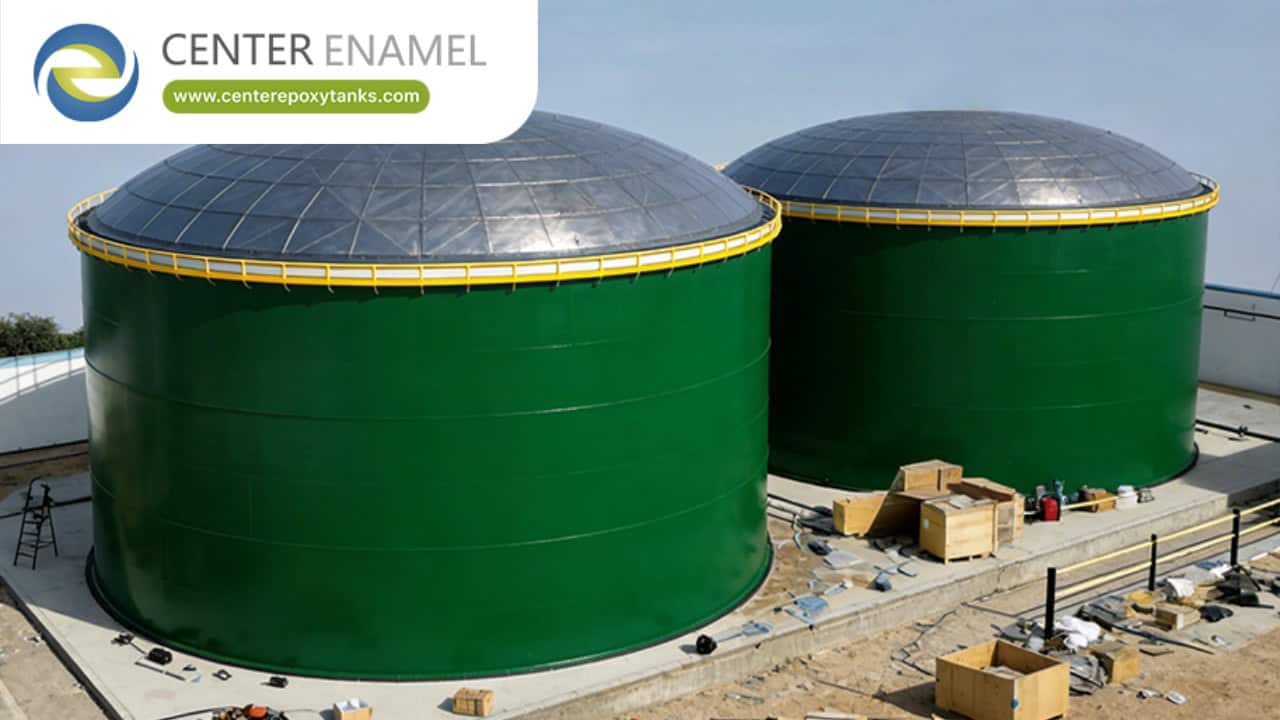
What Is a Chlorine Contact Tank (CCT)?
A chlorine contact tank is a baffled disinfection basin in water and wastewater treatment where chlorinated water is held long enough to achieve the required contact time (CT) before the point of use or discharge. Baffling forces plug flow through the tank, ensuring every water particle receives full disinfection exposure.
Disinfection math is unforgiving: kill rates depend on chlorine concentration multiplied by contact time (the CT value), and regulators credit only contact time the water actually experiences. An unbaffled tank short-circuits — some water exits in minutes while other water stagnates for hours — so its theoretical volume buys far less disinfection than its dimensions suggest.
The CCT solves this with baffle engineering: serpentine walls or over-and-under weirs stretch the flow path until the tank behaves like a pipe, achieving baffling factors near 1.0 versus 0.1 to 0.3 for unbaffled basins. Steel construction with chlorine-resistant coatings suits the aggressive chemistry — chlorine and its byproducts are hard on bare steel and concrete alike — and circular or rectangular configurations adapt to plot constraints.
Why Contact Time Is an Engineering Deliverable
Health departments do not accept tank volume as disinfection; they accept demonstrated CT. Tracer studies on baffled tanks are how plants prove every liter received its dose.
l Short-circuiting wastes up to 70 to 90 percent of nominal volume's disinfection value.
l Under-disinfected water triggers immediate violations and boil-water orders.
l Chlorine chemistry attacks unprotected steel and concrete surfaces continuously.
CCT Design and Validation Sequence
A compliant contact tank follows a proven path:
1. CT Requirement Establishment: Target organism, chlorine residual, temperature, and pH define the required CT per disinfection regulations.
2. Baffle and Volume Engineering: Baffling factor targets drive baffle layout and effective volume, with inlet and outlet arrangements designed against short-circuiting.
3. Corrosion-Resistant Construction: Steel shell, baffles, and coatings are engineered for continuous chlorine exposure at design residuals.
4. Tracer Validation: Dye or salt tracer studies verify the achieved contact time, documenting compliance for the health authority.
Baffled CCT vs Unbaffled Basin vs Inline Pipe Contact
Design Approach | Baffled Steel CCT | Unbaffled Basin | Long Discharge Pipe |
Baffling Factor | 0.6 to 0.9 achievable | 0.1 to 0.3 typical | 0.9+ but capacity-limited |
Volume Efficiency | High — most volume does disinfection work | Low — dead zones dominate | Limited by pipe length |
Verification | Tracer-tested and documented | Fails tracer studies routinely | Calculable but constrained |
Retrofit Ease | Baffles added to existing tanks | Requires conversion | Plot-dependent |
CCT Applications
l Municipal drinking water disinfection basins
l Wastewater effluent disinfection before discharge
l Reuse and reclamation plant contact chambers
l Food and beverage process water disinfection
l Aquaculture and irrigation water treatment
l Package plants with integrated contact tanks
Key Advantages of Engineered Steel CCTs
1. Disinfection Compliance You Can Prove
Baffle engineering plus tracer validation converts tank volume into documented CT — the exact evidence health authorities require.
2. Chlorine-Resistant Construction
Coated steel with chlorine-class linings withstands continuous disinfectant exposure far longer than unprotected concrete surfaces.
3. Compact Performance
High baffling factors mean the required CT fits in a smaller tank, saving plot and capital on retrofit projects.
Quality Standards and Proven References
Center Enamel provides design, fabrication, construction, and aftermarket services for storage tanks and silos under ISO 9001 and ISO 45001 certified quality systems, with EN 1090 structural steel certification. With three decades of experience and projects delivered to more than 100 countries — including biogas and wastewater references for Paques and Veolia and industrial references for PetroChina and Sinopec — the company supports tank assets from commissioning through decades of inspection-driven service.
Frequently Asked Questions (FAQ)
Q: What is a baffling factor?
A: It is the ratio of actual to theoretical contact time, measured by tracer study; engineered baffled tanks reach 0.6 to 0.9 while unbaffled basins often measure below 0.3.
Q: How is contact tank size calculated?
A: Required CT divided by the achievable chlorine residual gives needed time; tank volume then follows from design flow multiplied by that time, adjusted for the baffling factor.
Q: Can existing tanks be converted to effective CCTs?
A: Yes — retrofit baffle packages inside existing basins commonly lift baffling factors severalfold, converting wasted volume into compliant disinfection capacity.
Q: What is the expected lifespan of a professionally engineered steel tank?
A: Steel tanks designed and built to recognized codes (API 650, API 620, AWWA D100, or ASME Section VIII) and maintained under scheduled inspection, coating, and repair programs routinely deliver service lives exceeding 30 years — and tanks managed under API 653-class integrity programs commonly remain in safe service for 50 years or more.


