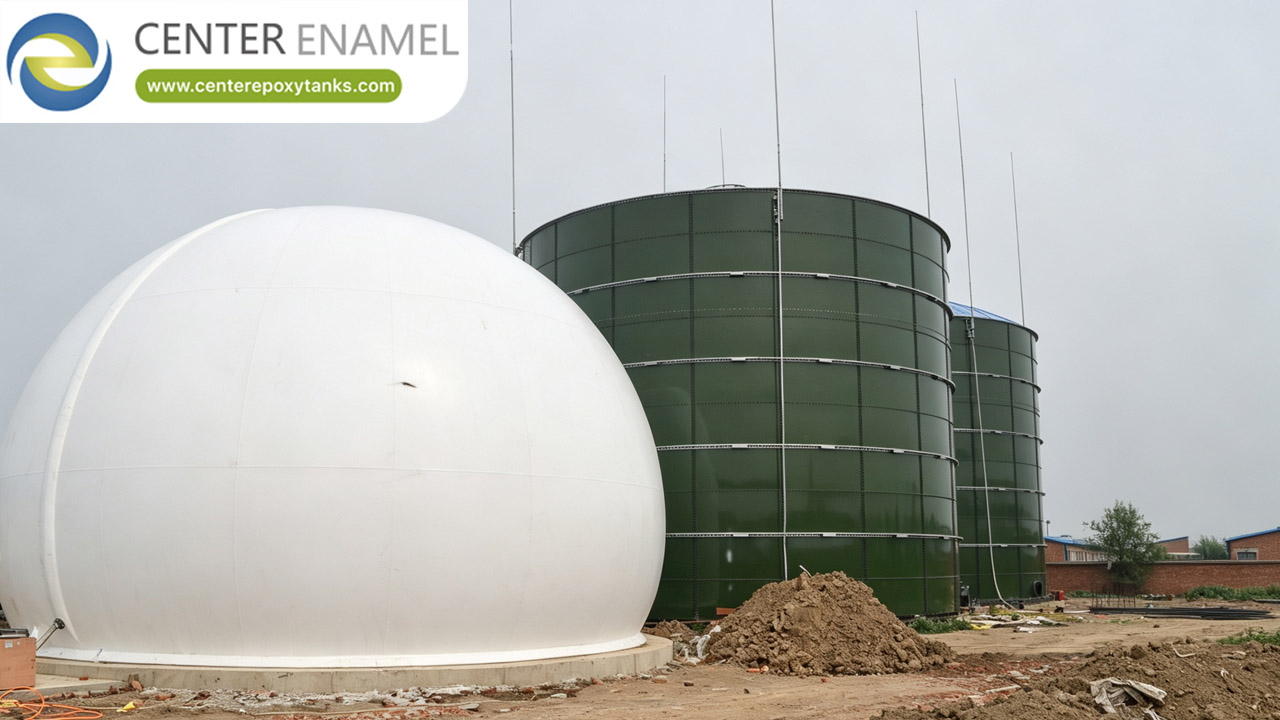
What is a Fermenter Tank?
A fermenter tank is a sealed vessel in which microorganisms convert organic substrates into products — biogas in anaerobic fermentation, or ethanol, enzymes, and food ingredients in industrial fermentation. Epoxy coated bolted steel fermenter tanks deliver inert, corrosion-resistant biological processing for 30+ years.
What is a Fermenter Tank?
A fermenter tank is any vessel in which a controlled microbial fermentation takes place. In the biogas industry, fermenter is the common European term for the anaerobic digester itself; across wider industry, fermenters produce bioethanol, organic acids, enzymes, yeast, and fermented foods and beverages.
All fermentation processes place the same demands on the vessel: a clean, chemically inert interior that never contaminates the product, temperature control for the biology, and — for anaerobic duties — gas-tight construction. Epoxy coated bolted steel fermenter tanks satisfy all three with a factory-fused thermoset lining that is smooth, non-porous, and stable across fermentation temperatures, at a fraction of solid stainless cost.
Why Fermentation Vessels Demand Inert Surfaces
Every fermentation is only as clean as its vessel. Corrosion products, coating degradation, and porous surfaces all contaminate the culture, alter product chemistry, and create sanitation dead zones.
l Rust and scale from unlined steel introduce iron and microbes into the product.
l Site-applied coatings degrade under warm, acidic fermentation conditions.
l Rough or porous surfaces harbor biofilms that survive cleaning between batches.
The Engineering and Fusion-Bonding Process
The inert interior of an epoxy coated fermenter tank is created in a controlled factory sequence:
1. Surface Preparation (Shot Blasting): Premium structural steel plates undergo automated grit or shot blasting to achieve a pristine anchor profile, removing all rust, mill scale, oils, and surface impurities.
2. Electrostatic Powder Application: Specialized thermoset epoxy powder is applied uniformly across both sides of the steel panels using automated electrostatic spray equipment.
3. Thermal Cross-Link Curing: The coated sheets pass through precision tunnel ovens (150°C to 250°C), where the epoxy powder melts, flows, and chemically cross-links into a dense, continuous protective polymer film.
4. Rigorous Quality Control & Holiday Testing: Every individual panel undergoes strict dry film thickness verification and high-voltage holiday spark testing (typically at 1,100V to 1,500V) to guarantee absolute zero pinholes or micro-discontinuities.
Technical Performance Matrix: Fermenter Tank Technologies
Technical Parameter | Epoxy Coated Bolted Steel Fermenter Tanks | Solid Stainless Steel Fermenters | Field-Welded Coated Fermenters |
Product Purity | Smooth, non-porous FBE lining; zero metallic contamination | Ultimate inertness for the most demanding products | Coating wear and weld corrosion risk contamination |
Capital Cost | Significantly lower than stainless at large volumes | Very high at fermentation scales | Moderate but coating life uncertain |
Temperature & Cleanability | Thermoset film stable at fermentation temperatures; smooth surface sanitizes readily | Excellent | Thermal cycling accelerates coating failure |
Installation & Expansion | Bolted modular assembly; capacity added in stages | Slow fabrication and welding program | Slow; expansion requires major rework |
Fermenter Tank Applications
l Anaerobic fermenters (digesters) on biogas and biomethane plants
l Bioethanol fermentation and beer well storage
l Enzyme, organic acid, and yeast production vessels
l Food and beverage fermentation, from dairy to condiments
l Pre-fermentation and substrate blending tanks
l Post-fermentation buffer and maturation storage
Key Advantages of Epoxy Coated Fermenter Tanks
1. An Inert Stage for the Biology
The dense cross-linked epoxy surface neither corrodes nor interacts with the fermenting broth, keeping product chemistry stable batch after batch across a 30+ year vessel life.
2. Stainless Performance, Bolted-Steel Economics
For most fermentation duties outside sterile pharmaceutical production, FBE-lined bolted steel delivers the required inertness at a fraction of solid stainless installed cost.
3. Modular Vessels for Growing Production
Bolted fermenters add capacity with extra panel courses and support gas-tight roof options for anaerobic duty — all installed without hot work beside live production.
Quality Standards and Proven References
Center Enamel's epoxy coated and glass-fused-to-steel tanks are engineered in strict accordance with AWWA D103-09, OSHA, ISO 28765, and EN 1090, and manufactured under ISO 9001 and ISO 45001 certified quality systems. As the first manufacturer of glass-fused-to-steel tanks in China — holding nearly 200 enameling patents — Center Enamel has delivered bolted tank projects to more than 100 countries, including a 16,760 m³ biogas project in Inner Mongolia and wastewater and biogas references for global environmental leaders such as Paques and Veolia.
Frequently Asked Questions (FAQ)
Q: Is a fermenter tank the same as a biogas digester?
A: In the biogas industry, yes — fermenter is the standard European term for the anaerobic digestion vessel; the words describe the same sealed, heated, mixed biological reactor.
Q: Are epoxy coated fermenter tanks food-grade?
A: With certified food-contact epoxy formulations complying with FDA 21 CFR and equivalent standards, FBE-lined tanks serve food, beverage, and fermentation duties safely.
Q: What temperatures can the lining tolerate?
A: The thermoset film is cured at 150°C to 250°C and comfortably handles mesophilic and thermophilic fermentation temperatures plus hot cleaning cycles.
Q: What is the expected lifespan of an epoxy coated fermenter tank?
A: When manufactured in strict compliance with international design codes (such as AWWA D103) and properly maintained, an epoxy coated fermenter tank is engineered for a dependable operational lifespan exceeding 30 years.


