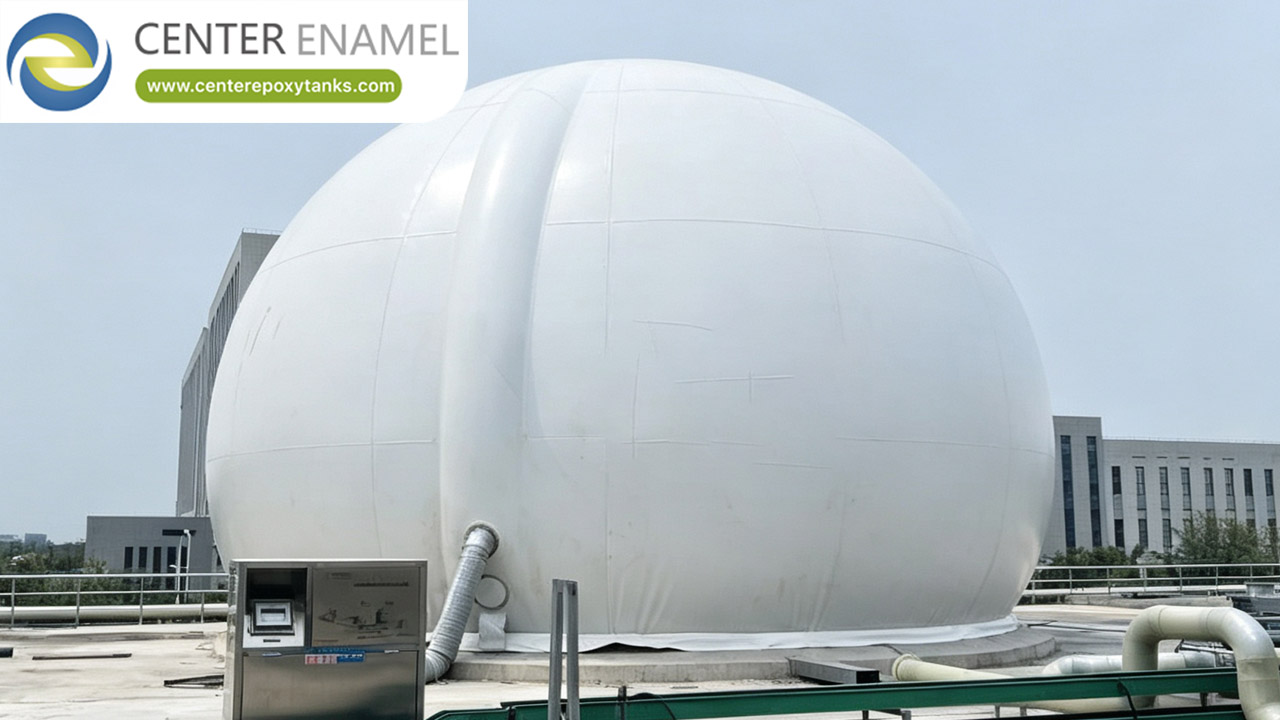
What is a Double Membrane Gas Holder?
A double membrane gas holder is a low-pressure biogas storage system built from an inner gas membrane, an outer weather membrane, and a pressurized air cushion between them. Mounted on digesters or standalone tanks, it stores biogas at a constant 2 to 10 mbar across capacities from 50 to over 5,000 cubic meters.
What is a Double Membrane Gas Holder?
A double membrane gas holder is the industry-standard solution for storing raw biogas at low pressure. It consists of three elements: an inner membrane that directly contains the biogas, an outer membrane that sheds weather and snow loads, and the air cushion between them that is kept under constant pressure by a support-air blower.
As biogas flows in from the digester, the inner membrane rises; as gas is drawn off to the CHP engine or upgrader, it falls. Because the air cushion pressure is blower-regulated, the gas leaves the holder at a constant 2 to 10 mbar regardless of fill level — the steady supply that engines and upgrading plants need for efficient operation.
How a Double Membrane Gas Holder Is Built
Gas holder performance is decided in fabrication, not on site. Quality holders are engineered as complete pressure systems:
l Membranes of high-strength polyester fabric coated with gas-tight, UV-stable polymer layers.
l High-frequency welded seams, each pressure- and leak-tested before dispatch.
l Integrated safety equipment: over-pressure and under-pressure relief valves, and level measurement.
l Center poles, tensioning systems, and support-air blowers matched to holder geometry.
Double Membrane Gas Holder Operation
Day to day, the system runs itself with only the blower and safety devices active:
1. Surface Preparation (Shot Blasting): Premium structural steel plates undergo automated grit or shot blasting to achieve a pristine anchor profile, removing all rust, mill scale, oils, and surface impurities.
2. Electrostatic Powder Application: Specialized thermoset epoxy powder is applied uniformly across both sides of the steel panels using automated electrostatic spray equipment.
3. Thermal Cross-Link Curing: The coated sheets pass through precision tunnel ovens (150°C to 250°C), where the epoxy powder melts, flows, and chemically cross-links into a dense, continuous protective polymer film.
4. Rigorous Quality Control & Holiday Testing: Every individual panel undergoes strict dry film thickness verification and high-voltage holiday spark testing (typically at 1,100V to 1,500V) to guarantee absolute zero pinholes or micro-discontinuities.
Technical Performance Matrix: Biogas Holder Designs
Parameter | Double-Membrane Gas Holder | Single-Membrane Cover | Water-Sealed / Piston Holder |
Output Pressure | Constant 2 to 10 mbar, blower-regulated | Near-atmospheric, fill-dependent | Low but variable |
Weather & Snow Capability | Outer membrane engineered for wind and snow loads | Limited; ponding risk in rain and snow | Heavy civil structure required |
Capacity Indication | Continuous level measurement on inner membrane | Difficult to measure accurately | Mechanical position indication |
Maintenance Profile | Blower service plus periodic membrane inspection | Low but frequent tensioning checks | Seals and water treatment demand attention |
Double Membrane Gas Holder Applications
l Roof-mounted gas storage on heated anaerobic digesters
l Standalone silo gas holders on bolted steel tanks
l Gas buffering ahead of CHP engines and upgrading plants
l Wastewater treatment sludge digestion gas systems
l Food waste and industrial effluent biogas plants
l Agricultural co-digestion facilities with variable gas output
Key Advantages of Double Membrane Gas Holders
1. Steady Pressure for Steady Revenue
Constant 2 to 10 mbar output keeps CHP engines in their efficiency band and upgraders at full rate — directly protecting the plant's gas income.
2. Big Storage Without Big Structures
Capacities from 50 to more than 5,000 cubic meters install on existing digester roofs or slim bolted silos, avoiding the land and steel of separate storage vessels.
3. Engineered Safety by Design
Over-pressure and under-pressure relief, membrane level monitoring, and ATEX-appropriate equipment are integrated into a factory-tested system rather than added on site.
Quality Standards and Proven References
Center Enamel supplies complete biogas storage solutions — double-membrane gas holders integrated on epoxy coated and glass-fused-to-steel bolted tank platforms — engineered in accordance with AWWA D103-09, OSHA, ISO 28765, and EN 1090, and manufactured under ISO 9001 and ISO 45001 certified quality systems. With bolted tank projects delivered to more than 100 countries and biogas references for environmental leaders such as Paques and Veolia, the company provides tank, roof, and gas holder packages as one coordinated system.
Frequently Asked Questions (FAQ)
Q: How does a double membrane gas holder maintain constant pressure?
A: A support-air blower keeps the cushion between the inner and outer membranes at a set pressure; as gas volume changes, the inner membrane rises or falls while output pressure stays fixed.
Q: How much biogas can a double membrane holder store?
A: Standard designs span roughly 50 to more than 5,000 cubic meters, typically sized at 25% to 50% of daily gas production or 8 to 12 hours of engine consumption.
Q: What maintenance does a double membrane holder need?
A: Routine blower and valve service, periodic seam and membrane inspection, and level-system checks; quality membranes serve 10 to 20 years before replacement.
Q: What is the expected lifespan of an bolted steel tank supporting a double membrane gas holder?
A: When manufactured in strict compliance with international design codes (such as AWWA D103) and properly maintained, an bolted steel tank supporting a double membrane gas holder is engineered for a dependable operational lifespan exceeding 30 years.


