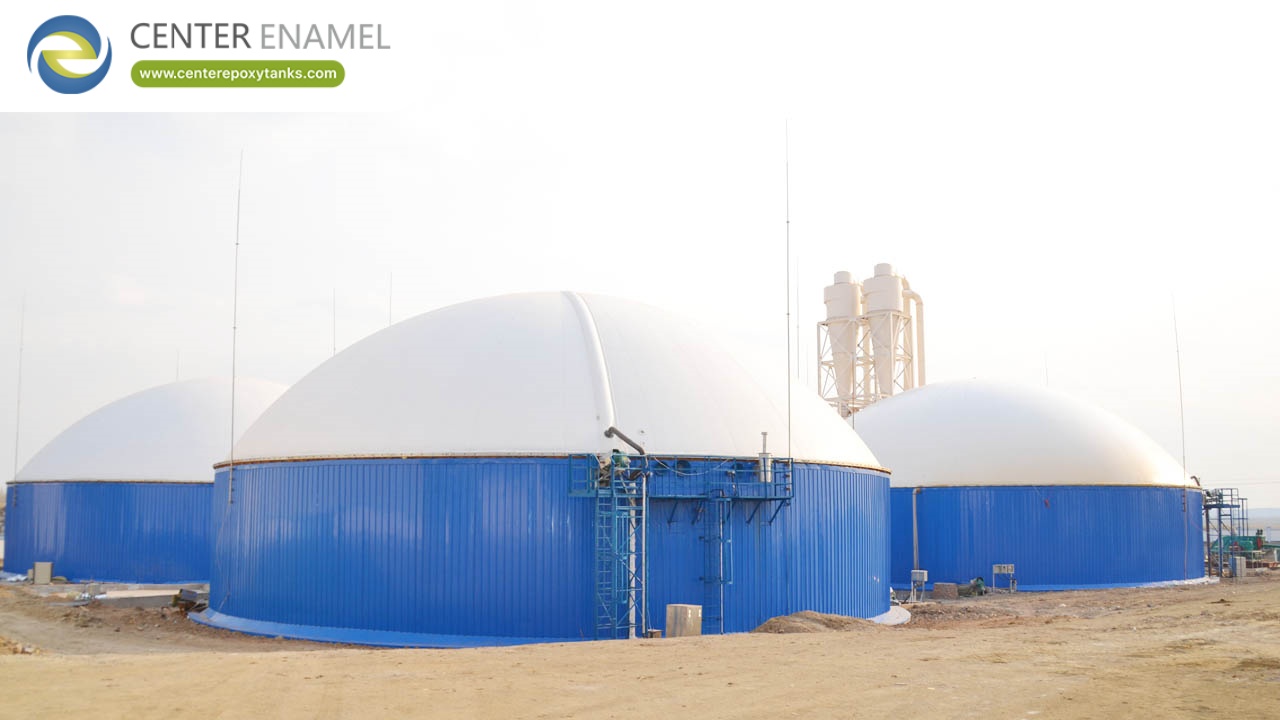
What is a Digester Tank?
A digester tank is the sealed vessel at the core of any digestion process, from municipal sludge to agricultural manure. Epoxy coated bolted steel digester tanks deliver gas-tight, corrosion-resistant containment with factory-controlled quality and installation measured in weeks.
What is a Digester Tank?
A digester tank is the pressure-containing vessel in which digestion happens — anaerobic digestion for biogas production most commonly, but the term also covers aerobic digestion vessels at wastewater plants. Whatever the biology, the tank's job is identical: hold the process contents securely, support the equipment that feeds and mixes them, and never let gas escape.
Because digester tanks combine structural, chemical, and gas-tight duties in one vessel, material choice dominates whole-life economics. Epoxy coated bolted steel digester tanks ship to site as factory-coated panel kits with gasketed joints, engineered roofs, and mixer interfaces, assembling in weeks and delivering AWWA D103-09-grade performance for more than 30 years.
What to Specify When Buying a Digester Tank
Digestion projects succeed or fail on procurement discipline. A digester tank specification should lock down the following before any contract is signed:
l Gas-tight construction at the specified operating pressure, with tested roof options and pressure-relief integration.
l Factory-applied, holiday-tested corrosion protection rated for H2S and ammonia service — never site-applied coatings alone.
l Structural design to a recognized code (such as AWWA D103-09) covering mixer loads, wind, and seismic conditions.
l Clear expansion path: additional panel courses or parallel tanks as feedstock grows.
The Engineering and Fusion-Bonding Process
Every digester tank panel passes through a verified factory protection sequence:
1. Surface Preparation (Shot Blasting): Premium structural steel plates undergo automated grit or shot blasting to achieve a pristine anchor profile, removing all rust, mill scale, oils, and surface impurities.
2. Electrostatic Powder Application: Specialized thermoset epoxy powder is applied uniformly across both sides of the steel panels using automated electrostatic spray equipment.
3. Thermal Cross-Link Curing: The coated sheets pass through precision tunnel ovens (150°C to 250°C), where the epoxy powder melts, flows, and chemically cross-links into a dense, continuous protective polymer film.
4. Rigorous Quality Control & Holiday Testing: Every individual panel undergoes strict dry film thickness verification and high-voltage holiday spark testing (typically at 1,100V to 1,500V) to guarantee absolute zero pinholes or micro-discontinuities.
Technical Performance Matrix: Digester Tank Materials
Technical Parameter | Epoxy Coated Bolted Steel Digester Tanks | Cast-in-Place Concrete Digesters | Field-Welded Steel Digesters |
Gas-Tightness | Gasketed joints and engineered roofs hold specified pressure | Cracking and creep leak gas progressively | Welds hold; penetrations and aging coatings fail |
Corrosion Resistance | FBE fused and tested on every panel at the factory | Requires sacrificial liners with recurring renewal | Site coatings degrade quickly in digester atmospheres |
Construction Schedule | Weeks from foundation-ready to water test | Months of formwork, pouring, and curing | Weather-dependent fabrication and coating |
Whole-Life Cost | Minimal maintenance across a 30+ year life | Repair, relining, and structural remediation cycles | Periodic sandblasting and repainting programs |
Digester Tank Applications
l Anaerobic digester vessels on biogas and biomethane plants
l Aerobic sludge digestion tanks at wastewater treatment works
l Industrial effluent digestion for food, beverage, and paper sectors
l Secondary digesters and unmixed post-digestion vessels
l Sludge blending and pre-digestion holding tanks
l Lagoon conversion projects upgrading open storage to digesters
Key Advantages of Epoxy Coated Digester Tanks
1. One Vessel, Three Duties Solved
Structural strength for mixers and roofs, chemical resistance for digestion chemistry, and gas-tight joints for methane retention are all engineered into a single bolted steel package.
2. Quality Proven at the Factory, Not Hoped for on Site
Coating thickness and holiday testing happen per panel under controlled conditions, removing weather and workmanship from the quality equation entirely.
3. Built to Grow
Bolted digester tanks add capacity with extra panel courses or replicate as parallel trains — a decisive advantage as feedstock volumes and tipping contracts expand.
Quality Standards and Proven References
Center Enamel's epoxy coated and glass-fused-to-steel tanks are engineered in strict accordance with AWWA D103-09, OSHA, ISO 28765, and EN 1090, and manufactured under ISO 9001 and ISO 45001 certified quality systems. As the first manufacturer of glass-fused-to-steel tanks in China — holding nearly 200 enameling patents — Center Enamel has delivered bolted tank projects to more than 100 countries, including a 16,760 m³ biogas project in Inner Mongolia and wastewater and biogas references for global environmental leaders such as Paques and Veolia.
Frequently Asked Questions (FAQ)
Q: Steel or concrete for a digester tank — which is better?
A: For most modern plants, factory-coated bolted steel wins on gas-tightness, corrosion protection, build speed, and expandability; concrete remains viable where local economics strongly favor civil works but carries long-term cracking and relining risk.
Q: What design code governs bolted digester tanks?
A: Epoxy coated bolted steel tanks are engineered to AWWA D103-09 with project-specific structural verification for mixer loads, wind, and seismic conditions, and manufactured under ISO 9001 quality systems.
Q: Can a digester tank be relocated?
A: Yes — bolted panels dismantle and re-erect at a new site with new gaskets, a flexibility that welded and concrete vessels cannot offer.
Q: What is the expected lifespan of an epoxy coated digester tank?
A: When manufactured in strict compliance with international design codes (such as AWWA D103) and properly maintained, an epoxy coated digester tank is engineered for a dependable operational lifespan exceeding 30 years.


