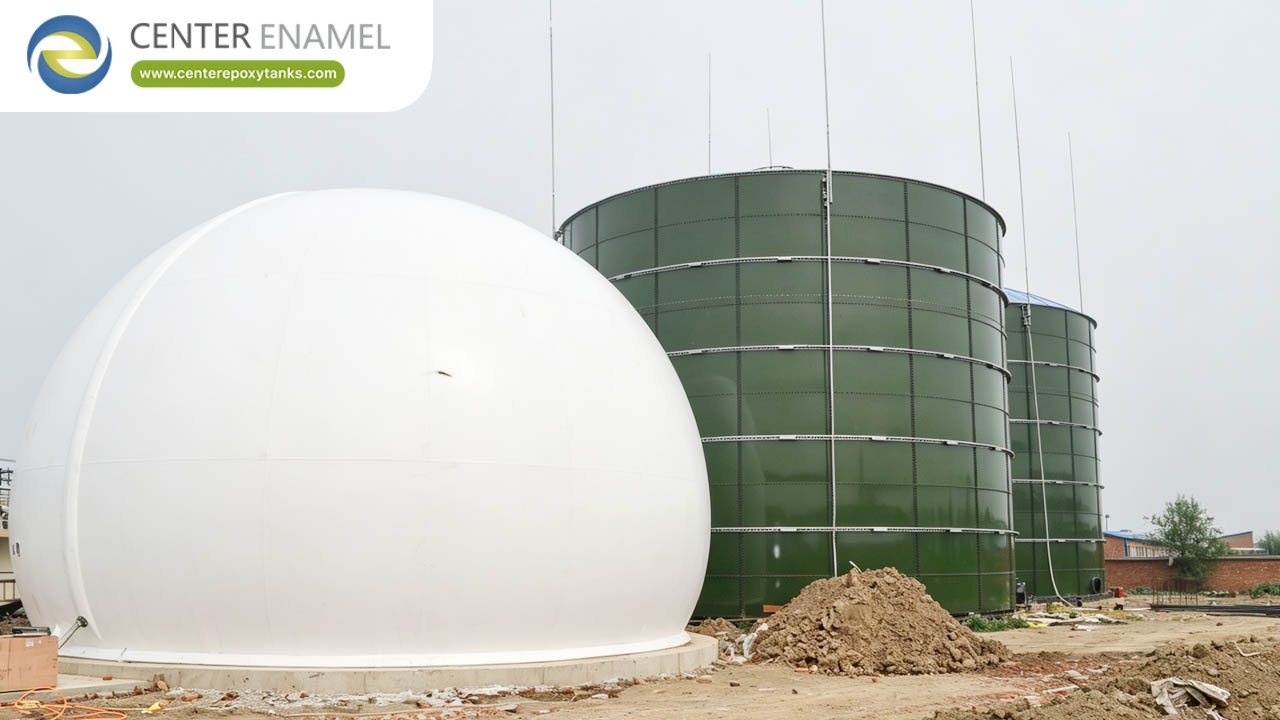
What is a Digestate Storage Tank?
A digestate storage tank is a sealed bolted steel vessel that holds the liquid by-product of anaerobic digestion until it can be applied as fertilizer or further processed. Gas-tight covered digestate tanks capture residual methane, turning storage into additional energy recovery.
What is a Digestate Storage Tank?
Digestate is the stabilized, nutrient-rich material that leaves an anaerobic digester once the biogas has been extracted. A digestate storage tank holds that liquid — still warm, still biologically active, and still releasing residual methane — through weeks or months of storage until field spreading windows, separation, or transport open up.
Storage design determines whether digestate is an asset or a liability. Open stores lose nitrogen to volatilization, release methane to the atmosphere, and fill with rainwater; sealed, covered stores keep the fertilizer value in and can capture remaining gas. Epoxy coated bolted steel digestate tanks with gas-tight membrane covers deliver that sealed storage in capacities from hundreds to over 20,000 cubic meters, engineered for a 30+ year life.
Why Digestate Storage Is Under Tightening Scrutiny
Regulation now targets the emissions digestate generates after digestion: methane slip from open storage can erase a meaningful share of a plant's carbon benefit, and nutrient regulations in many regions demand covered, leak-free stores.
l Residual methane from open digestate stores vents to the atmosphere, undermining plant carbon accounting.
l Ammonia volatilization strips nitrogen value out of the fertilizer before it reaches the field.
l Storage capacity must bridge long non-spreading seasons — six months or more in cold climates.
The Engineering and Fusion-Bonding Process
Every panel of an epoxy coated digestate storage tank is protected in an automated factory sequence:
1. Surface Preparation (Shot Blasting): Premium structural steel plates undergo automated grit or shot blasting to achieve a pristine anchor profile, removing all rust, mill scale, oils, and surface impurities.
2. Electrostatic Powder Application: Specialized thermoset epoxy powder is applied uniformly across both sides of the steel panels using automated electrostatic spray equipment.
3. Thermal Cross-Link Curing: The coated sheets pass through precision tunnel ovens (150°C to 250°C), where the epoxy powder melts, flows, and chemically cross-links into a dense, continuous protective polymer film.
4. Rigorous Quality Control & Holiday Testing: Every individual panel undergoes strict dry film thickness verification and high-voltage holiday spark testing (typically at 1,100V to 1,500V) to guarantee absolute zero pinholes or micro-discontinuities.
Technical Performance Matrix: Digestate Storage Technologies
Technical Parameter | Epoxy Coated Bolted Steel Digestate Tanks | Open Earthen Lagoons | Cast-In-Place Concrete Stores |
Emissions Control | Gas-tight covers capture residual methane and ammonia | Open surface; methane and ammonia vent freely | Cracking releases gas and leachate over time |
Nutrient Preservation | Sealed storage retains nitrogen fertilizer value | Volatilization and rainwater dilution degrade value | Moderate, with sealing degradation |
Capacity & Expansion | Hundreds to 20,000+ m³; extended by adding courses | Fixed by excavation; expansion means new earthworks | Permanent; expansion impractical |
Lifespan & Maintenance | 30+ year structure with periodic cover service | Dredging, liner repair, closure liability | Ongoing crack repair programs |
Digestate Storage Tank Applications
l Liquid digestate storage ahead of seasonal field application
l Digestate separation feed and liquid-fraction holding
l Gas-tight post-digestion storage capturing residual methane
l Solid digestate and fiber maturation buffer volumes
l Fertilizer transport loading and haul-out storage
l Process water recycle storage on the biogas plant loop
Key Advantages of Epoxy Coated Digestate Storage Tanks
1. Storage That Pays Its Own Way
Gas-tight covered digestate tanks capture residual methane for extra energy revenue and retain nitrogen fertilizer value — converting a compliance requirement into income.
2. Season-Bridging Capacity, Built Modular
Bolted panels deliver the six-month storage volumes northern climates demand, and extend by adding courses as feedstock — and digestate output — grows.
3. Corrosion Protection for Warm, Aggressive Liquor
The factory-fused FBE lining resists the ammonia and residual organic acids of digestate, protecting the tank through decades of agitation and empty-refill cycles.
Quality Standards and Proven References
Center Enamel's epoxy coated and glass-fused-to-steel tanks are engineered in strict accordance with AWWA D103-09, OSHA, ISO 28765, and EN 1090, and manufactured under ISO 9001 and ISO 45001 certified quality systems. As the first manufacturer of glass-fused-to-steel tanks in China — holding nearly 200 enameling patents — Center Enamel has delivered bolted tank projects to more than 100 countries, including a 16,760 m³ biogas project in Inner Mongolia and wastewater and biogas references for global environmental leaders such as Paques and Veolia.
Frequently Asked Questions (FAQ)
Q: Why should digestate storage be covered?
A: Covered, gas-tight storage captures residual methane that open lagoons release, retains nitrogen fertilizer value, and excludes rainwater — improving both plant carbon balance and digestate economics.
Q: How much digestate storage does a plant need?
A: Sizing follows spreading regulations and climate: many European regions require six months of storage; bolted tank farms reach these volumes by combining multiple modular tanks.
Q: Is digestate a valuable fertilizer?
A: Yes — digestate carries nitrogen, phosphorus, and potassium in a stabilized, low-odor, plant-available form that typically displaces synthetic fertilizer on the farms it returns to.
Q: What is the expected lifespan of an epoxy coated digestate storage tank?
A: When manufactured in strict compliance with international design codes (such as AWWA D103) and properly maintained, an epoxy coated digestate storage tank is engineered for a dependable operational lifespan exceeding 30 years.


