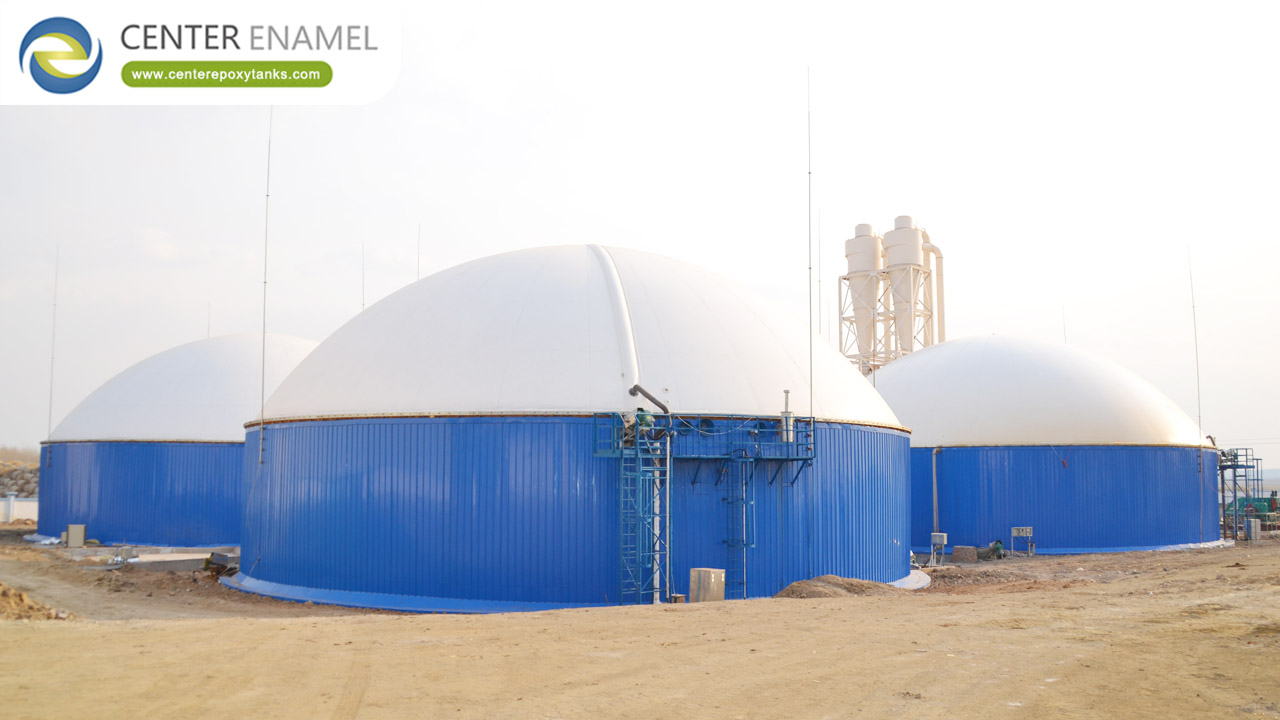
What is a Covered Lagoon Digester?
A covered lagoon digester is a wastewater lagoon sealed with an impermeable cover that captures biogas from naturally occurring anaerobic digestion. It offers low-cost biogas recovery for dilute waste streams, while heated bolted steel digesters serve higher-solids, higher-yield applications.
What is a Covered Lagoon Digester?
A covered lagoon digester is an existing or purpose-built earthen lagoon fitted with an impermeable floating or suspended cover. Organic matter in the lagoon already decomposes anaerobically; the cover simply captures the methane that would otherwise escape, directing it to a flare, boiler, or CHP engine.
Because lagoons run at ambient temperature without mixing, their biology is slow and climate-dependent — efficient in warm regions and on dilute, flushed waste streams, much less so in cold climates or on thick slurries. That is why covered lagoons and heated, mixed bolted steel digesters are best seen as complementary technologies: the lagoon as the low-capital entry point, the engineered steel digester as the high-yield workhorse when feedstock solids and gas targets rise.
When a Covered Lagoon Works — and When It Does Not
The covered lagoon is the simplest biogas system available, but its ambient, unmixed biology imposes firm limits:
l Works best: warm climates, dilute flushed manure (under 2% solids), large existing lagoons.
l Struggles: cold climates where lagoon temperature falls below productive digestion range.
l Not suited: high-solids slurry and food waste, which need heated, mixed complete-mix digestion.
l Yield: significantly lower and more seasonal than a heated steel digester on the same feedstock.
From Lagoon to Engineered Digester
Many operations start with a covered lagoon and graduate to higher-yield digestion as gas revenue ambitions grow:
1. Surface Preparation (Shot Blasting): Premium structural steel plates undergo automated grit or shot blasting to achieve a pristine anchor profile, removing all rust, mill scale, oils, and surface impurities.
2. Electrostatic Powder Application: Specialized thermoset epoxy powder is applied uniformly across both sides of the steel panels using automated electrostatic spray equipment.
3. Thermal Cross-Link Curing: The coated sheets pass through precision tunnel ovens (150°C to 250°C), where the epoxy powder melts, flows, and chemically cross-links into a dense, continuous protective polymer film.
4. Rigorous Quality Control & Holiday Testing: Every individual panel undergoes strict dry film thickness verification and high-voltage holiday spark testing (typically at 1,100V to 1,500V) to guarantee absolute zero pinholes or micro-discontinuities.
Technical Performance Matrix: Covered Lagoon vs Bolted Steel Digester
Parameter | Covered Lagoon Digester | Heated Bolted Steel Digester (CSTR) |
Temperature | Ambient, climate-driven | Controlled 35°C to 55°C, heated |
Feedstock Solids | Below about 2% TS (flushed, dilute) | 2% to 12% TS slurries and waste |
Retention Time | 30 to 60+ days | 15 to 30 days |
Biogas Yield | Low, seasonal, weather-dependent | High and stable year-round |
Capital & Land | Lowest capital, very large land area | Higher capital, compact footprint |
Covered Lagoon Digester Applications
l Dairy flush and scrape manure systems in warm climates
l Piggery effluent lagoons with existing earthworks
l Food processing effluent with dilute organic load
l Municipal lagoon retrofits adding gas capture
l Interim methane abatement ahead of full digester projects
l Farms monetizing carbon credits from avoided methane emissions
Key Advantages of Covered Lagoon Digesters
1. Lowest-Cost Entry Into Biogas
Where a lagoon already exists, adding a cover is the cheapest methane capture available — turning an emissions liability into flare, boiler, or CHP fuel with minimal capital.
2. Methane Abatement and Carbon Revenue
Capturing lagoon methane directly serves carbon programs; avoided-emission credits frequently fund the cover itself on large livestock operations.
3. A Natural Path to Engineered Digestion
Bolted steel digesters and digestate tanks bolt onto the same site as lagoon operations grow — the modular tank platform absorbs rising feedstock without starting over.
Quality Standards and Proven References
Center Enamel's epoxy coated and glass-fused-to-steel tanks are engineered in strict accordance with AWWA D103-09, OSHA, ISO 28765, and EN 1090, and manufactured under ISO 9001 and ISO 45001 certified quality systems. As the first manufacturer of glass-fused-to-steel tanks in China — holding nearly 200 enameling patents — Center Enamel has delivered bolted tank projects to more than 100 countries, including a 16,760 m³ biogas project in Inner Mongolia and wastewater and biogas references for global environmental leaders such as Paques and Veolia.
Frequently Asked Questions (FAQ)
Q: Do covered lagoons work in cold climates?
A: Only marginally — lagoon biology slows sharply as temperature drops, so cold-region projects typically choose heated, insulated bolted steel digesters for productive year-round gas output.
Q: How much biogas does a covered lagoon produce?
A: Output is site-specific and seasonal; dilute flushed manure yields modest, weather-dependent gas volumes — typically several times less per animal than a heated complete-mix digester achieves.
Q: Can a lagoon project upgrade to a steel digester later?
A: Yes, and many do: bolted steel digesters, gas holders, and digestate tanks install beside existing lagoons, letting operations raise yield and stability as feedstock and gas contracts grow.
Q: What is the expected lifespan of an epoxy coated bolted steel digester?
A: When manufactured in strict compliance with international design codes (such as AWWA D103) and properly maintained, an epoxy coated bolted steel digester is engineered for a dependable operational lifespan exceeding 30 years.


