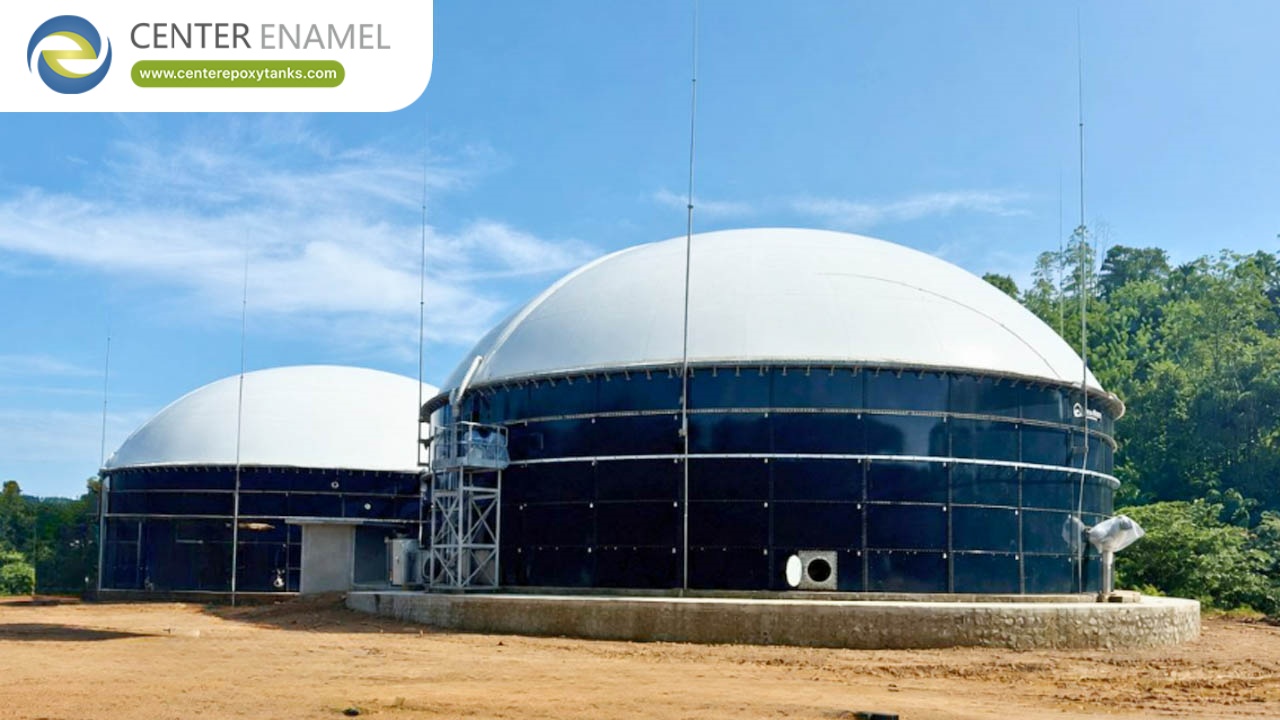
What is a Bolted Steel Anaerobic Digester?
A bolted steel anaerobic digester is a factory-manufactured digester vessel assembled from coated steel panels joined with high-tensile bolts and gaskets. Compared with cast-in-place concrete, it installs in weeks, offers factory-tested corrosion protection, and can be expanded or relocated as plant needs change.
What is a Bolted Steel Anaerobic Digester?
A bolted steel anaerobic digester is a complete digestion vessel manufactured in a factory and assembled on site: steel panels coated with fusion bonded epoxy or glass-fused-to-steel, joined edge to edge with high-tensile bolts and engineered gaskets, and topped with a gas-tight fixed or membrane roof.
The bolted approach moves every quality-critical step — cutting, coating, and testing — off the construction site and into controlled factory conditions. What arrives on site is a kit of verified panels that assembles into an AWWA D103-09-grade digester in weeks, ready for mixers, heating loops, and gas collection equipment engineered into the design from the start.
Why Bolted Steel Displaces Concrete Digesters
Concrete digestion vessels served the industry's first fifty years, but their structural and commercial limitations now weigh heavily against them:
l Gas-tightness is a permanent battle: concrete creeps, cracks, and admits air.
l Mixer torque and thermal cycling drive structural cracking over service life.
l Construction runs for months, and expansion or relocation is practically impossible.
The Factory Coating Sequence Behind Every Panel
Corrosion protection on a bolted steel digester is applied and verified before shipment:
1. Surface Preparation (Shot Blasting): Premium structural steel plates undergo automated grit or shot blasting to achieve a pristine anchor profile, removing all rust, mill scale, oils, and surface impurities.
2. Electrostatic Powder Application: Specialized thermoset epoxy powder is applied uniformly across both sides of the steel panels using automated electrostatic spray equipment.
3. Thermal Cross-Link Curing: The coated sheets pass through precision tunnel ovens (150°C to 250°C), where the epoxy powder melts, flows, and chemically cross-links into a dense, continuous protective polymer film.
4. Rigorous Quality Control & Holiday Testing: Every individual panel undergoes strict dry film thickness verification and high-voltage holiday spark testing (typically at 1,100V to 1,500V) to guarantee absolute zero pinholes or micro-discontinuities.
Technical Performance Matrix: Anaerobic Digester Construction Methods
Technical Parameter | Bolted Steel Digesters (FBE / GFS) | Cast-in-Place Concrete Digesters | Field-Welded Steel Digesters |
Quality Control | Factory coating, holiday-tested per panel | Site-dependent workmanship and curing | Site welding and coating variability |
Gas-Tightness | Engineered gasketed joints and tested roofs | Degrades with cracking over years | Seams sound, coating weak points |
Construction Time | Weeks from foundation to water test | Months of civil works | Long weather-dependent fabrication |
Expansion / Relocation | Add courses or relocate the vessel | Permanent, fixed forever | Major cutting and rewelding |
Whole-Life Cost | Low maintenance over 30+ years | Repair and relining cycles | Periodic repainting programs |
Bolted Steel Anaerobic Digester Applications
l Agricultural biogas plants digesting manure and crops
l Municipal sludge digestion and food waste co-digestion
l Industrial effluent digestion at breweries and food plants
l Secondary digesters and post-digestion gas collection
l Rapid-deployment digestion capacity upgrades
l Relocatable digestion for phased waste programs
Key Advantages of Bolted Steel Anaerobic Digesters
1. Factory Quality, Site Speed
Panels are coated, cured, and holiday-tested in controlled conditions, then bolted together in weeks — quality that site-coated and concrete vessels cannot replicate, delivered on a fraction of the schedule.
2. Engineered as a Complete Digester
Mixer bridges, heating interfaces, gas roof loads, and instrumentation ports are designed into the structure from day one, eliminating retrofit penetrations that create corrosion and gas leaks.
3. A Digester That Follows the Business
Capacity grows by adding panel courses, digesters replicate as parallel trains, and the vessel can even relocate — bolted steel turns digestion assets into flexible capital.
Quality Standards and Proven References
Center Enamel's epoxy coated and glass-fused-to-steel tanks are engineered in strict accordance with AWWA D103-09, OSHA, ISO 28765, and EN 1090, and manufactured under ISO 9001 and ISO 45001 certified quality systems. As the first manufacturer of glass-fused-to-steel tanks in China — holding nearly 200 enameling patents — Center Enamel has delivered bolted tank projects to more than 100 countries, including a 16,760 m³ biogas project in Inner Mongolia and wastewater and biogas references for global environmental leaders such as Paques and Veolia.
Frequently Asked Questions (FAQ)
Q: Are bolted steel digesters gas-tight?
A: Yes. Joints use engineered gaskets with bolted flange connections, and roofs — fixed or membrane — are designed and tested for digester gas service at low operating pressures.
Q: What coating options exist for bolted digesters?
A: Fusion bonded epoxy (FBE) for chemical resistance at competitive cost, or glass-fused-to-steel for a harder, abrasion-resistant glass-ceramic surface in high-grit feedstock duty.
Q: How big can a bolted steel digester be built?
A: Single vessels commonly range from several hundred to more than 10,000 cubic meters, with multiple digesters combined on large plants.
Q: What is the expected lifespan of an bolted steel anaerobic digester?
A: When manufactured in strict compliance with international design codes (such as AWWA D103) and properly maintained, an bolted steel anaerobic digester is engineered for a dependable operational lifespan exceeding 30 years.


