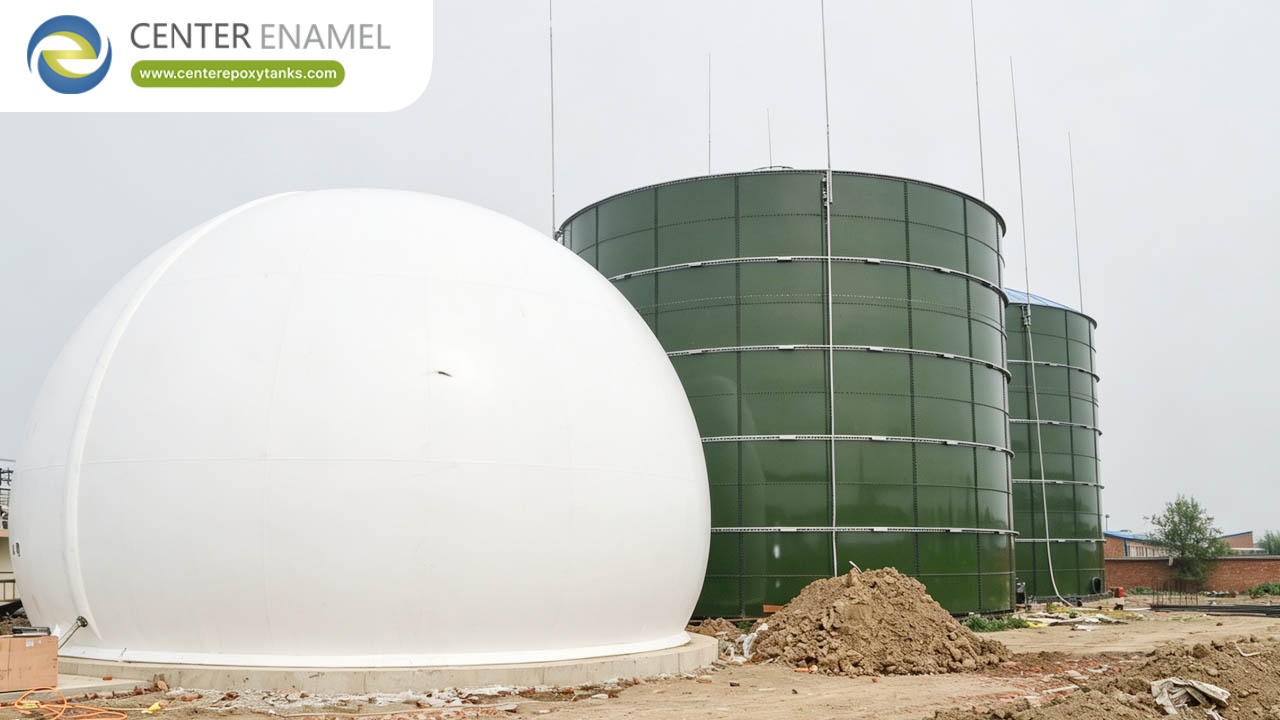
What is a Gas Holder?
A gas holder is a storage device that collects and holds biogas produced by digestion at low pressure, buffering between production and consumption. Modern double-membrane gas holders mount on bolted steel digester tanks or standalone silos, storing gas at 2 to 10 mbar with constant pressure output.
What is a Gas Holder?
A gas holder is the buffer in every biogas system. Digestion produces gas continuously but unevenly, while CHP engines, boilers, and upgrading plants consume it at their own rhythm — the gas holder absorbs that mismatch, holding hours of production at low pressure and delivering it at a steady rate.
Three designs dominate. Double-membrane holders — an inner gas membrane inside an outer weather membrane kept pressurized by an air blower — are today's standard, integrating directly on the digester roof or a standalone bolted steel silo. Single-membrane covers provide simple low-cost storage on lagoons and tanks, while pressurized steel vessels serve niche high-pressure duties. For most plants, the membrane gas holder on a bolted steel tank is the default economics.
Why Every Biogas Plant Needs Gas Storage
Without a gas holder, every mismatch between gas production and consumption is lost revenue: engines trip on lean gas, upgraders starve, and surplus production flares into the sky.
l CHP engines and upgrading plants demand steady gas flow and pressure to run efficiently.
l Flaring surplus gas wastes energy revenue and attracts regulatory attention.
l Maintenance windows on engines or upgraders require somewhere to put continuing production.
Gas Holder Design and Manufacturing
Modern membrane gas holders are engineered and fabricated as complete systems rather than site-improvised covers:
1. Surface Preparation (Shot Blasting): Premium structural steel plates undergo automated grit or shot blasting to achieve a pristine anchor profile, removing all rust, mill scale, oils, and surface impurities.
2. Electrostatic Powder Application: Specialized thermoset epoxy powder is applied uniformly across both sides of the steel panels using automated electrostatic spray equipment.
3. Thermal Cross-Link Curing: The coated sheets pass through precision tunnel ovens (150°C to 250°C), where the epoxy powder melts, flows, and chemically cross-links into a dense, continuous protective polymer film.
4. Rigorous Quality Control & Holiday Testing: Every individual panel undergoes strict dry film thickness verification and high-voltage holiday spark testing (typically at 1,100V to 1,500V) to guarantee absolute zero pinholes or micro-discontinuities.
Technical Performance Matrix: Biogas Storage Options
Parameter | Double-Membrane Gas Holder | Single-Membrane Cover | Pressurized Steel Vessel |
Operating Pressure | Constant 2 to 10 mbar | Minimal, weather-limited | 8 bar and above |
Gas Output Pressure Stability | Constant, blower-regulated | Variable with fill level | High but regulator-dependent |
Typical Capacity Range | 50 to 5,000+ m³ | Large but low-pressure only | Small, high-cost per m³ |
Integration | On digester roofs or bolted silo tanks | On lagoons and open tanks | Standalone pressure equipment |
Gas Holder Applications
l CHP fuel buffering on agricultural and municipal biogas plants
l Feed buffering ahead of biogas upgrading plants
l Sludge digestion gas storage at wastewater treatment works
l Landfill gas collection and buffering
l Lagoon covers with gas capture on livestock facilities
l Process gas buffering in food and brewery effluent plants
Key Advantages of Modern Gas Holders
1. Constant-Pressure Gas, On Demand
The air-cushion design delivers biogas at a steady 2 to 10 mbar regardless of fill level, protecting CPH engines and upgraders from pressure swings that cut efficiency and lifespan.
2. Integrated, Visible Storage
Membrane holders mount directly on the digester or silo tank roof, with the inner membrane's rise giving operators an immediate visual read of stored gas volume.
3. No Moving Parts in the Gas Path
With only the air blower as active equipment, membrane gas holders deliver years of service with minimal maintenance compared with piston or water-sealed predecessors.
Quality Standards and Proven References
Center Enamel supplies complete biogas storage solutions — double-membrane gas holders integrated on epoxy coated and glass-fused-to-steel bolted tank platforms — engineered in accordance with AWWA D103-09, OSHA, ISO 28765, and EN 1090, and manufactured under ISO 9001 and ISO 45001 certified quality systems. With bolted tank projects delivered to more than 100 countries and biogas references for environmental leaders such as Paques and Veolia, the company provides tank, roof, and gas holder packages as one coordinated system.
Frequently Asked Questions (FAQ)
Q: How does a gas holder work?
A: Biogas collects under an inner membrane; a blower pressurizes the space between it and the outer membrane, keeping gas at a constant 2 to 10 mbar and pressing it out on demand.
Q: How is gas holder capacity sized?
A: Holders are commonly sized to store roughly 25% to 50% of daily biogas production, or 8 to 12 hours of CHP consumption — balancing buffer value against membrane cost.
Q: How long do membrane gas holders last?
A: Quality gas membranes serve 10 to 20 years depending on climate and biogas quality, while the supporting bolted steel tank infrastructure is engineered for 30+ years.
Q: What is the expected lifespan of an bolted steel tank supporting a membrane gas holder?
A: When manufactured in strict compliance with international design codes (such as AWWA D103) and properly maintained, an bolted steel tank supporting a membrane gas holder is engineered for a dependable operational lifespan exceeding 30 years.


