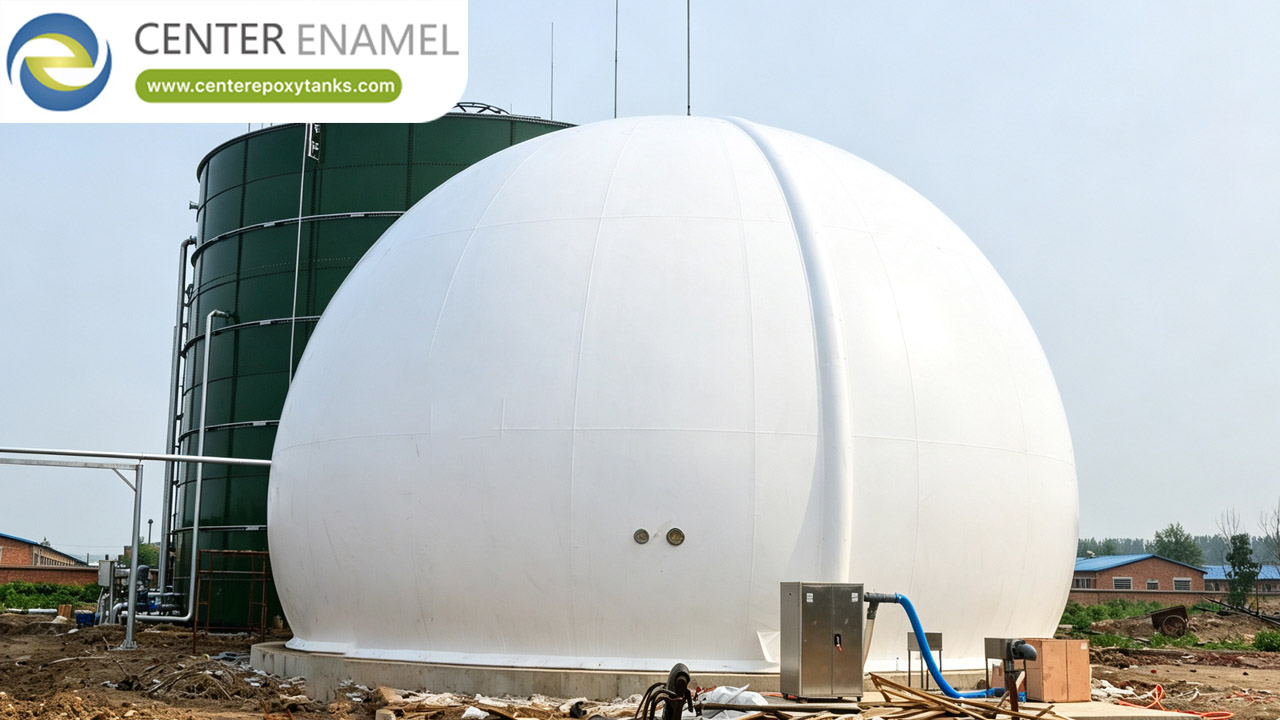
What is a Double Membrane Gas Holder?
A double membrane gas holder (or biogas dome) is an advanced, flexible storage structure engineered specifically to capture and temporarily store biogas produced during anaerobic digestion. Unlike rigid steel gas tanks, it is an air-supported structure that utilizes dual layers of specialized technical fabrics to manage fluctuating gas volumes safely and efficiently.
Operating essentially as the "lung" of a biogas plant, the double membrane system expands as biogas is produced by the digester and contracts as the gas is consumed by boilers, flares, or Combined Heat and Power (CHP) engines. It is widely considered the industry standard for commercial and municipal biogas facilities due to its low capital cost, rapid installation, and highly reliable constant-pressure output.
The Working Principle
The efficiency of a double membrane gas holder relies on the interaction between its two primary layers and a continuous air support system:
The Inner Membrane (Gas Storage): This flexible inner layer forms the actual variable-volume gas containment chamber. It rises and falls dynamically based on the amount of biogas being produced versus consumed.
The Outer Membrane (Weather Protection & Pressure): The outer layer encapsulates the inner membrane. It does not touch the biogas. Instead, the space between the inner and outer membranes is continuously injected with atmospheric air by a support blower.
Constant Pressure Delivery: The air blower maintains a constant, precise pressure in the interstitial space (typically between 2 to 25 mbar). This pressurized air cavity pushes down on the inner membrane, forcing the biogas out of the holder and into the plant's piping at a steady, reliable pressure, eliminating the need for expensive secondary gas boosters. At the same time, the pressurized outer dome remains perfectly rigid, deflecting extreme wind, rain, and snow loads.
Core Components and Material Specifications
Double membrane systems are constructed using highly engineered, PVC-coated polyester fabrics. These materials are flame-retardant, fungicide-treated, and designed to withstand the corrosive effects of biogas components like hydrogen sulfide (H2S) and methane (CH4).
Component | Material / Equipment | Primary Function |
Outer Membrane | UV-stabilized, PVC-coated polyester | Provides the rigid aerodynamic shape, absorbs wind/snow loads, and contains the pressurized air buffer. |
Inner Membrane | Biogas-specific, low-permeability polyester | Expands and contracts to safely contain the volatile biogas; highly resistant to H2S and moisture. |
Bottom Membrane | PVC-coated heavy-duty fabric | Used only in ground-mounted systems to seal the gas chamber against the concrete foundation. |
Support Air Blower | Explosion-proof (ATEX) centrifugal fan | Continuously injects outside air between the membranes to maintain operational pressure and structural rigidity. |
Air Regulation Valve | Mechanical damper or pressure valve | Automatically exhausts excess support air when the inner membrane expands, keeping the internal pressure balanced. |
Ultrasonic Level Sensor | Laser or ultrasonic radar | Measures the height of the inner membrane to provide operators with real-time gas volume data (0-100% capacity). |
Frequently Asked Questions (FAQ)
Q: What happens if the biogas plant produces more gas than the holder can store?
A: Every double membrane gas holder is integrated with a hydraulic or mechanical safety relief valve (overpressure valve). If the internal biogas volume exceeds maximum capacity and pushes the pressure beyond the design threshold, the valve automatically opens to safely vent the excess methane to a flare or the atmosphere, preventing the membranes from rupturing.
Q: Are double membrane gas holders safe from extreme weather?
A: Yes. Because the outer membrane is continuously pressurized by the support air blower, the dome acts like a rigid structural shell. The aerodynamic spherical shape naturally sheds heavy snow and deflects high-velocity winds. During extreme weather events, the blower can be adjusted to increase internal pressure, further stiffening the outer structure.
Q: What is the typical lifespan of a double membrane gas holder?
A: A well-maintained double membrane gas holder typically lasts between 15 and 20 years. The inner membrane generally lasts longer because it is protected from ultraviolet (UV) degradation. The outer membrane, which faces continuous UV exposure and weather, is usually the limiting factor and may require replacement near the 15-year mark depending on the geographic location's UV index.
Q: Can they be installed on the ground or do they have to be on a tank?
A: They can be installed in both configurations. Roof-mounted gas holders are bolted directly to the top flange of the anaerobic digester tank (acting as the tank's roof), which is highly space-efficient. Ground-mounted systems are built on an independent flat concrete slab and utilize a third "bottom membrane" to achieve a complete gas seal.


