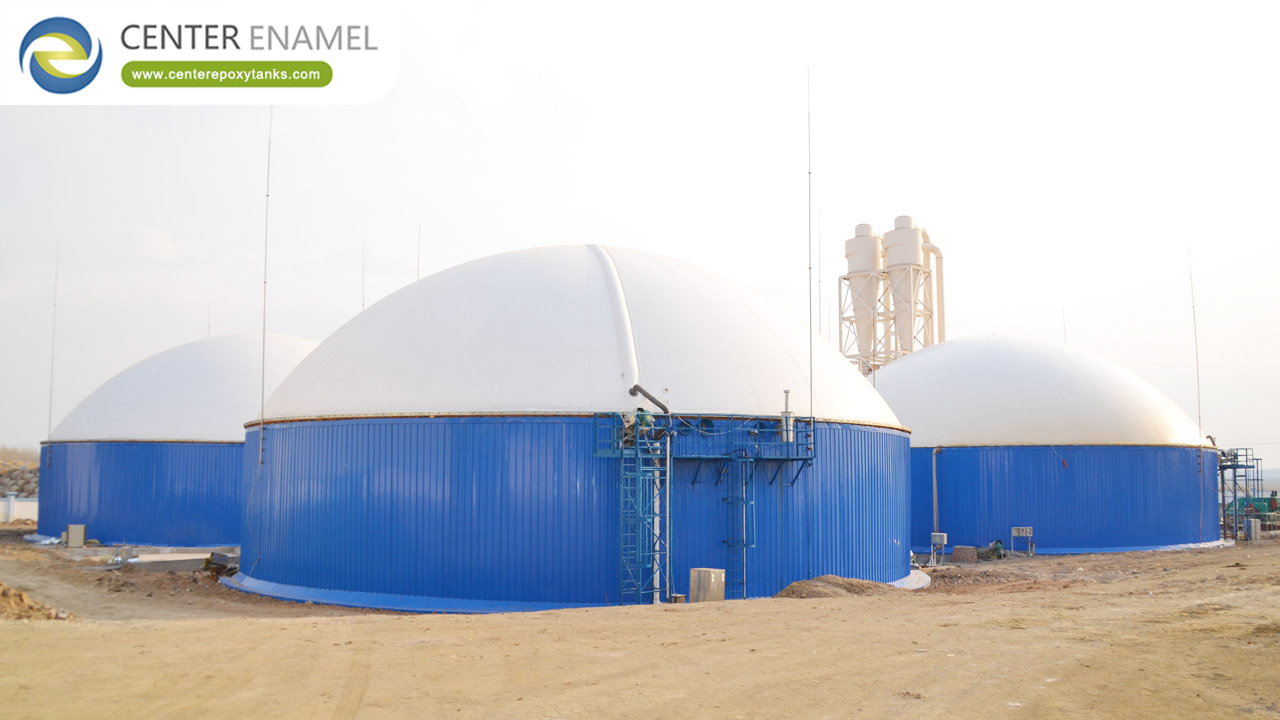
Membrane Covers for Biogas Storage Tanks: Engineering & Integration Guide
A membrane cover for a biogas storage tank is a specialized, flexible fabric structure designed to seal an anaerobic digester, capture volatile methane emissions, and provide temporary gas storage. Unlike traditional rigid steel roofs, membrane covers dynamically adapt to fluctuating gas volumes, operating as the flexible "lung" of a commercial biogas facility.
Constructed from high-tensile, PVC-coated polyester fabrics, these covers are engineered to withstand highly corrosive internal environments—specifically high concentrations of hydrogen sulfide (H2S)—while enduring extreme external UV exposure and weather conditions.
The GFS Tank Advantage
The reliability of a membrane cover is largely dictated by the tank it is mounted on. For modern B2B municipal and industrial applications, integrating membrane covers with Glass-Fused-to-Steel (GFS) tanks provides the highest return on investment.
Because GFS tanks are assembled using precision-engineered bolted steel panels, the stainless steel mounting flange of the membrane cover can be seamlessly mated to the tank’s upper chime. This creates a 100% gas-tight, zero-emission compression seal that is difficult to achieve with uneven cast-in-place concrete walls. Furthermore, the high-temperature bonded glass coating of a GFS tank provides unparalleled corrosion resistance against the aggressive biogas headspace, perfectly matching the chemical resilience of the specialized membrane fabrics.
Single vs. Double Membrane Configurations
When engineering a biogas storage solution, facility managers must choose between single and double membrane architectures based on their gas buffering requirements and environmental loads.
1. Single Membrane Covers
A single membrane cover consists of one layer of gas-tight fabric stretched over a central mast and a network of support straps (often forming a cone shape).
Function: It serves primarily as a gas-tight roof to prevent odor and capture emissions.
Limitation: Because it is directly exposed to the elements, its internal volume fluctuates visibly, and it cannot maintain a constant gas delivery pressure on its own. It is typically used for odor control or small-scale agricultural digesters.
2. Double Membrane Covers (Biogas Domes)
A double membrane cover utilizes two distinct layers of fabric. The inner membrane expands and contracts to store the biogas. The outer membrane is continuously inflated by an explosion-proof air blower, creating a pressurized air buffer between the two layers.
Function: The pressurized air pushes down on the inner membrane, ensuring biogas is delivered to downstream equipment (like a CHP engine) at a constant, steady pressure.
Advantage: The inflated outer dome remains perfectly rigid, deflecting heavy snow loads and high wind shear, making it the standard for high-capacity industrial plants.
Data Table: Single vs. Double Membrane Covers
Feature / Metric | Single Membrane Cover | Double Membrane Cover |
Primary Use Case | Odor control, low-pressure gas capture | High-capacity buffer storage, constant pressure delivery |
Layers | 1 (Gas containment & weather protection combined) | 2 (Inner for gas, Outer for weather & pressure) |
Gas Delivery Pressure | Variable (Requires secondary gas boosters) | Constant (2 mbar to 25 mbar) |
Weather Resistance | Moderate (Susceptible to wind flutter) | High (Rigid outer dome sheds snow and wind) |
Thermal Insulation | Low | High (Pressurized air acts as an insulating buffer) |
Capital Cost | Lower | Higher (Requires support air blowers and sensors) |
Frequently Asked Questions (FAQ)
Q: Can a membrane cover be retrofitted onto an existing steel or concrete tank?
A: Yes. While native integration with bolted GFS tanks is the most efficient, membrane covers can be retrofitted onto existing structures using customized stainless steel mounting brackets and heavy-duty anchor bolts, provided the existing tank wall can handle the tensile loads.
Q: How is the gas volume measured under a membrane cover?
A: In a double membrane system, biogas volume is tracked using an ultrasonic or laser level sensor mounted at the inner apex of the outer dome. It measures the deflection of the inner membrane, translating that distance into a 0-100% capacity reading for the plant's centralized data matrix.
Q: How does a double membrane cover prevent over-pressurization?
A: Every industrial membrane cover is equipped with a mechanical hydraulic safety relief valve (water seal). If the biogas volume exceeds the design threshold, the valve automatically triggers, safely venting excess methane to prevent the membrane fabric from tearing or damaging the tank chime.
Q: Does the outer membrane blower consume a lot of electricity?
A: No. The support air blower is typically a low-horsepower centrifugal fan. In advanced corporate setups, it is paired with a Variable Frequency Drive (VFD) or pressure regulation valve, modulating its output to consume minimal power while maintaining the precise required dome pressure.


