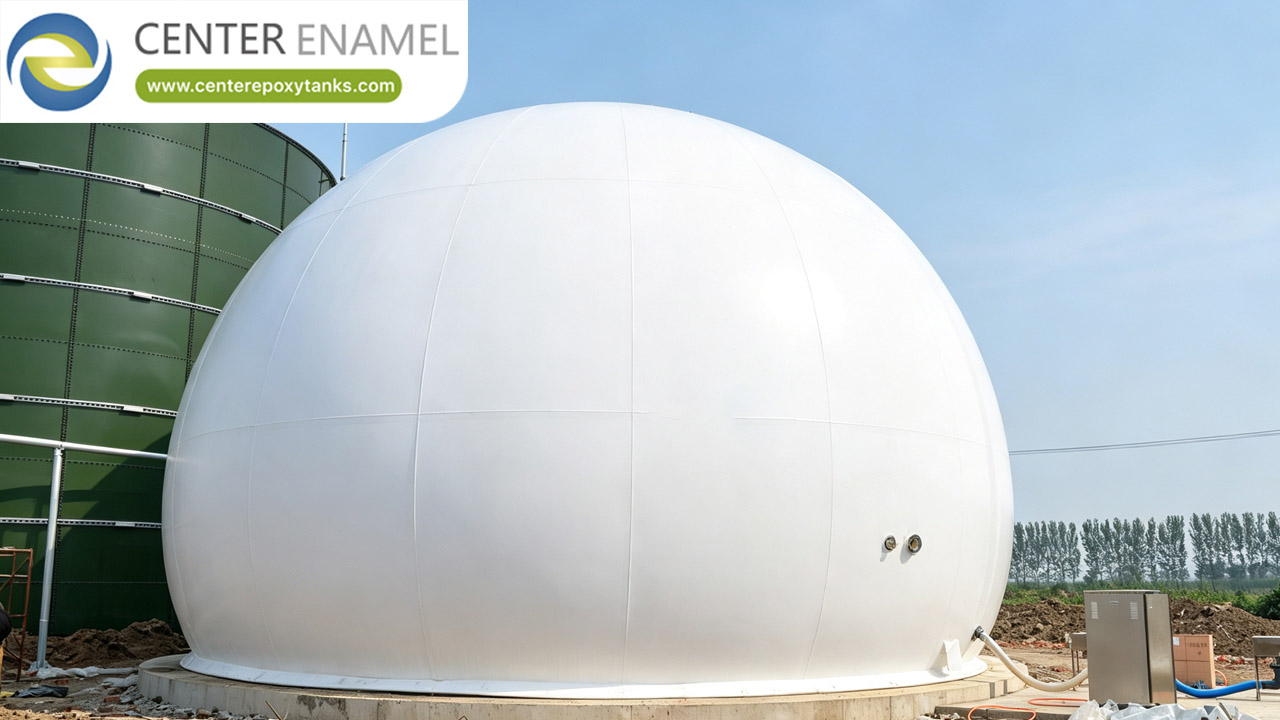
Biogas Holder Design for Commercial CSTR AD Plants
A double membrane biogas holder is a critical, flexible storage structure engineered to temporarily capture and store biogas produced during anaerobic digestion. In commercial Continuously Stirred Tank Reactor (CSTR) plants, the gas holder typically functions as the roof of the digester itself. It consists of an inner gas-tight membrane that expands to hold fluctuating volumes of methane, and an outer weatherproof membrane that is continuously pressurized by an air blower. This pressurized air buffer protects the inner layer and maintains a steady gas delivery pressure to downstream equipment like flares, boilers, or Combined Heat and Power (CHP) engines.
Designing a biogas holder specifically for a CSTR environment requires careful integration with the digester's mixing systems, the tank wall structure, and the aggressive chemical environment generated by high-yield agricultural or industrial feedstocks.
1. CSTR Digester Synergy and Operational Buffering
CSTRs are the workhorse of modern commercial biogas facilities because their continuous mixing ensures maximum microbial contact with the substrate. However, this continuous biological activity produces high volumes of biogas that must be managed safely.
Continuous Production vs. Intermittent Consumption: The primary role of the biogas holder is to act as a buffer. While the CSTR produces gas 24/7, a CHP engine may throttle down during off-peak hours. A well-designed roof-mounted holder typically stores 20% to 30% of the plant's daily gas production, smoothing out these operational spikes.
Thermal Insulation: CSTRs require strict temperature control (typically mesophilic at 35–40°C or thermophilic at 50–55°C). The pressurized air cavity between the inner and outer membranes acts as an excellent thermal insulator, significantly reducing the heating energy required to maintain the digester's internal temperature in colder climates.
2. Seamless Glass-Fused-to-Steel (GFS) Tank Integration
The structural interface between the flexible biogas dome and the rigid digester tank dictates the long-term reliability and emission control of the entire plant.
For commercial CSTR applications, roof-mounted holders are most effectively deployed on top of Glass-Fused-to-Steel (GFS) tanks. Because GFS tanks are assembled using precision-engineered bolted steel panels, the stainless steel mounting flange of the double membrane holder can be perfectly matched to the tank’s upper chime.
This creates a 100% gas-tight, zero-emission compression seal. Furthermore, the inert, high-temperature bonded glass coating of a GFS tank provides unparalleled resistance to the corrosive hydrogen sulfide (H2S) found in the digester's headspace, perfectly complementing the chemical resistance of the inner biogas membrane.
3. Mixing System Accommodations
CSTRs rely on aggressive mixing—via mechanical agitators, hydraulic jets, or biogas recirculation—to prevent crust formation and ensure homogeneous digestion.
When designing the roof-mounted gas holder, engineers must account for the mechanical penetrations required by top-mounted, slow-speed submersible mixers. The inner and outer membranes must be custom-fabricated with reinforced, stainless steel encapsulated rope edges around these penetrations to maintain gas-tight integrity while allowing the mixer shafts to operate under high torque.
Data Table: Double Membrane Material Specifications for CSTRs
A commercial-grade biogas holder utilizes distinct technical fabrics for its inner and outer layers, driven by their different operational exposures.
Specification / Component | Inner Membrane (Gas Containment) | Outer Membrane (Weather Protection) |
Primary Material | PVC-coated polyester / Biogas-specific acrylic | UV-stabilized PVC-coated polyester |
Methane Permeability | Extremely Low (< 400 cm³/m²/day) | Not applicable (contains air) |
Chemical Resistance | High (H2S, Ammonia, moisture) | Moderate (Air and atmospheric pollutants) |
UV Resistance | Low (Protected from sunlight) | Very High (Requires specialized topcoats) |
Operating Pressure Role | Variable volume, pushed by outer air pressure | Constant pressure (Typically 10 to 25 mbar) |
Expected Lifespan | 20+ Years (Not exposed to UV degradation) | 15–20 Years (Depending on regional UV index) |
Frequently Asked Questions (FAQ)
Q: How does the system prevent the biogas dome from over-pressurizing the CSTR tank?
A: Every commercial double membrane system is equipped with a mechanical hydraulic safety relief valve (often called a water seal). If the internal biogas volume exceeds the design limit, the valve automatically triggers, venting excess methane safely to a flare or the atmosphere to prevent structural damage to the membranes or the GFS tank.
Q: Does the air blower for the outer membrane run continuously?
A: Yes, the air blower typically operates continuously. It is often modulated by a pressure control valve or a Variable Frequency Drive (VFD) to maintain a rigid dome shape against dynamic wind and snow loads, while providing a constant downward push on the inner membrane to deliver biogas to the engine.
Q: How do operators know how much gas is currently stored in the dome?
A: Biogas volume is tracked using an electronic measurement system, typically an ultrasonic level sensor mounted at the apex of the outer dome. It measures the distance down to the inner membrane and sends a 4-20mA signal to the plant's SCADA system, allowing operators to automate gas consumption based on real-time buffer levels.
Q: Can a roof-mounted gas holder handle heavy snow loads in northern climates?
A: Yes. The outer membrane is specifically engineered and pressurized to resist both high wind shear and significant snow accumulation. In extreme environments, the operating pressure is increased and the fabric's tensile strength is uprated to ensure the dome does not collapse inward under heavy snow weight.


