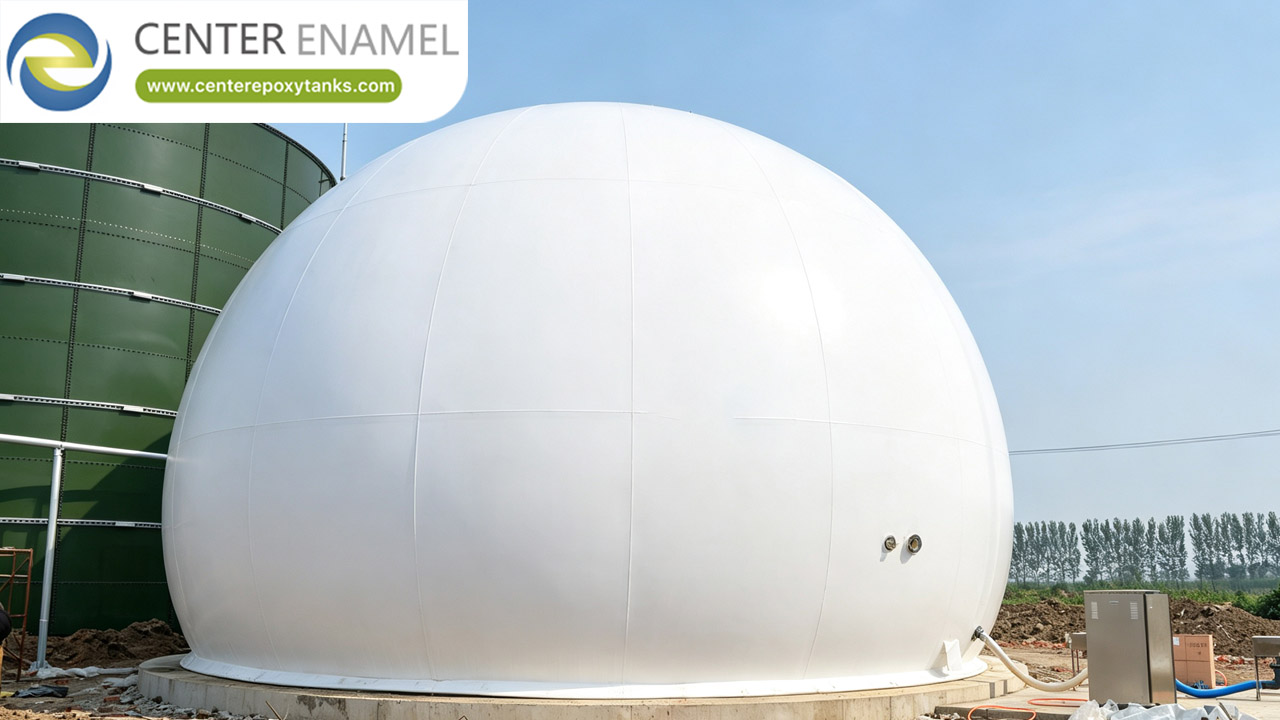
Double Membrane Gas Holders: A Technical Comparison of Ground and Roof-Mounted Systems
A double membrane gas holder is an advanced, flexible storage structure engineered to temporarily capture and store biogas produced by anaerobic digestion. The system consists of an inner gas-tight membrane that expands to hold fluctuating volumes of methane, and a continuously pressurized outer weatherproof membrane that protects the inner layer while maintaining steady gas delivery pressure to downstream equipment like flares or Combined Heat and Power (CHP) engines.
When designing a biogas plant, engineers must choose between two primary configurations: roof-mounted (installed directly on top of the digester tank) and ground-mounted (installed on an independent foundation). Selecting the right configuration depends on your plant's footprint, gas buffer requirements, and underlying tank infrastructure.
1. Roof-Mounted Gas Holders: Maximizing Site Efficiency
A roof-mounted configuration utilizes the gas holder as the actual roof of the anaerobic digester. This is the most common and space-efficient design for modern agricultural and municipal biogas plants.
Seamless GFS Tank Integration
The operational efficiency of a roof-mounted system peaks when paired with premium Glass-Fused-to-Steel (GFS) tanks. Because GFS tanks are assembled using bolted steel panels, the stainless steel mounting flange of the double membrane holder can be perfectly matched to the tank’s upper chime. This creates a 100% gas-tight, zero-emission seal. The inherent corrosion resistance of the GFS panels perfectly complements the hydrogen sulfide (H_2S) resistance of the biogas membrane, creating a unified, multi-decade asset.
Key Advantages:
Zero Additional Footprint: By placing the storage on top of the digester, the plant requires significantly less land.
Lower Civil Engineering Costs: Eliminates the need to pour a separate, dedicated concrete foundation solely for gas storage.
Thermal Efficiency: The pressurized air buffer between the inner and outer membranes acts as a thermal insulator for the heated slurry inside the digester, reducing the energy needed to maintain mesophilic or thermophilic temperatures.
2. Ground-Mounted Gas Holders: High-Capacity Buffer Storage
For massive industrial plants or facilities where gas production vastly outpaces immediate consumption, a ground-mounted system is often required. These are typically designed as 3/4 spheres or half-spheres and are installed on an independent, flat concrete slab.
Independent Structural Integrity
Unlike roof-mounted systems, ground-mounted holders require a third bottom membrane to seal the biogas against the concrete foundation. Because they are decoupled from the digester tank, their sizing is completely independent of the digester's diameter.
Key Advantages:
Unlimited Scalability: Ideal for massive buffer storage needs, easily scaling to volumes exceeding 10,000 m^3.
Retrofit Friendly: Can be added to existing biogas plants that need to expand their gas storage capacity without altering the original digester tanks.
Isolated Maintenance: Allows operators to perform maintenance on the digester tanks without having to depressurize or dismantle the primary gas storage matrix.
Data Table: Configuration Comparison
Feature / Metric | Roof-Mounted (On Digester Tank) | Ground-Mounted (Standalone) |
Primary Application | Space-constrained sites, unified GFS digesters | Large-scale plants requiring massive buffer storage |
Membrane Layers | 2 (Inner Gas, Outer Air) | 3 (Inner Gas, Outer Air, Bottom Seal) |
Footprint Required | None (Uses existing tank footprint) | High (Requires dedicated land) |
Foundation Costs | Low (Bolted to tank chime) | High (Requires dedicated concrete slab) |
Typical Operating Pressure | 10 mbar to 25 mbar | 15 mbar to 30 mbar |
Capacity Constraints | Limited by the diameter of the digester tank | Highly scalable, independent of digester size |
Frequently Asked Questions (FAQ)
Q: Which configuration provides better protection against extreme wind and snow loads?
A: Both configurations are highly resilient if properly pressurized. However, ground-mounted systems (being closer to the earth) generally experience slightly lower wind shear than roof-mounted systems elevated 15 to 20 meters in the air. For roof-mounted systems on GFS tanks, the blower must be calibrated to maintain higher internal pressure during storm events to ensure the outer dome remains rigid.
Q: Can a roof-mounted gas holder be installed on a concrete tank?
A: Yes, but it requires a specialized cast-in-place mounting ring and heavy-duty anchor bolts. Integrating with a bolted GFS tank is generally faster and provides a more reliable, flush seal due to the precision-engineered steel chime.
Q: How is the gas volume measured in a ground-mounted system?
A: Just like roof-mounted systems, ground-mounted holders use an ultrasonic level sensor mounted at the inner apex, or a wire-actuated mechanical encoder. This tracks the height of the inner membrane and sends a 4-20mA signal back to the plant's centralized data matrix, allowing for automated control of gas consumption.
Q: Do I need a separate safety relief valve for a ground-mounted holder?
A: Yes. Regardless of the mounting configuration, every double membrane gas holder must feature a mechanical hydraulic overpressure valve (water seal) to automatically vent excess methane if the internal pressure exceeds the design threshold, preventing catastrophic membrane rupture.


