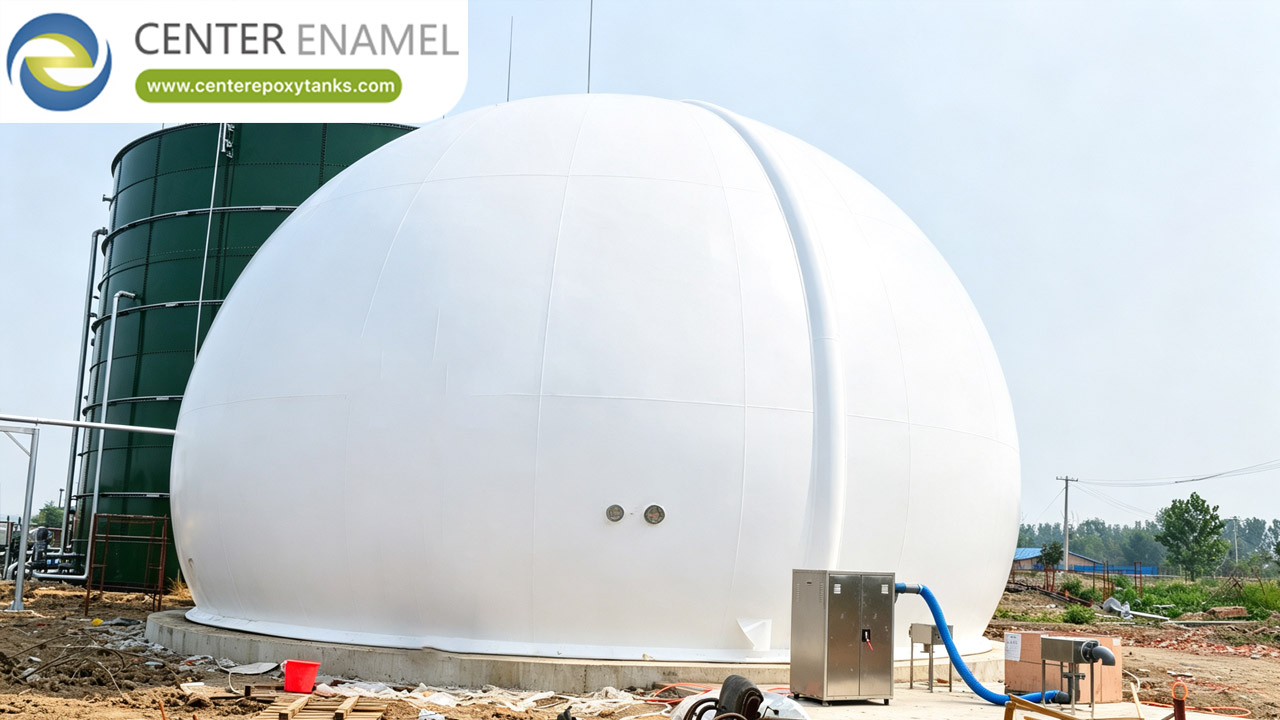
Double Membrane Biogas Holder for Efficient Gas Storage
A double membrane biogas holder is a flexible, highly durable dual-layer structure designed to temporarily store biogas produced by an anaerobic digester. Operating as the "lung" of a biogas plant, it features an inner gas-tight membrane that inflates and deflates to match the fluctuating volume of generated methane, while an outer weatherproof membrane is constantly pressurized by an air blower to protect the inner layer and maintain a steady gas delivery pressure to the flare or Combined Heat and Power (CHP) engine.
For industrial and agricultural plants aiming to optimize their global B2B footprint, selecting a high-efficiency biogas holder—and seamlessly integrating it with the correct digester tank matrix—is crucial to maximizing methane yield and operational safety.
How Double Membrane Holders Drive Plant Efficiency
1. Constant Pressure Gas Delivery
One of the primary efficiency drivers of a double membrane system is its ability to deliver biogas at a highly stable pressure. The constant air pressure in the interstitial space (between the inner and outer membranes) pushes down on the stored biogas. This eliminates the need for expensive downstream gas booster compressors, allowing methane to feed directly into boilers, generators, or upgrading systems at a steady rate.
2. Seamless Integration with Bolted Steel & GFS Tanks
The true efficiency of a biogas holder is realized when it is paired with the right underlying tank structure.
Top-Mounted Synergy: Mounting the holder directly on top of the digester tank (acting as the tank's roof) saves significant land space and reduces concrete foundation costs.
GFS Tank Compatibility: Double membrane holders are most efficiently deployed on top of Glass-Fused-to-Steel (GFS) or Fusion Bonded Epoxy (FBE) bolted tanks. The stainless steel compression profile of the gas holder can be perfectly matched to the bolted chime of a GFS tank, ensuring a 100% leak-proof, zero-emission seal. Furthermore, the inherent corrosion resistance of the GFS panels perfectly complements the H_2S resistance of the biogas membrane, creating a unified, multi-decade asset.
3. Superior Weather & UV Protection
The outer membrane is constructed from robust, UV-stabilized PVC or acrylic-lacquered polyester. Because it remains rigidly inflated at all times, it deflects heavy snow loads and resists extreme wind shear, protecting the vital inner gas-storage membrane from the elements and preventing thermal shock to the mesophilic or thermophilic biology inside the digester.
Biogas Holder Configuration Matrix
Understanding the difference between top-mounted and ground-mounted configurations is key to strategic site planning.
Feature / Metric | Top-Mounted (On Digester Tank) | Ground-Mounted (Standalone) |
Primary Use Case | Space-constrained sites, unified GFS digesters | Large-scale plants needing massive buffer storage |
Foundation Requirement | Bolted directly to tank flange (No extra concrete) | Requires a dedicated flat concrete slab |
Number of Membranes | 2 (Inner Gas, Outer Air) | 3 (Inner Gas, Outer Air, Bottom Seal) |
Operating Pressure | 10 mbar to 25 mbar | 15 mbar to 30 mbar |
Capital Expenditure | Lower (Doubles as the tank roof) | Higher (Requires extra footprint and ground prep) |
Capacity Sizing | Typically 20% - 30% of daily production | Scalable up to 10,000 m3+ |
Frequently Asked Questions (FAQ)
Q: How do you measure the volume of gas inside a double membrane holder?
A: Biogas volume is precisely monitored using an ultrasonic level sensor mounted at the apex of the outer dome. The sensor measures the distance to the inner membrane. This data is converted into a 4-20mA signal and fed into the plant's centralized control matrix, allowing operators to automate the CHP engine or flare based on real-time gas availability.
Q: Is the inner membrane safe from the highly corrosive hydrogen sulfide (H2S) found in biogas?
A: Yes. The inner membrane is specifically engineered from biogas-grade, low-permeability polyester fabric that is highly resistant to H2S, ammonia, and water vapor. However, it is standard engineering practice to also employ biological or chemical desulfurization within the tank to protect downstream engines.
Q: What happens if gas production exceeds the capacity of the holder?
A: All efficient gas storage systems are equipped with a mechanical hydraulic safety relief valve. If the internal gas volume pushes the pressure beyond the maximum design threshold, the safety valve automatically triggers, venting the excess gas safely to a flare or the atmosphere to prevent membrane rupture.
Q: Can a double membrane holder be retrofitted onto an existing concrete or steel tank?
A: Yes. Provided the existing tank's upper wall can support the combined aerodynamic and structural load of the dome, a stainless steel mounting flange can be retrofitted. However, native integration with modular bolted GFS tanks during the initial design phase yields the highest operational synergy and lowest lifetime maintenance cost.


