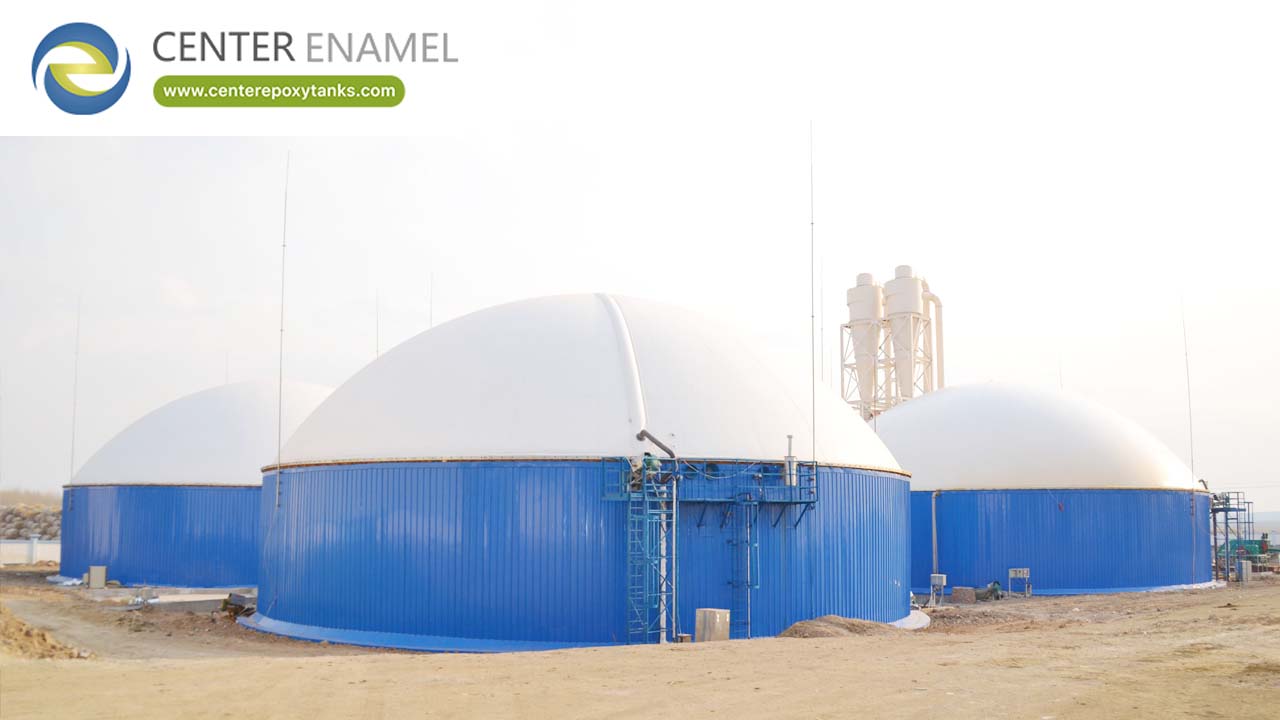
How to Choose a Double Membrane Biogas Holder for Anaerobic Digesters
A double membrane biogas holder is a flexible, gas-tight storage structure mounted on top of an anaerobic digester or a concrete foundation. It consists of two primary layers: an inner membrane that expands and contracts to store the generated biogas, and a continuously pressurized outer membrane that protects the inner layer from wind, snow, and UV degradation while maintaining a constant operating pressure for the gas network.
Selecting the correct biogas holder is critical for plant safety, gas utilization efficiency, and long-term asset protection. Here are the core engineering criteria to evaluate when specifying a double membrane system.
1. Tank Integration and Flange Compatibility
The structural synergy between the biogas holder and the digester tank below it dictates the long-term reliability of the seal. When mounting a gas holder on top of industrial anaerobic digesters—particularly premium Glass-Fused-to-Steel (GFS) tanks—the interface must be flawless.
Chime Sealing: Ensure the holder’s stainless steel compression profile matches the exact diameter and flange specifications of the GFS tank.
Hydrostatic Load: The underlying tank must be engineered to bear both the hydrostatic load of the internal slurry and the aerodynamic load (wind shear) transferred from the inflated dome.
Gas Tightness: Look for systems that utilize EPDM rubber gaskets between the membrane bead and the tank wall to guarantee zero fugitive methane emissions.
2. Sizing and Gas Storage Capacity
Biogas storage capacity is not just about the digester's total volume; it is a buffer designed to handle the differential between gas production rates and gas consumption rates (e.g., feeding a Combined Heat and Power (CHP) engine or a flare).
A standard rule of thumb for agricultural and industrial biogas plants is to size the holder to store 25% to 30% of the plant’s daily gas production.
If your plant produces 1,000 m^3 of biogas per day, the holder should have a net usable volume of at least 250 m^3 to 300 m^3.
3. Operating Pressure and Structural Loads
The outer membrane is kept inflated by an explosion-proof air blower. This creates a pressurized air space between the inner and outer layers, pushing down on the inner gas membrane to deliver biogas to the engine at a constant pressure.
Standard Operating Pressures: Typically range from 10 mbar to 25 mbar (1.0 to 2.5 kPa).
Snow and Wind Loads: If the plant is located in an extreme environment, the outer membrane's operating pressure and fabric tensile strength must be uprated to resist wind speeds exceeding 120 km/h or heavy snow accumulation, preventing the dome from collapsing inward.
4. Membrane Material Selection
Biogas contains harsh compounds like hydrogen sulfide (H_2S), ammonia, and water vapor. The inner membrane must be chemically inert, while the outer membrane must resist aggressive UV radiation and thermal expansion.
Data Table: Biogas Membrane Material Comparison
Material Type | Primary Application | Chemical Resistance (H2S) | UV & Weather Resistance | Expected Lifespan | Relative Cost |
Standard PVC Coated | Small agricultural digesters | Moderate | Moderate (Requires UV inhibitors) | 10 – 12 Years | Low |
Biogas-Specific Polyester (Acrylic lacquered) | Industrial GFS tanks, municipal WWTPs | High (Permeability < 400 cm^3/m^2/day) | High | 15 – 20 Years | Moderate |
ETFE / PTFE | Extreme industrial environments, specialized uses | Excellent | Excellent (Self-cleaning) | 25+ Years | Very High |
Frequently Asked Questions (FAQ)
Q: How is the inner membrane protected from over-pressurization?
A: Every double membrane biogas holder must be equipped with a mechanical hydraulic safety relief valve (often called a water seal or overpressure valve). If the gas volume exceeds the design limit, the valve automatically vents the excess biogas to the atmosphere or a flare, preventing membrane rupture.
Q: Can a double membrane biogas holder be installed on the ground instead of on a tank?
A: Yes. Ground-mounted biogas holders (usually 3/4 spheres or half-spheres) are installed on a flat concrete foundation slab. In this configuration, a third layer—a bottom membrane—is used to seal the gas against the concrete base.
Q: Does the air blower run continuously?
A: Yes, the air blower typically runs continuously, modulated by a pressure control valve or a Variable Frequency Drive (VFD). It constantly replenishes air to the outer chamber to maintain a rigid dome shape against weather forces and to provide a steady push against the inner gas membrane.
Q: How do operators know how much gas is inside the holder?
A: Holders utilize an electronic volume measurement system. This usually involves an ultrasonic sensor mounted at the top of the dome pointing down at the inner membrane, or a mechanical wire-actuated encoder that physical tracks the height of the inner membrane, sending a 4-20mA signal to the plant's SCADA system.


