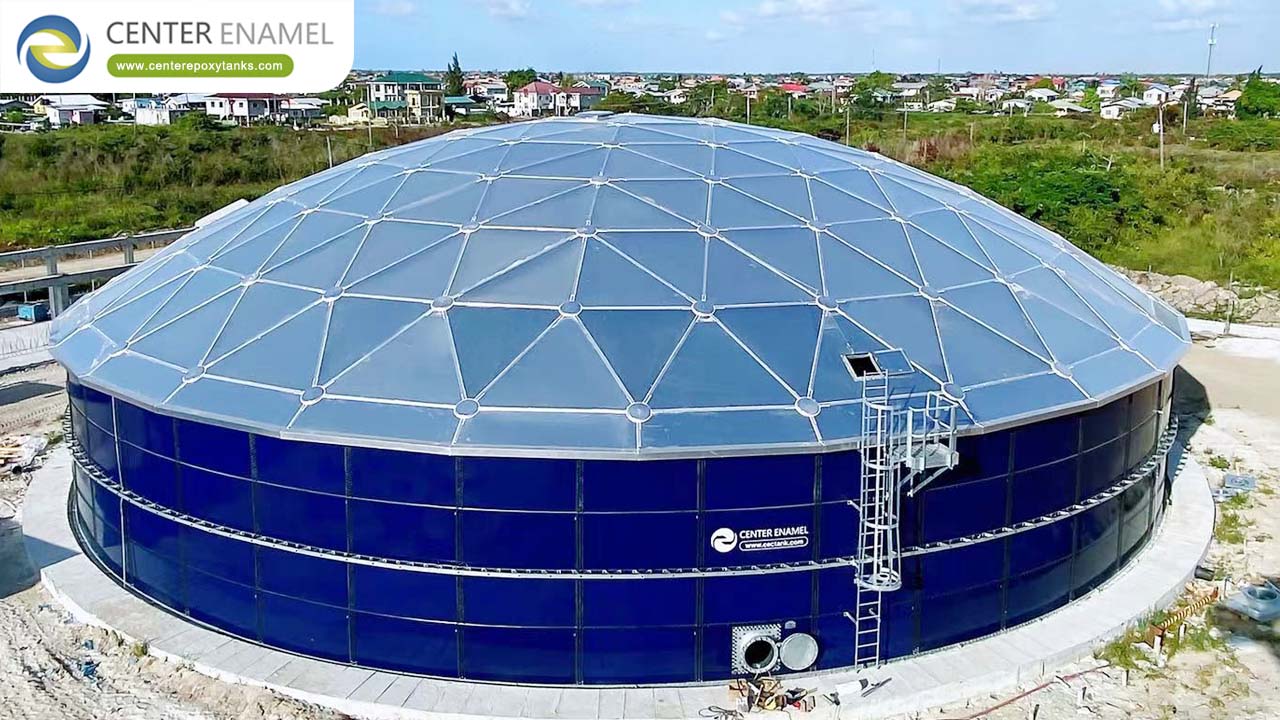
What Is a Dome Roof Tank? Design, Geodesic Structures, and Industrial Applications
In modern industrial bulk liquid containment—spanning petroleum storage terminals, municipal water reservoirs, and chemical processing facilities—roof design plays a pivotal role in asset longevity and environmental compliance. While traditional tanks have long relied on heavy welded steel cone roofs, advanced fluid management has shifted toward dome roof tanks, specifically engineered with structural aluminum geodesic frames.
A dome roof tank is an aboveground storage tank (AST) crowned with a self-supporting, three-dimensional geodesic dome structure. This modern engineering approach eliminates the need for internal support columns, offering superior structural strength, zero interior corrosion, and enhanced protection against environmental elements.
1. The Engineering Mechanics of Aluminum Geodesic Domes
Unlike traditional fixed roofs that rely on heavy steel rafters and center support columns, a geodesic dome roof utilizes a triangular space-frame geometry derived from mathematical principles:
Self-Supporting Clear-Span Design: The dome structure distributes loads uniformly along the perimeter ring beam attached to the top of the tank shell. This provides an absolute clear-span interior, eliminating internal columns that can interfere with internal floating roofs, mixers, or bottom cleaning systems.
High-Strength Aluminum Alloys: Modern industrial domes are constructed using marine-grade aluminum alloys (typically 6061-T6). Aluminum provides an exceptional strength-to-weight ratio while forming a natural protective oxide layer that resists atmospheric weathering, hydrogen sulfide corrosion, and ultraviolet (UV) radiation without requiring painting.
2. Integration with Internal Floating Roofs (IFRTs)
One of the most powerful applications of a dome roof tank is its synergy with internal floating decks:
The Ultimate Emission-Control Pairing: When an aluminum geodesic dome is installed over an internal floating roof tank (IFRT), it creates a dual-barrier system. The internal deck eliminates volatile organic compound (VOC) vapor space, while the exterior aluminum dome blocks 100% of rain, snow, wind shear, and solar heat gain.
Thermal Efficiency: The reflective surface of the aluminum dome reduces solar radiation absorption inside the tank, significantly lowering internal temperatures and minimizing product vaporization and breathing losses.
Data Table: Aluminum Geodesic Dome Roofs vs. Traditional Welded Steel Cone Roofs
Evaluation Parameter | Aluminum Geodesic Dome Roofs | Traditional Welded Steel Cone Roofs |
Structural Architecture | Self-supporting triangular space frame (Clear-span) | Rafters and plates; requires internal columns on large spans |
Material Composition | Marine-grade aluminum (Alloy 6061-T6) | Structural carbon steel (requiring periodic painting) |
Corrosion Resistance | Excellent; natural oxide layer requires zero painting | Moderate to low; requires protective coatings and linings |
Roof Weight | Extremely lightweight; minimizes seismic overturning moments | Heavy dead load; increases foundational requirements |
Retrofit Capability | Highly adaptable for retrofitting existing open-top tanks | Complex and labor-intensive to modify in the field |
3. Compliance and Structural Standards
Dome roof tanks are precision-engineered to meet stringent international standards, ensuring they withstand extreme meteorological conditions:
ASCE 7 and API 650 Compliance: Geodesic domes are designed to withstand regional live loads, including heavy snow accumulation, hurricane-force winds, and seismic activity, in strict compliance with API 650 Appendix G or AWWA D100 standards.
Frequently Asked Questions (FAQ)
Q: What is a dome roof tank?
A: A dome roof tank is an industrial storage vessel featuring a self-supporting, three-dimensional geodesic dome roof—typically constructed from high-strength aluminum—that covers the tank without requiring internal support columns.
Q: Why are aluminum geodesic domes preferred over steel roofs?
A: Aluminum geodesic domes are preferred because they are lightweight, completely corrosion-resistant (eliminating the need for periodic painting), require no internal support columns, and can be easily retrofitted onto existing tanks.
Q: Can a dome roof tank be used with an internal floating roof?
A: Yes. Combining an aluminum geodesic dome with an internal floating roof creates an optimal hybrid storage system that eliminates VOC emissions while completely shielding the floating deck from rain, snow, and wind.
Q: What engineering standards govern aluminum dome roof tanks?
A: They are designed, fabricated, and installed in accordance with international structural codes, including API 650 Appendix G for industrial storage and AWWA D100 for municipal water applications.


