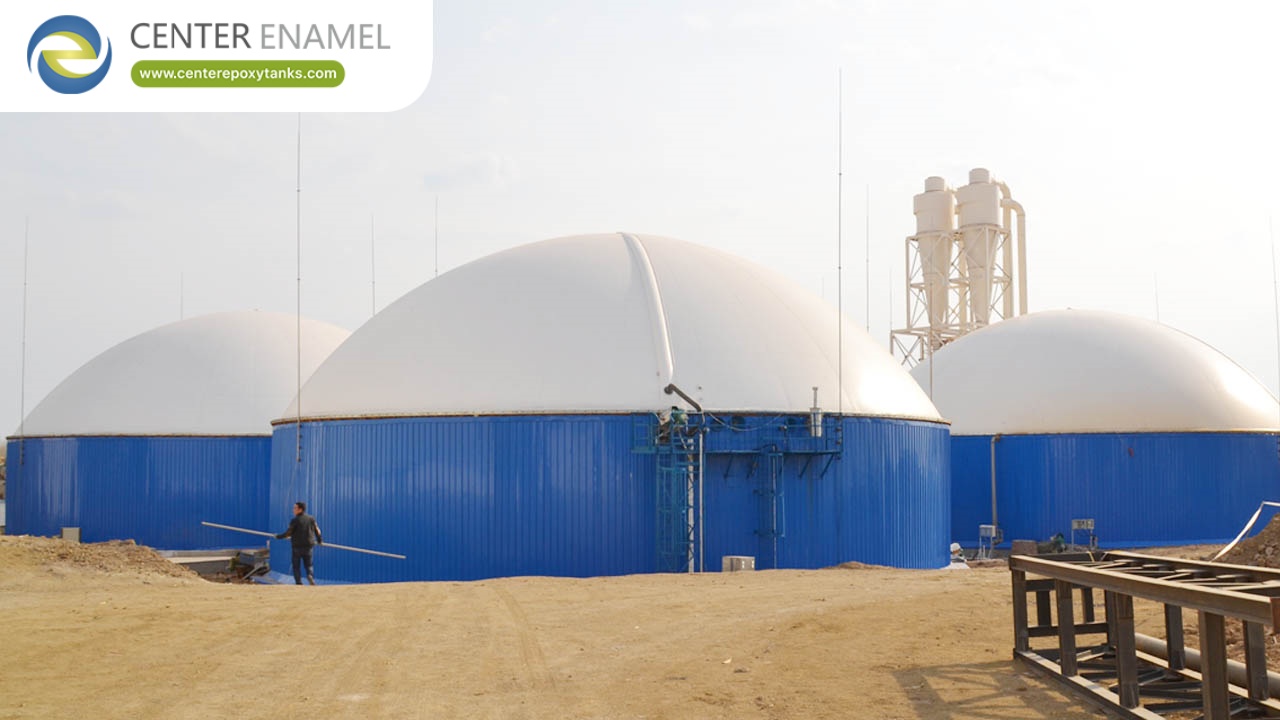
What is a Biogas Tank?
A biogas tank is the sealed steel vessel at the heart of a biogas system where organic waste is digested and biogas is produced, stored, and buffered. Epoxy coated bolted steel biogas tanks combine gas-tight construction, corrosion resistance, and modular installation for 30+ years of service.
What is a Biogas Tank?
The term biogas tank covers two related vessels in every biogas system. The first is the digester — the heated, mixed, oxygen-free tank in which bacteria decompose manure, sludge, or food waste and release methane-rich gas. The second is the gas storage tank or gas holder that buffers the biogas between production and use in a CHP engine, boiler, or upgrading plant.
Both duties punish ordinary materials. Inside the digester, hydrogen sulfide and ammonia attack unprotected steel; on the roof, constant gas pressure and mixer loads demand engineered structure; in storage, moisture and trace gases corrode from within. Epoxy coated bolted steel biogas tanks answer with a factory-fused thermoset lining on every panel, gasketed gas-tight joints, and modular construction that installs a complete biogas tank farm in weeks.
Why Biogas Systems Demand Specialized Tanks
Biogas revenue depends on gas that never leaks and biology that never stops. The digester environment — warm, wet, sulfurous, and continuously agitated — is one of the most corrosive service conditions in industrial tank engineering.
l H2S in raw biogas converts to sulfuric acid on cool surfaces above the liquid line.
l Gas-tightness failures lose methane revenue and create explosion-zone compliance issues.
l Concrete digesters crack under mixer torque and thermal cycling, and are nearly impossible to relocate or extend.
The Engineering and Fusion-Bonding Process
Every panel of an epoxy coated biogas tank is protected in an automated factory sequence:
1. Surface Preparation (Shot Blasting): Premium structural steel plates undergo automated grit or shot blasting to achieve a pristine anchor profile, removing all rust, mill scale, oils, and surface impurities.
2. Electrostatic Powder Application: Specialized thermoset epoxy powder is applied uniformly across both sides of the steel panels using automated electrostatic spray equipment.
3. Thermal Cross-Link Curing: The coated sheets pass through precision tunnel ovens (150°C to 250°C), where the epoxy powder melts, flows, and chemically cross-links into a dense, continuous protective polymer film.
4. Rigorous Quality Control & Holiday Testing: Every individual panel undergoes strict dry film thickness verification and high-voltage holiday spark testing (typically at 1,100V to 1,500V) to guarantee absolute zero pinholes or micro-discontinuities.
Technical Performance Matrix: Biogas Tank Construction Technologies
Technical Parameter | Epoxy Coated Bolted Steel Biogas Tanks | Cast-in-Place Concrete Digesters | Field-Welded Steel Tanks |
Gas-Tightness | Engineered gasketed joints with gas-tight roof integration | Concrete creep and cracking make permanent gas-tightness difficult | Weld seams and site coatings require continuous inspection |
Corrosion Resistance | FBE lining resists H2S, ammonia, and digestate chemistry on every panel | Acid attack on concrete matrix and rebar over digestion cycles | Site-applied coatings degrade rapidly in biogas service |
Installation Velocity | Modular bolted assembly in weeks, including roofs and mixer interfaces | Multi-month civil works with formwork and curing | Slow field welding, blasting, and coating in weather-dependent conditions |
Expansion & Relocation | Tanks extendable by adding courses or relocatable as plants grow | Permanent structure; expansion impractical | Rigid footprint; modification requires cutting and rewelding |
Biogas Tank Applications
l Primary and secondary digester vessels on agricultural biogas plants
l Sewage sludge digestion at municipal wastewater treatment works
l Food waste and agro-industrial effluent digestion
l Post-digestion biogas storage with membrane gas holders
l Digestate storage and buffer tanks completing the plant tank package
l Industrial wastewater anaerobic treatment in food, brewery, and pulp and paper sectors
Key Advantages of Epoxy Coated Biogas Tanks
1. Gas-Tight, Factory-Verified Construction
Panel joints engineered with certified gaskets, combined with tested membrane roof options, keep methane in the system — protecting gas revenue and simplifying ATEX and gas-safety compliance.
2. Corrosion Protection Engineered for Digestion Chemistry
The cross-linked FBE film resists the H2S, ammonia, and acidic conditions inside the digester and the condensing gas atmosphere above the liquid line.
3. Complete Tank Packages, Installed in Weeks
Digesters, gas storage, and digestate tanks arrive as one coordinated bolted steel package — dramatically compressing plant construction schedules against civil alternatives.
Quality Standards and Proven References
Center Enamel's epoxy coated and glass-fused-to-steel tanks are engineered in strict accordance with AWWA D103-09, OSHA, ISO 28765, and EN 1090, and manufactured under ISO 9001 and ISO 45001 certified quality systems. As the first manufacturer of glass-fused-to-steel tanks in China — holding nearly 200 enameling patents — Center Enamel has delivered bolted tank projects to more than 100 countries, including a 16,760 m³ biogas project in Inner Mongolia and wastewater and biogas references for global environmental leaders such as Paques and Veolia.
Frequently Asked Questions (FAQ)
Q: What is the difference between a biogas digester and a biogas storage tank?
A: A digester is the heated, mixed vessel where biology produces the gas; a storage tank or gas holder buffers the produced biogas before it is used. Complete plants need both, and bolted steel platforms supply them as a matched package.
Q: What feedstocks can a biogas tank process?
A: Livestock manure and slurry, energy crops, food waste, sewage sludge, grease trap waste, and agro-industrial effluents are all common feedstocks, with tank sizing set by retention time and solids content.
Q: How does an epoxy coated biogas tank compare with glass-fused-to-steel?
A: Both are factory-coated bolted steel systems; FBE offers excellent flexibility and chemical resistance at competitive cost, while glass-fused-to-steel adds a harder, abrasion-resistant glass-ceramic surface for high-grit feedstocks.
Q: What is the expected lifespan of an epoxy coated biogas tank?
A: When manufactured in strict compliance with international design codes (such as AWWA D103) and properly maintained, an epoxy coated biogas tank is engineered for a dependable operational lifespan exceeding 30 years.


