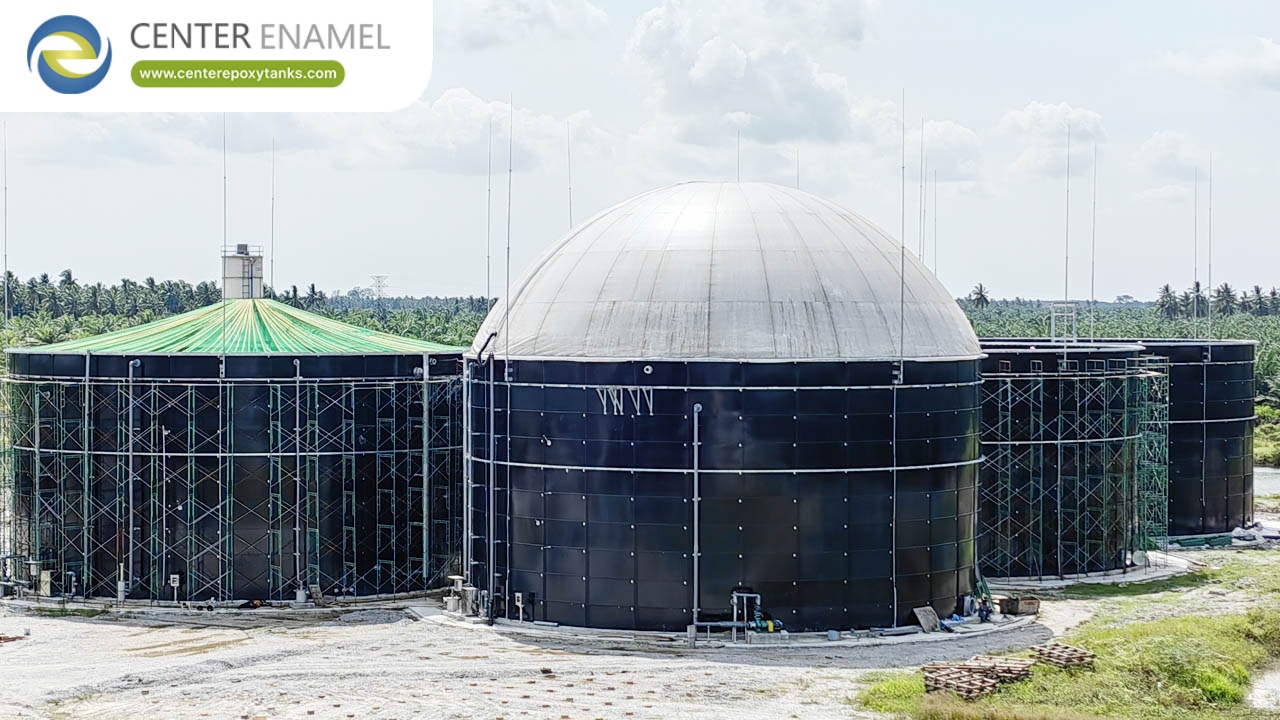
What is a Biogas Reactor?
A biogas reactor is the biological vessel in which anaerobic microorganisms convert organic substrate into biogas. Common designs include continuously stirred tank reactors (CSTR), plug-flow reactors, upflow anaerobic sludge blanket (UASB) reactors, and covered lagoons — most built on bolted steel tank platforms.
What is a Biogas Reactor?
A biogas reactor is the engineering term for the vessel in which anaerobic digestion actually happens. The reactor design is chosen to match feedstock solids and organic strength: high-solids slurries favor continuously stirred tank reactors (CSTR), thick waste streams suit plug-flow designs, and soluble industrial effluents are treated in high-rate systems such as UASB and internal circulation (IC) reactors.
Whatever the configuration, every reactor shares the same demands: gas-tight construction, corrosion resistance against warm H2S-laden atmospheres, and structural support for mixing or internal separation equipment. Epoxy coated bolted steel reactors meet all three, with factory-tested panels and engineered equipment interfaces, and can be configured across the full spectrum of reactor types.
Biogas Reactor Types Compared
Selecting the reactor type is the defining design decision of any biogas project, because it determines feedstock flexibility, gas yield, and tank geometry:
l CSTR: fully mixed, handles manure, sludge, and food waste up to roughly 12% solids.
l Plug-flow: elongated channel reactors for thicker, high-fiber feedstocks.
l UASB / IC: high-rate granular-biomass reactors for warm, soluble effluents with low solids.
l Covered lagoon: ambient-temperature conversion of dilute flushed waste, lowest cost but lowest yield.
The Engineering and Fusion-Bonding Process
Bolted steel biogas reactors receive their corrosion protection in an automated factory sequence:
1. Surface Preparation (Shot Blasting): Premium structural steel plates undergo automated grit or shot blasting to achieve a pristine anchor profile, removing all rust, mill scale, oils, and surface impurities.
2. Electrostatic Powder Application: Specialized thermoset epoxy powder is applied uniformly across both sides of the steel panels using automated electrostatic spray equipment.
3. Thermal Cross-Link Curing: The coated sheets pass through precision tunnel ovens (150°C to 250°C), where the epoxy powder melts, flows, and chemically cross-links into a dense, continuous protective polymer film.
4. Rigorous Quality Control & Holiday Testing: Every individual panel undergoes strict dry film thickness verification and high-voltage holiday spark testing (typically at 1,100V to 1,500V) to guarantee absolute zero pinholes or micro-discontinuities.
Technical Performance Matrix: Biogas Reactor Types
Parameter | CSTR Reactor | Plug-Flow Reactor | UASB Reactor | Covered Lagoon |
Feedstock Solids | 2% to 12% TS | 12% to 25% TS | Below 1% to 2% TS | Below 2% TS |
Operating Temperature | Mesophilic or thermophilic, heated | Heated, gradient along channel | 25°C to 35°C typical | Ambient, climate-driven |
Retention Time | 15 to 30 days | 15 to 25 days | Hours to 1 day | 30 to 60+ days |
Biogas Yield | High and stable | High for suitable feedstocks | High per unit COD removed | Low and seasonal |
Biogas Reactor Applications
l CSTR reactors on manure, sludge, and food waste biogas plants
l UASB and IC reactors treating brewery, dairy, and chemical effluents
l Plug-flow reactors for high-fiber cattle and crop feedstocks
l Covered lagoon conversions on dairy flush and piggery sites
l Secondary and polishing reactors completing treatment trains
l Sequential batch reactors for variable industrial flows
Key Advantages of Bolted Steel Biogas Reactors
1. Reactor Geometry Without Civil Constraints
Bolted steel panels configure into any diameter-to-height ratio a reactor design demands — squat CSTRs or tall UASB vessels — without the formwork economics that shape concrete choices.
2. Corrosion Protection Proven Panel by Panel
Factory-fused FBE coatings, holiday-tested at 1,100V to 1,500V, protect against the warm, moist, sulfurous reactor atmosphere that destroys site-coated vessels.
3. Reactor Platforms That Adapt
Bolted reactors extend with extra courses, replicate as parallel trains, or convert between duties — protecting plant value as feedstock and loading change.
Quality Standards and Proven References
Center Enamel's epoxy coated and glass-fused-to-steel tanks are engineered in strict accordance with AWWA D103-09, OSHA, ISO 28765, and EN 1090, and manufactured under ISO 9001 and ISO 45001 certified quality systems. As the first manufacturer of glass-fused-to-steel tanks in China — holding nearly 200 enameling patents — Center Enamel has delivered bolted tank projects to more than 100 countries, including a 16,760 m³ biogas project in Inner Mongolia and wastewater and biogas references for global environmental leaders such as Paques and Veolia.
Frequently Asked Questions (FAQ)
Q: Which biogas reactor suits high-solids feedstock?
A: CSTR reactors handle up to about 12% total solids with full mixing, and plug-flow designs work above that for thick, fibrous feedstocks such as cattle manure and crop silage.
Q: When is a UASB reactor the right choice?
A: UASB and IC reactors suit warm, soluble, low-solids industrial effluents — brewery, dairy, sugar, and chemical wastewaters — where granular biomass achieves very high loading rates with only hours of retention.
Q: Can one bolted steel platform serve different reactor types?
A: Yes — the same factory-coated panel system configures as CSTR, buffer, or high-rate reactor vessels, letting plants standardize tankage across the whole treatment train.
Q: What is the expected lifespan of an epoxy coated biogas reactor?
A: When manufactured in strict compliance with international design codes (such as AWWA D103) and properly maintained, an epoxy coated biogas reactor is engineered for a dependable operational lifespan exceeding 30 years.


