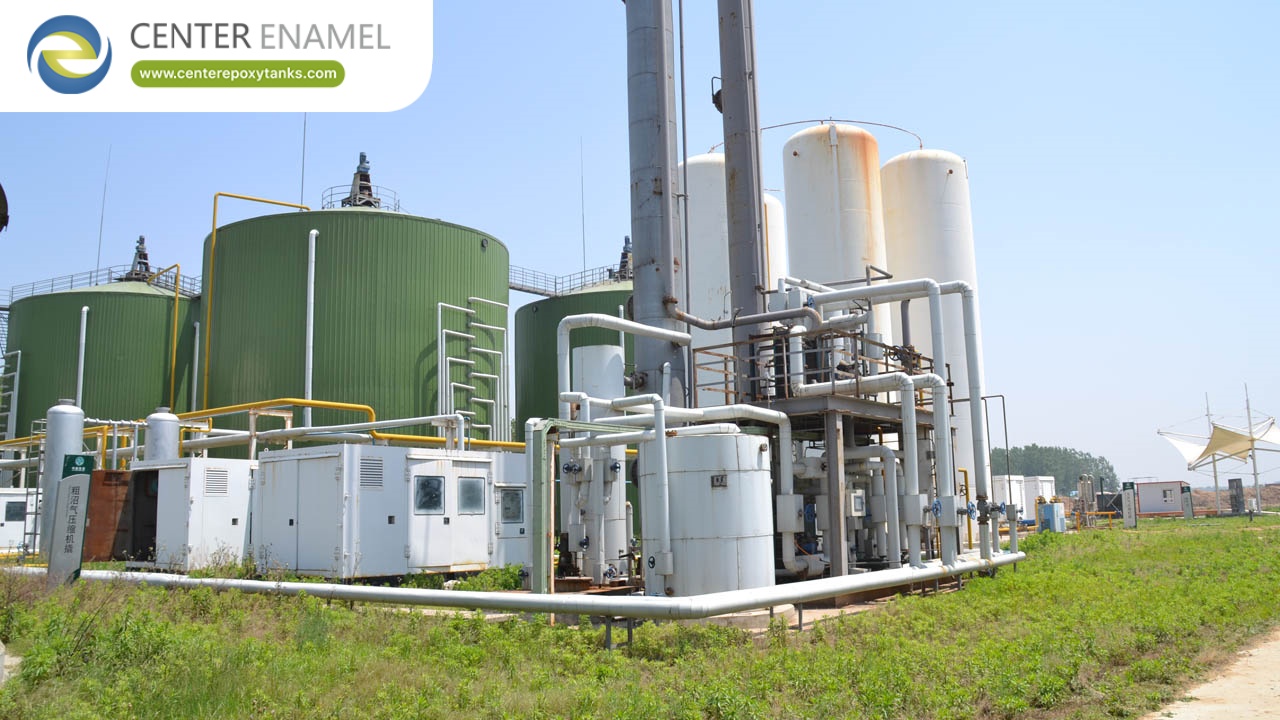
What is a Biogas Plant?
A biogas plant is an integrated facility that converts organic waste into renewable energy, combining feedstock reception, pre-treatment, anaerobic digesters, gas storage, and utilization systems. Bolted steel tanks with fused epoxy coatings form the core vessels from digester to digestate storage.
What is a Biogas Plant?
A biogas plant is a complete industrial system, not a single tank. Feedstock arrives at reception and pre-treatment, is digested in heated anaerobic vessels, and leaves as two products: biogas — conditioned, stored, and converted to power, heat, or biomethane — and digestate, stored and applied as fertilizer.
Every stage of that flow lives in tanks. Reception and buffer tanks, the digester itself, secondary digesters, gas holders, and digestate stores together typically account for the majority of a plant's civil scope. That is why modern biogas plants standardize on epoxy coated bolted steel tank packages: identical factory-coated panels serve all duties, install in weeks, and simplify expansion as feedstock grows.
Core Components of a Biogas Plant
A typical biogas plant integrates the following tank and equipment groups:
l Feedstock reception, pasteurization, and pre-treatment tanks
l Primary and secondary anaerobic digesters with mixing and heating
l Biogas conditioning, desulfurization, and gas storage (membrane holders)
l Digestate separation and liquid digestate storage tanks
l Utilization: CHP engines, boilers, or upgrading to biomethane
l Plant utilities: process water, flare stack, and digestate liquor returns
Why Bolted Steel Tanks Anchor Modern Biogas Plants
Across every vessel duty on a biogas plant, factory-coated bolted steel delivers the same verified protection sequence:
1. Surface Preparation (Shot Blasting): Premium structural steel plates undergo automated grit or shot blasting to achieve a pristine anchor profile, removing all rust, mill scale, oils, and surface impurities.
2. Electrostatic Powder Application: Specialized thermoset epoxy powder is applied uniformly across both sides of the steel panels using automated electrostatic spray equipment.
3. Thermal Cross-Link Curing: The coated sheets pass through precision tunnel ovens (150°C to 250°C), where the epoxy powder melts, flows, and chemically cross-links into a dense, continuous protective polymer film.
4. Rigorous Quality Control & Holiday Testing: Every individual panel undergoes strict dry film thickness verification and high-voltage holiday spark testing (typically at 1,100V to 1,500V) to guarantee absolute zero pinholes or micro-discontinuities.
Technical Performance Matrix: Biogas Plant Scale Options
Parameter | Farm-Scale Plant | Municipal / Utility Plant | Industrial Effluent Plant |
Typical Feedstock | Manure, slurry, energy crops | Sewage sludge, food waste | Brewery, dairy, paper effluent |
Digester Volume | 500 to 3,000 m³ | 3,000 to 10,000+ m³ | 1,000 to 8,000 m³ |
Energy Output | CHP 100 to 500 kW | CHP or biomethane injection | CHP covering plant load plus export |
Tank Construction | Bolted steel digester and stores | Bolted steel tank farm with gas holders | High-rate reactors plus bolted buffer tanks |
Biogas Plant Applications
l Agricultural plants digesting manure, slurry, and crops
l Municipal food waste and sewage sludge co-digestion facilities
l Industrial plants treating brewery, dairy, and pulp and paper effluent
l Landfill-linked organic waste treatment centers
l Biomethane production hubs feeding gas grids or vehicle fuel
l Community and cooperative energy plants in rural regions
Key Advantages of Bolted Steel Biogas Plant Tank Packages
1. One Tank Platform for Every Duty
Reception, digestion, gas storage, and digestate tanks all draw on the same factory-coated panel system — simplifying engineering, spares, and future expansion plant-wide.
2. Compressed Construction Schedules
Tank packages arrive as kits and erect in parallel, cutting plant construction schedules by months against civil-heavy alternatives and bringing gas revenue forward.
3. Bankable, Certified Quality
AWWA D103-09 engineering, ISO 9001 manufacture, and panel-level holiday testing give lenders and insurers the verification trail that biogas financing demands.
Quality Standards and Proven References
Center Enamel's epoxy coated and glass-fused-to-steel tanks are engineered in strict accordance with AWWA D103-09, OSHA, ISO 28765, and EN 1090, and manufactured under ISO 9001 and ISO 45001 certified quality systems. As the first manufacturer of glass-fused-to-steel tanks in China — holding nearly 200 enameling patents — Center Enamel has delivered bolted tank projects to more than 100 countries, including a 16,760 m³ biogas project in Inner Mongolia and wastewater and biogas references for global environmental leaders such as Paques and Veolia.
Frequently Asked Questions (FAQ)
Q: What waste can a biogas plant process?
A: Manure and slurry, sewage sludge, source-separated food waste, greases, crop residues and silage, and high-strength industrial effluents — most plants co-digest several feedstocks for stable output.
Q: What energy does a biogas plant produce?
A: Raw biogas fuels CHP engines for electricity and heat, boilers for process steam, or is upgraded to biomethane above 97% methane for grid injection and vehicle fuel.
Q: How many tanks does a biogas plant need?
A: A typical plant combines reception and buffer tanks, one or two digesters, a gas holder, and digestate storage — commonly five to eight coordinated vessels, all buildable on one bolted steel platform.
Q: What is the expected lifespan of an epoxy coated bolted steel tank package on a biogas plant?
A: When manufactured in strict compliance with international design codes (such as AWWA D103) and properly maintained, an epoxy coated bolted steel tank package on a biogas plant is engineered for a dependable operational lifespan exceeding 30 years.


