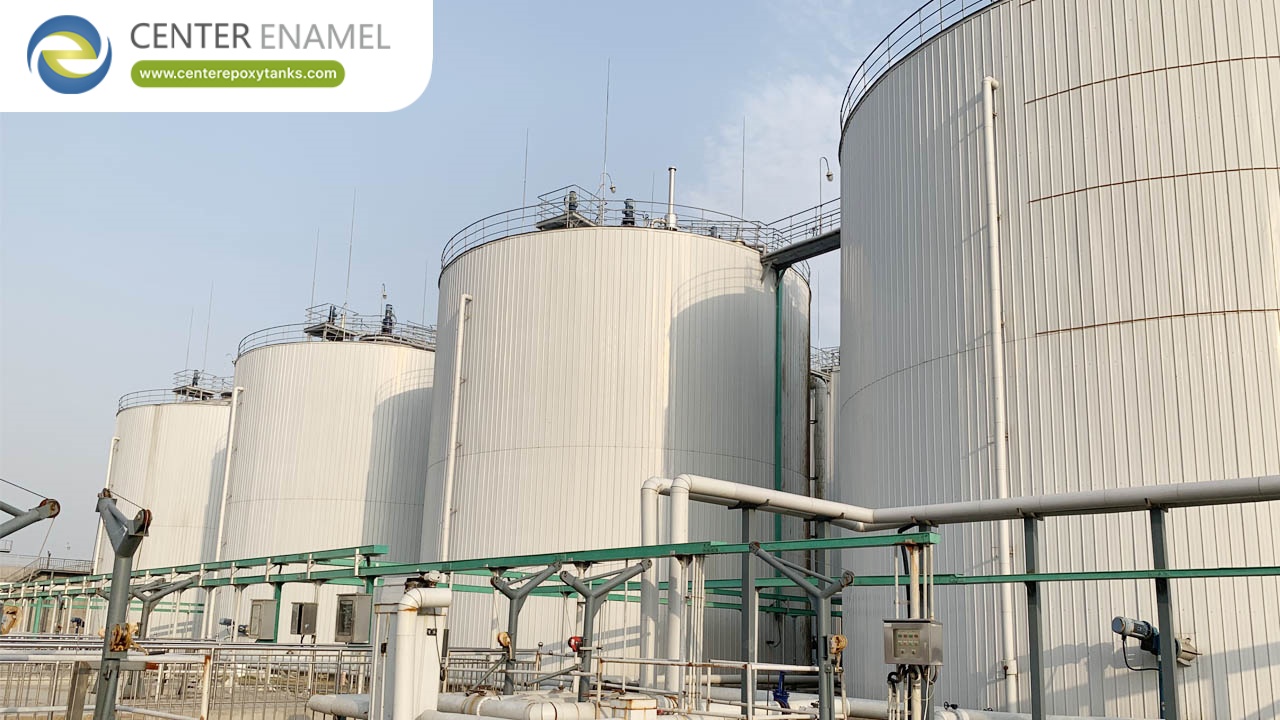
What is a Biogas Digester?
A biogas digester is an oxygen-free sealed tank in which microorganisms decompose organic feedstocks such as manure, sludge, and food waste, producing methane-rich biogas and digestate. Epoxy coated steel digesters provide the gas-tight, corrosion-resistant environment the process requires.
What is a Biogas Digester?
A biogas digester is the biological reactor of every biogas system: a heated, mixed, completely sealed tank in which anaerobic bacteria break down organic matter in four overlapping stages — hydrolysis, acidogenesis, acetogenesis, and methanogenesis — releasing a methane-rich gas typically 55% to 70% CH4.
Digesters usually run mesophilic at about 35°C to 40°C or thermophilic at about 50°C to 55°C, with feedstock retained for roughly 15 to 30 days depending on solids and biology. The vessel must stay warm, gas-tight, and structurally sound under constant mixing — which is why epoxy coated bolted steel digesters, with factory-fused corrosion barriers and engineered mixer and roof interfaces, have become the standard for modern plants.
What a Digester Must Withstand
The biology inside a digester is sensitive, but the environment it creates is chemically brutal. A digester that corrodes, leaks gas, or cracks under mixer loads does not just age early — it shuts down the revenue stream of the entire plant.
l Hydrogen sulfide and ammonia in the digester headspace attack bare steel and concrete alike.
l Continuous mixing at 15 to 30 day retention times imposes fatigue loads on walls and roofs.
l Thermal cycling between feed slugs and heated digestion temperature stresses site-applied coatings.
The Engineering and Fusion-Bonding Process
Corrosion protection for a biogas digester is applied and verified entirely at the factory, before any panel reaches the plant:
1. Surface Preparation (Shot Blasting): Premium structural steel plates undergo automated grit or shot blasting to achieve a pristine anchor profile, removing all rust, mill scale, oils, and surface impurities.
2. Electrostatic Powder Application: Specialized thermoset epoxy powder is applied uniformly across both sides of the steel panels using automated electrostatic spray equipment.
3. Thermal Cross-Link Curing: The coated sheets pass through precision tunnel ovens (150°C to 250°C), where the epoxy powder melts, flows, and chemically cross-links into a dense, continuous protective polymer film.
4. Rigorous Quality Control & Holiday Testing: Every individual panel undergoes strict dry film thickness verification and high-voltage holiday spark testing (typically at 1,100V to 1,500V) to guarantee absolute zero pinholes or micro-discontinuities.
Technical Performance Matrix: Biogas Digester Construction Technologies
Technical Parameter | Epoxy Coated Bolted Steel Digesters | Cast-in-Place Concrete Digesters | Field-Welded Steel Digesters |
Biological Service Suitability | Smooth inert FBE surface supports stable biology and clean-out | Porous surfaces harbor grit and are difficult to clean | Coating flakes and rust risk biological contamination |
Gas-Tightness & Pressure | Gasketed joints with engineered membrane or fixed roofs | Creep cracking makes gas-tightness unreliable long term | Weld seam integrity requires ongoing inspection |
Mixer & Roof Load Capability | Steel structure engineered for mixer bridges and gas equipment | Mixer torque cracks concrete over repeated cycles | Adequate structure but coating damage at penetrations |
Build Time & Flexibility | Erected in weeks; expandable and relocatable | Multi-month civil works; permanent footprint | Slow weather-dependent field fabrication |
Biogas Digester Applications
l Farm and cooperative agricultural digesters running manure and energy crops
l Municipal sewage sludge digesters at wastewater treatment works
l Food waste digestion plants serving cities and food processors
l Brewery, distillery, and agro-industrial effluent digestion
l Secondary and post-digesters completing the digestion train
l Retrofit digesters added to existing wastewater lagoon systems
Key Advantages of Epoxy Coated Biogas Digesters
1. A Stable Home for Methane-Producing Biology
The smooth, non-porous FBE interior gives anaerobic bacteria a clean, inert environment while allowing complete digester emptying and inspection between service campaigns.
2. Factory-Tested Corrosion Barrier in a Sulfurous Atmosphere
Every panel is holiday-tested at 1,100V to 1,500V before shipment, so the H2S and ammonia resistance of the digester is verified rather than assumed.
3. Modular Digesters That Track Plant Growth
Bolted construction allows digesters to be extended with additional tank courses, replicated as parallel trains, or relocated — flexibility that concrete cannot match.
Quality Standards and Proven References
Center Enamel's epoxy coated and glass-fused-to-steel tanks are engineered in strict accordance with AWWA D103-09, OSHA, ISO 28765, and EN 1090, and manufactured under ISO 9001 and ISO 45001 certified quality systems. As the first manufacturer of glass-fused-to-steel tanks in China — holding nearly 200 enameling patents — Center Enamel has delivered bolted tank projects to more than 100 countries, including a 16,760 m³ biogas project in Inner Mongolia and wastewater and biogas references for global environmental leaders such as Paques and Veolia.
Frequently Asked Questions (FAQ)
Q: How long does feedstock stay in a biogas digester?
A: Typical hydraulic retention times range from 15 to 30 days for wet digestion, with thermophilic plants at the shorter end and high-solids feedstocks at the longer end.
Q: At what temperature do biogas digesters operate?
A: Mesophilic digesters run at about 35°C to 40°C and are the most common; thermophilic digesters run at about 50°C to 55°C for faster digestion and higher gas output at the cost of higher heat demand.
Q: What biogas yield can a digester produce?
A: Yields depend on feedstock: manure typically yields 20 to 30 cubic meters of biogas per ton, while food waste and greases can yield several times more — sizing the digester and gas system to feedstock is a core design task.
Q: What is the expected lifespan of an epoxy coated biogas digester?
A: When manufactured in strict compliance with international design codes (such as AWWA D103) and properly maintained, an epoxy coated biogas digester is engineered for a dependable operational lifespan exceeding 30 years.


