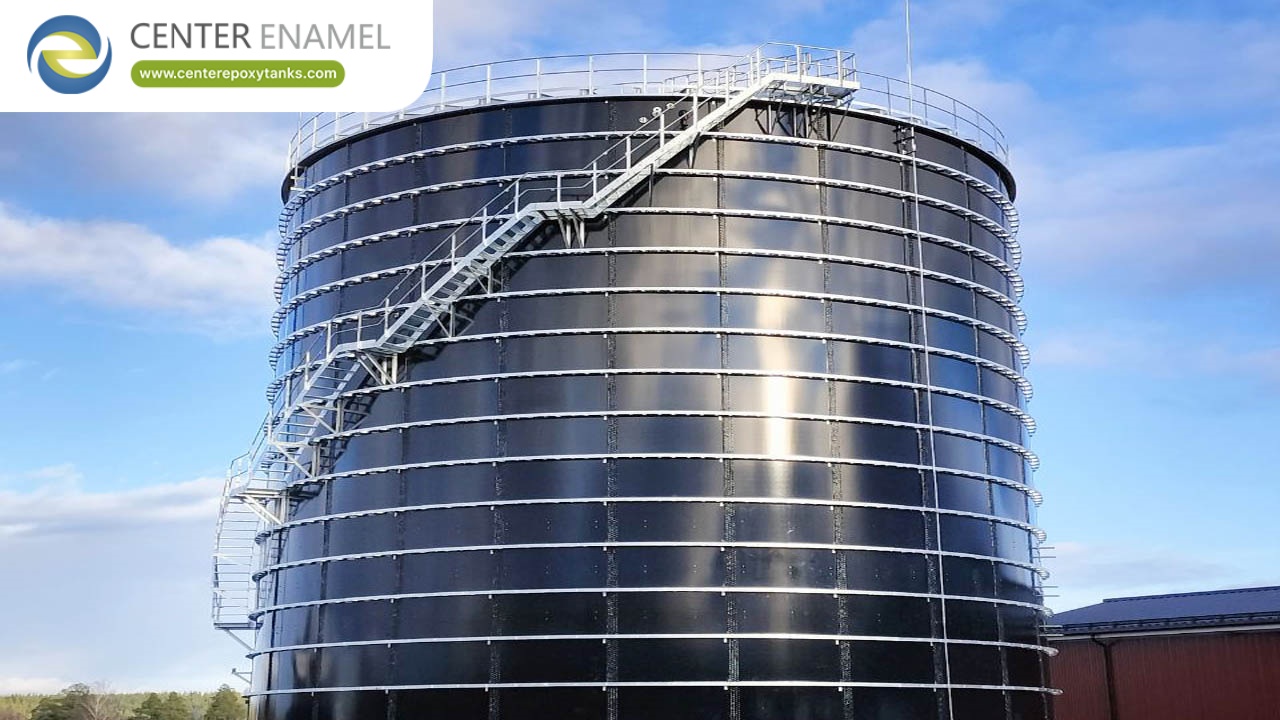
What is a Biogas Digester Tank?
A biogas digester tank is the pressure-capable, gas-tight bolted steel vessel that houses anaerobic digestion. It features a fused epoxy corrosion barrier, engineered roofs for mixers and gas collection, and modular panels that install in weeks, serving biogas plants for 30+ years.
What is a Biogas Digester Tank?
A biogas digester tank is the engineered vessel component of a biogas plant: a cylindrical bolted steel tank with a gas-tight roof, substrate inlets and outlets, heating interfaces, and structural mounting for mixing systems — everything the biological process needs except the biology itself.
Digester tanks differ from ordinary storage tanks in three ways: they must hold modest gas pressure without leaking, they must carry rotating equipment and heating loops, and they must resist an internal atmosphere of warm, moist, sulfurous gas. Epoxy coated bolted steel digester tanks meet all three by combining factory-fused FBE panel protection with structural design codes such as AWWA D103-09, delivering vessels that assemble on site in weeks and stay gas-tight for decades.
What Separates a Digester Tank From Ordinary Storage
Specifying a digester tank as if it were a water tank is the most common — and most expensive — procurement error in biogas projects. Digestion duty adds gas pressure, mixer fatigue, and chemical attack that plain storage vessels are never designed for.
l Gas-tightness at operating pressure must be proven, not assumed, or methane revenue leaks away.
l Mixer bridges, draft tubes, and heating manifolds impose structural loads beyond static liquid pressure.
l H2S condensate above the liquid line attacks coatings that survive fully submerged.
The Engineering and Fusion-Bonding Process
Digester tank panels are coated and verified in a controlled factory sequence:
1. Surface Preparation (Shot Blasting): Premium structural steel plates undergo automated grit or shot blasting to achieve a pristine anchor profile, removing all rust, mill scale, oils, and surface impurities.
2. Electrostatic Powder Application: Specialized thermoset epoxy powder is applied uniformly across both sides of the steel panels using automated electrostatic spray equipment.
3. Thermal Cross-Link Curing: The coated sheets pass through precision tunnel ovens (150°C to 250°C), where the epoxy powder melts, flows, and chemically cross-links into a dense, continuous protective polymer film.
4. Rigorous Quality Control & Holiday Testing: Every individual panel undergoes strict dry film thickness verification and high-voltage holiday spark testing (typically at 1,100V to 1,500V) to guarantee absolute zero pinholes or micro-discontinuities.
Technical Performance Matrix: Biogas Digester Tank Options
Technical Parameter | Epoxy Coated Bolted Steel Digester Tanks | Concrete Digester Vessels | Welded Steel Digester Vessels |
Gas-Tight Design | Gasketed panel joints with tested membrane or fixed gas roofs | Gas-tightness degrades with creep and cracking | Seams remain sound but penetrations corrode first |
Equipment Integration | Engineered interfaces for mixers, heating, and instrumentation | Penetrations difficult and crack-prone | Good integration but coating damage at welds common |
Corrosion Protection | Factory-fused FBE on all surfaces, holiday-tested per panel | Requires protective liners with limited life | Site coatings degrade in warm H2S service |
Delivery & Expansion | Weeks to erect; courses added for more volume | Seasons to build; fixed forever | Slow fabrication; expansion impractical |
Biogas Digester Tank Applications
l Complete-mix (CSTR) digester vessels for manure, food waste, and sludge
l Contact and hybrid anaerobic reactors on industrial effluent plants
l Secondary digesters and post-digestion storage with gas collection
l Co-digestion vessels blending multiple feedstocks
l Retrofit digester tanks for lagoon conversion projects
l Spare and expansion digesters added to operating plants without shutdown
Key Advantages of Epoxy Coated Digester Tanks
1. Engineered for the Complete Digester Duty
Gas pressure, mixer torque, thermal loads, and chemical exposure are all addressed in one structural design, eliminating the interface failures that plague tanks assembled from generic storage components.
2. Panel-Level Quality Verification
Because the FBE coating is applied and holiday-tested in the factory, every square meter of the digester arrives with proven corrosion protection — a claim no site-coated vessel can make.
3. Speed and Staged Growth
A digester tank erects in weeks and extends by adding panel courses, letting biogas plants phase capital investment against feedstock contracts.
Quality Standards and Proven References
Center Enamel's epoxy coated and glass-fused-to-steel tanks are engineered in strict accordance with AWWA D103-09, OSHA, ISO 28765, and EN 1090, and manufactured under ISO 9001 and ISO 45001 certified quality systems. As the first manufacturer of glass-fused-to-steel tanks in China — holding nearly 200 enameling patents — Center Enamel has delivered bolted tank projects to more than 100 countries, including a 16,760 m³ biogas project in Inner Mongolia and wastewater and biogas references for global environmental leaders such as Paques and Veolia.
Frequently Asked Questions (FAQ)
Q: What pressures do biogas digester tanks hold?
A: Low-pressure digesters typically operate at a few millibars to tens of millibars, with membranes commonly in the 2 to 10 mbar range; tanks and roofs are engineered to the specified operating band with pressure-relief protection.
Q: What roof options are available on digester tanks?
A: Fixed flat or conical steel roofs for mixer mounting, and single or double membrane roofs that combine gas-tight digestion with integrated biogas storage volume.
Q: How large can a bolted digester tank be built?
A: Modular designs commonly span from several hundred to more than 10,000 cubic meters per tank, with multiple tanks combined for larger plants.
Q: What is the expected lifespan of an epoxy coated digester tank?
A: When manufactured in strict compliance with international design codes (such as AWWA D103) and properly maintained, an epoxy coated digester tank is engineered for a dependable operational lifespan exceeding 30 years.


