What Are Typical Crude Oil Storage Tanks?
Typical crude oil storage tanks are large, vertical, cylindrical industrial vessels designed to hold crude oil before it is refined or transported. Because crude oil varies significantly in volatility, viscosity, and chemical composition, there is no "one-size-fits-all" tank design. However, the vast majority of industrial crude storage adheres to the API 650 standard for aboveground, welded or bolted storage tanks.
These tanks serve as critical links in the energy supply chain, operating as buffering stations that manage the flow between upstream extraction and downstream refining.
Common Tank Design Types
Engineers classify "typical" crude tanks primarily by their roof structure, which is determined by the volatility of the stored product and emission regulations.
1. Fixed-Roof Tanks (Cone or Dome)
Fixed-roof tanks are the simplest design, where the roof is permanently attached to the top of the shell.
Best For: Heavy, non-volatile crude oils or high-flash-point substances.
Key Advantage: Cost-effective and lower maintenance.
Design Consideration: Because they have a vapor space above the liquid, they require pressure/vacuum relief valves to accommodate thermal breathing.
2. Floating-Roof Tanks (External or Internal)
These tanks feature a roof that sits directly on the surface of the liquid and moves up and down as the volume changes.
Best For: High-volatility crude oils (light sweet crude) that easily evaporate.
Key Advantage: By eliminating the vapor space between the liquid and the roof, these tanks reduce evaporative losses (VOC emissions) by up to 99% and significantly lower the risk of fire.
Sub-Types:
External Floating Roof (EFR): The roof is exposed to the elements.
Internal Floating Roof (IFR): A fixed roof is placed over the tank for weather protection, while an internal deck floats on the oil.
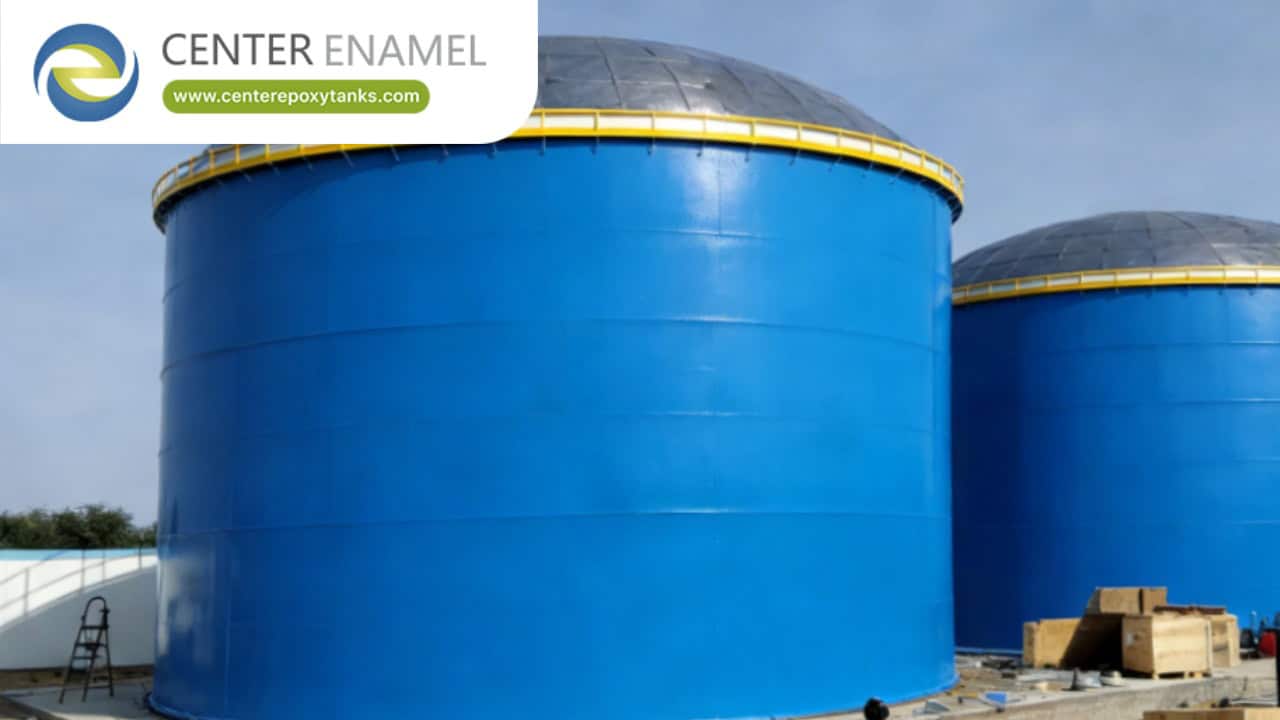
3. Bolted Steel Tanks (Modern Alternative)
While traditional field-welded tanks are standard for mega-terminals, bolted steel tanks (particularly Glass-Fused-to-Steel) have become a common "typical" solution for mid-sized storage or decentralized oilfield tank batteries.
Best For: Fast-track projects, remote oilfields, and produced water/crude separation.
Key Advantage: These can be shipped in compact containers and bolted together on-site, drastically reducing construction timelines and eliminating the need for extensive field-welding and hot work.
Essential Components of a Typical Tank
Regardless of the type, a typical industrial crude oil tank consists of several standardized components necessary for safe operation:
Shell Courses: The cylindrical wall, constructed of steel plates, with thickness graduated from bottom to top based on hydrostatic pressure.
Annular/Bottom Plate: The floor of the tank, often engineered to withstand settlement and corrosion.
Nozzles: Engineered connections for filling, emptying, and instrumentation.
Stairways and Walkways: OSHA-compliant access systems for monitoring, gauging, and maintenance.
Secondary Containment (Bunds): Dikes or berms surrounding the tank to contain potential spills.
Frequently Asked Questions (FAQ)
What is the most common standard for crude oil tanks?
The most common standard is API 650, which dictates the materials, design, fabrication, and testing requirements for welded and bolted aboveground storage tanks operating at atmospheric pressure.
Why do crude oil tanks have floating roofs?
Floating roofs rise and fall with the liquid level, effectively eliminating the vapor space above the oil. This minimizes the evaporation of volatile components, reduces emission costs, and improves safety by keeping the vapor concentration outside the flammable range.
What is the difference between welded and bolted crude oil tanks?
Welded tanks are typically custom-fabricated on-site and are standard for very large-diameter, high-volume refineries. Bolted tanks are manufactured in a factory, transported as panels, and assembled on-site; they are often preferred for their modularity, rapid construction, and consistent factory-applied coating quality.
How often are these tanks inspected?
Routine in-service inspections occur regularly (e.g., monthly). Comprehensive out-of-service internal inspections, governed by API 653, are typically required every 10 to 20 years to check for internal corrosion, floor integrity, and foundation settlement.


