What are the Advantages of a Floating Roof Tank?
Why do refineries and terminals prioritize floating roof tanks? In the storage of volatile hydrocarbons, the primary engineering challenge is managing the "vapor space." A floating roof tank solves this by utilizing a buoyant deck that rests directly on the liquid surface. By eliminating the gap between the product and the roof, these systems provide a 98% reduction in evaporative loss and serve as the industry’s most effective defense against internal tank fires.
1. Drastic Reduction in VOC Emissions
For any modern refinery, environmental compliance is a top-tier priority. Traditional fixed-roof tanks allow Volatile Organic Compounds (VOCs) to accumulate in the headspace and escape during filling cycles.
● The Advantage: Because the floating roof prevents the liquid from turning into gas, it effectively traps the product in its liquid state. This helps facilities meet EPA, EU, and Ministry of Ecology and Environment (MEE) standards for air quality.
2. Enhanced Fire and Explosion Safety
The leading cause of industrial tank fires is the ignition of an explosive vapor-air mixture in the headspace.
● The Advantage: By removing the headspace, you remove the fuel for a potential explosion. Even if a lightning strike or static discharge occurs, there is no flammable "cloud" to ignite. This intrinsic safety makes floating roof tanks the mandatory choice for low-flashpoint products like gasoline, naphtha, and crude oil.
3. Significant Product Conservation (ROI)
In large-scale operations, "breathing losses" (evaporation due to daily temperature changes) and "working losses" (displacement during filling) can result in the loss of thousands of barrels of product per year.
● The Advantage: A floating roof tank ensures that the volume of product you put into the tank is the volume you take out. For high-value distillates, the savings in product conservation often pay for the roof installation within a single operational year.
4. Mitigation of Biogenic and Atmospheric Corrosion
Fixed-roof tanks often suffer from "roof rot" caused by moisture and corrosive gases ($H_2S$) condensing on the underside of the steel roof.
● The Advantage: High-quality floating roofs, especially those manufactured by Center Enamel using Aluminum or Stainless Steel, are inherently resistant to corrosion. By suppressing the vapors, the tank shell is also less exposed to corrosive gases, extending the overall service life of the asset.
5. Reduced Operational Maintenance
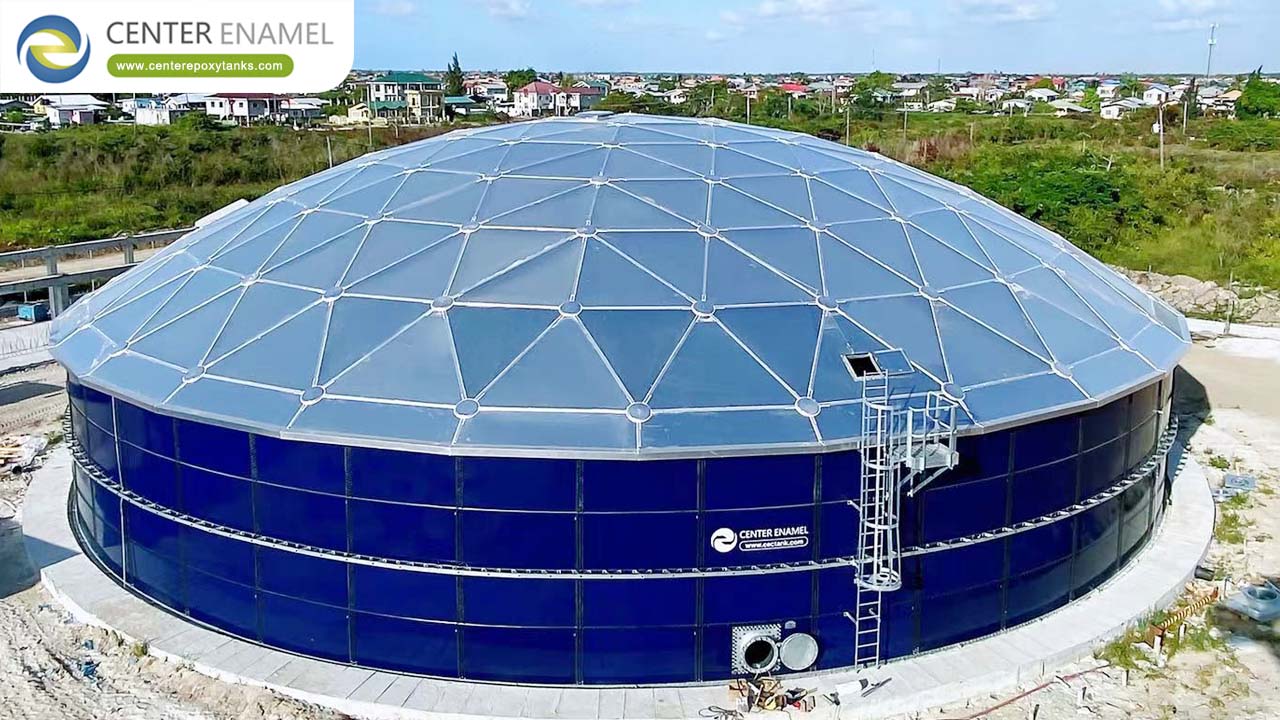
When an Internal Floating Roof (IFR) is paired with an Aluminum Geodesic Dome, the result is a maintenance-free containment system.
● The Advantage: The dome protects the floating deck from the elements (rain, snow, and wind), while the geodesic design provides a clear-span interior. This means there are no internal support columns that could interfere with the roof's movement or require periodic repainting and inspection.
Comparison: Floating Roof vs. Fixed Roof
Metric | Fixed Roof Tank | Floating Roof Tank |
Evaporative Loss | High (5% - 10% annually) | Ultra-Low (<2%) |
Explosion Risk | Present (Vapor Space) | Virtually Eliminated |
Environmental Compliance | Difficult | Excellent |
Product Purity | Subject to Condensation | Highly Protected |
Why Choose Center Enamel for Floating Roof Infrastructure?
With a 150,000 m² automated facility and a history of engineering excellence since 1989, Shijiazhuang Zhengzhong Technology Co., Ltd (Center Enamel) is a global leader in floating roof technology.
● API 650 Compliance: Our roofs are designed to meet global petroleum standards for buoyancy and seal integrity.
● CNC Precision: We ensure perfectly round seals and non-binding movement.
● Global Logistics: Our bolted designs are shipped to 100+ countries for rapid, weld-free assembly.


