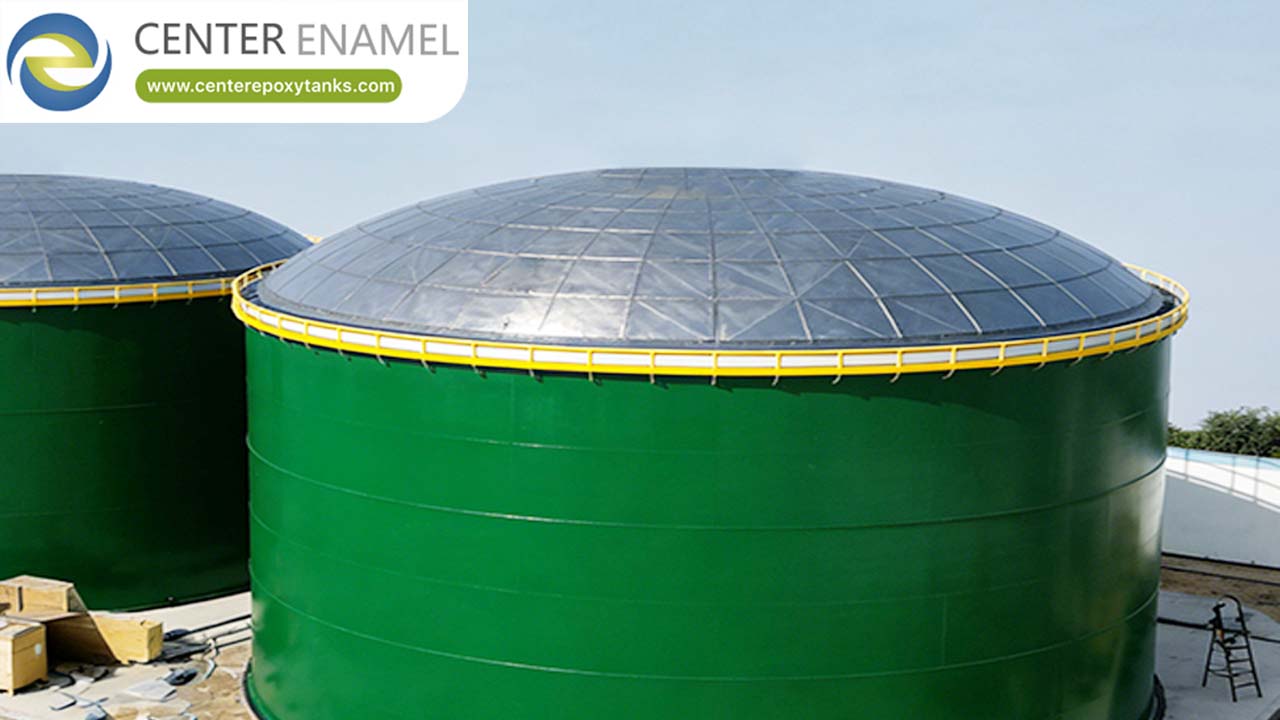
What are Steel Welded Tanks?
A steel welded tank is a robust industrial storage vessel constructed by permanently fusing steel plates together using advanced welding techniques (such as Submerged Arc Welding or TIG/MIG). Unlike modular or bolted tanks that rely on gaskets and mechanical seals, a welded tank forms a monolithic, continuous structure. This design creates a virtually leak-proof, crevice-free vessel, making it the preferred choice for industries requiring long-term structural integrity, such as petroleum, chemical processing, and critical water infrastructure.
Why Choose Steel Welded Tanks?
Engineers and procurement managers often specify welded steel tanks for projects where the cost of failure is high. Their design offers distinct mechanical advantages over other storage methods:
1. Monolithic Structural Integrity
Because there are no bolts or gaskets, there are no "weak points" prone to stress or fatigue. The tank acts as a single, unified structure capable of withstanding significant hydrostatic pressure, wind loads, and seismic activity.
2. Leak-Proof Performance
Bolted tanks rely on mechanical seals that can degrade over time. Welded tanks are fused at the molecular level, ensuring a permanent seal. This makes them the safest choice for storing hazardous chemicals, hydrocarbons, or expensive high-purity liquids where even a small leak is unacceptable.
3. Hygienic and Crevice-Free
In industries like food, beverage, and pharmaceuticals, hygiene is paramount. Welded tanks have smooth interiors without crevices where bacteria or contaminants can collect. This feature is critical for "Clean-in-Place" (CIP) sanitation processes.
4. Long-Term Durability
Welded tanks are often described as "permanent infrastructure." With proper coating (to ISO 12944 standards) or the use of corrosion-resistant alloys like stainless steel, these tanks can offer a service life spanning 50 to 100 years.
Technical Standards & Compliance
Industry leaders do not build storage tanks in isolation; they build to internationally recognized codes that guarantee safety. The most critical standard for this sector is API 650.
● API 650: The global benchmark for atmospheric-pressure welded steel tanks. It covers material selection, shell design, bottom plate configuration, and, most importantly, mandatory non-destructive testing (NDT) of welds.
● Non-Destructive Testing (NDT): To ensure compliance, every major weld seam on a high-quality tank is subjected to Ultrasonic (UT) or Radiographic (RT) testing to identify any subsurface porosity or cracks before the tank is commissioned.
Comparison: Welded vs. Bolted Steel Tanks
Feature | Welded Steel Tanks | Bolted Steel Tanks |
Construction | Monolithic (Welded) | Modular (Bolted panels) |
Leak Risk | Near Zero | Risk at panel/gasket joints |
Installation | High-skill (Site welding) | Rapid (Bolt-up) |
Customization | Infinite (Any shape/size) | Limited to panel dimensions |
Lifespan | Long-term (Permanent) | Variable (Component-based) |
Frequently Asked Questions (FAQ)
1. Why choose a welded tank over a bolted one?
Welded tanks are chosen for their superior structural integrity and lack of leak points. They are the ideal solution for permanent installations where the stored product is hazardous, high-value, or requires absolute environmental protection.
2. Are welded tanks more expensive?
While the initial fabrication and high-skill labor costs for welded tanks can be higher, they often offer a lower Total Cost of Ownership (TCO). Because they require virtually no ongoing maintenance regarding seals or gaskets, they save money over their multi-decade lifespan.
3. Can welded tanks be built on-site?
Yes. In fact, many large-scale tanks are "field-erected." Because these tanks can be too large for road transport, manufacturers ship steel plates to the site and perform the welding and assembly in the field under strict quality control protocols.
4. How is the quality of the welds verified?
Professional manufacturers use non-destructive testing (NDT). This includes X-rays (Radiography) or Ultrasonic Testing (sound waves) to "see" inside the weld seams, ensuring there are no hidden cracks or weaknesses that could cause a future failure.
5. Can these tanks be customized for specific chemicals?
Absolutely. Welded steel tanks are highly customizable. Engineers can select the exact grade of steel (e.g., carbon steel, 304/316L stainless steel) and apply internal linings or protective coatings based on the specific chemical compatibility profile of the stored medium.


